

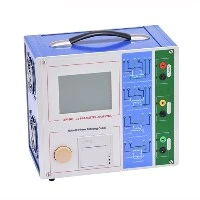
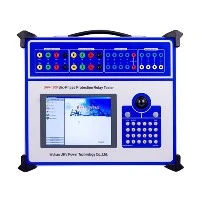
Yes, ambient temperature does indeed affect the test results of a sweep frequency response analysis test equipment, primarily through the following mechanisms:

1.Change in Winding Resistance:
The resistance of a conductor increases with rising temperature (following the formula R2=R1[1+α(T2−T1)]R2=R1[1+α(T2−T1)], where αα is the temperature coefficient of resistance).
Increased resistance leads to higher losses in the winding.
In Frequency Response Analysis (FRA), higher losses (mainly resistive losses) cause a reduction in the amplitude of the response curve, particularly in the mid-to-high frequency range. High-frequency signals are more susceptible to resistive losses.
Impact on Results: As temperature rises, the entire response curve, especially the mid-to-high frequency portions, shifts downward in amplitude (becomes more negative). This can mask genuine winding deformation features or create artifacts resembling minor deformations (e.g., overall amplitude reduction).
2.Dielectric Constant and Capacitive Effects:
Distributed capacitances exist between transformer winding turns, layers, discs, and to ground. These capacitances critically shape the frequency response curve.
The dielectric constant of insulating materials (e.g., oil, paper) changes with temperature. Generally, it increases as temperature rises.
An increased dielectric constant slightly raises the values of distributed capacitances.
Impact on Results: Changes in capacitance alter the resonant frequencies of the circuit. This can cause slight shifts in the positions (frequency points) of resonant peaks/dips on the frequency response curve. While typically less significant than the amplitude shift caused by resistance change, this effect needs consideration for high-precision comparisons or diagnostics.
3.Mechanical Stress on Windings (Minor and Indirect):
Extreme or rapid temperature changes can cause differential thermal expansion/contraction of internal materials (conductor, insulation, supports), generating minor mechanical stresses.
Impact on Results: Theoretically, this could cause extremely small, potentially reversible changes in winding geometry. These changes are usually too subtle for reliable detection by winding deformation testers (which target significant mechanical displacement/deformation), but in critical cases, might very weakly affect test result repeatability.
4.Temperature Drift of the Tester Itself (Requires Attention):
The performance parameters of electronic components within the tester (amplifiers, filters, ADC, etc.) may also drift slightly with ambient temperature changes.
Impact on Results: Modern high-quality instruments are designed to minimize this drift and mitigate its effects through calibration. However, under extreme temperatures or with lower-end instruments, the tester's own temperature drift could introduce additional measurement errors.