

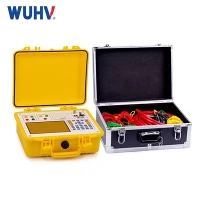


Protection Relay Tester
What Is Protection Relay Tester?
A protection relay tester is a device used to test and verify the performance of relay protection devices in power systems. One of its core functions is protection testing, which aims to ensure that relay protection devices operate correctly under various fault and operating conditions.
Higher computing power and processing speed
The protection relay tester uses an advanced digital processor and larger memory capacity, which can calculate and process large amounts of data more quickly and accurately, thus significantly improving test efficiency.
Higher reliability and stability
Adopting more stringent production and quality control standards, the protection relay tester has excellent anti-interference and stability, and can operate stably in harsh environments to ensure accurate test results. Sex.
Higher degree of intelligence
The protection relay tester can complete large-scale and complex verification work, has a high degree of automation, and can easily perform various protection setting tests, scans, fault recurrences, and real-time storage of test data. , display vector graphics, print reports online, etc., making the operation more convenient and intelligent.
Better operation convenience
The protection relay tester supports stand-alone operation without professional relay protection knowledge. It is simple to use and lowers the operating threshold.
Higher flexibility and scalability
The protection relay tester can run independently or be connected to a computer. It can be configured according to user needs, adding or reducing functions, and is suitable for various protection tests.
Powerful data recording and analysis capabilities
The protection relay tester has good data recording and analysis capabilities. It can save and analyze test data for a long time, providing strong support for fault diagnosis and performance optimization.
Remote monitoring and management capabilities
Through the remote monitoring and management function, the protection relay tester supports remote diagnosis and maintenance, improving work efficiency and stability.


Why Choose Us
Focused on Protection Relay Test equipment manufacturing for 21 years, a professional supplier in China, offering factory prices!
Our factory
We are a professional OEM manufacturer engaged in the R&D, sales and service of high voltage test equipment.We have the right to import and export by ourselves.
Customized services
We listen to our clients objectives and aspirations and therefore provide customize solutions.
Quality control
Our experienced staff is committed to strict quality control and thoughtful customer service and is always available to discuss your requirements and ensure full customer satisfaction.
Wide application of products
We have production lines of more than 108 different products in the field of high-voltage testing, and they are widely used in power energy, transportation, metallurgy, chemical industry, mining and water conservancy projects.
Research and design
During the research and design phase, the relay protection tester can be used to verify the performance of newly developed relay protection devices, ensuring that they meet design requirements.
Commissioning and installation
1. Initial testing: During the commissioning of new transmission lines and substations, protection relay testers are used to verify that all protection devices are correctly installed and configured. This includes testing the functionality of relays, circuit breakers, and other protective equipment.
2. Configuration verification: The testers help ensure that the protection settings are correctly configured according to the design specifications and regulatory standards.
Maintenance and periodic testing
1. Scheduled maintenance: Protection relay testers are used to conduct periodic tests on protection devices to verify their performance and identify any potential issues before they lead to failures.
2. Calibration: Protection relay testers are used to calibrate relays and other protective equipment, ensuring they operate within specified parameters.
Dynamic testing and real-time monitoring
1. Dynamic performance testing: Protection relay testers can perform dynamic performance testing to evaluate how protection devices respond to real-time changes in the transmission system. This includes testing under varying load conditions and transient events.
2. Real-time monitoring: Some advanced protection relay tester offer real-time monitoring capabilities, allowing operators to continuously monitor the performance of protection devices and detect any anomalies promptly.
Training and education
1. Hands-on training: Protection relay testers are used for training purposes, providing hands-on training to personnel. This helps them understand the operation and testing of protection devices.
2. Skill development: By using the testers in training sessions, personnel can develop the skills needed to effectively use the equipment in the field.
Fault simulation
The protection relay tester can simulate various faults in the power system, such as short circuits, broken wires, grounding, etc., to test the operational performance of the relay protection device under various fault conditions.
Parameter measurement
The tester can measure various parameters of the relay protection device, such as current, voltage, power, etc., to evaluate whether its performance meets the requirements.
Setting value verification
By conducting simulation tests on the relay protection device, the tester can verify its setting value to ensure it is within the specified range.
Time testing
The tester can accurately measure the action time and return time of the relay protection device to evaluate its performance.
Communication function
Modern protection relay testers usually have communication function, which can exchange data with the tested equipment to obtain more comprehensive information.

How to Maintain Protection Relay Tester
Daily Maintenance
●Cleaning: Regularly wipe the surface of the equipment with a clean soft cloth to avoid dust and dirt accumulation that may affect equipment performance. Meanwhile, be careful not to use cleaning agents containing corrosive substances to avoid damaging the equipment.
●Inspection: Regularly check if the equipment connection wires are loose or damaged, and replace them in a timely manner if necessary. At the same time, check if there are any foreign objects inside the equipment and clean them if necessary.
●Heat dissipation: Ensure sufficient ventilation space around the equipment to avoid high temperature environments affecting equipment performance. If conditions permit, auxiliary cooling equipment such as fans can be used.
Regular Maintenance
●Calibration: Regularly calibrate the equipment based on its usage frequency and environment to ensure the accuracy of test results.
●Software updates: Pay attention to the software update information released by the equipment manufacturer in a timely manner, upgrade the equipment to obtain better performance and more functions.
●Hardware inspection: Regularly inspect the hardware components of the equipment, such as sensors, circuit boards, etc. If there is any damage or aging, replace them in a timely manner.
Fault Handling
When the equipment malfunctions, the first step is to determine the cause of the malfunction. If it is a non hardware issue such as improper operation or environmental factors, it should be corrected and retested in a timely manner.
If the malfunction is a hardware issue, contact the equipment manufacturer or professional maintenance personnel for handling, and do not disassemble the equipment on your own.
Maintenance And Repair
To extend the service life of the equipment, it is recommended to conduct comprehensive maintenance and repair work once a year.
During the maintenance process, a comprehensive inspection of the equipment should be carried out, and any problems found should be promptly resolved. At the same time, necessary lubrication and cleaning work should be carried out on the equipment.
How To Use A Protection Relay Tester?
Protection relay tester can carry out overcurrent relay test, undervoltage relay test, overvoltage relay test, intermediate relay test, time relay test and other tests, that we use the protection relay tester to carry out these tests the specific method is how?
Overcurrent Relay Test
Using the "ac test" program, when the relay operating current is less than 35a, you can choose a phase current as a variable, select the appropriate current step, using automatic or manual test, of which, the manual mode can be used to measure the action value and return value, the automatic mode can only measure the action value.
When the relay action current is greater than 35a, two-phase or three-phase parallel current output can be used, three-phase parallel current output value is 105a, then the phase of the parallel current must be in the same phase, otherwise parallel mode can not be used to select multiple currents as variables, using automatic or manual test can be used to measure the action value and return value of the relay.
Undervoltage Relay Test
Undervoltage relay is also called low voltage relay, usually only normally closed contacts, normally closed contacts open relay action, you can choose a relatively high voltage value, and then reduce the voltage by a certain step until the relay action, the choice of "ac program", to be used in a manual way for the test, the first output of a voltage value, due to normally closed contacts, the screen will show the action of the relay. Contact, the screen will display the action time, the voltage value has not been cut, using manual rotation of the mouse, reduce the voltage until the action time value on the screen changes, this time that the relay is normally closed contact has been opened, the equivalent of the relay to return to the screen at this time to display the voltage value is the low-voltage relay action voltage value.
Over-voltage Relay Test
Adopt "ac test" program. When the rated voltage of the relay is less than 120v, the single-phase voltage value can be used as a variable for testing.
Select the voltage step and the initial value of the voltage, the use of automatic or manual mode to carry out voltage changes until the relay action, can measure the action voltage and action time value, each phase voltage value of 120v, when the rated voltage of the relay under test is greater than 120v, two-phase voltage can be used to carry out the test, for example, when the VA = 75, vb = 75v, VA and vb phase difference of 180, line voltage VAB = 150v, so when the phase difference between the two phase voltages is 180? When the line voltage is equal to the sum of the two phase voltages, select the two-phase voltage can be varied, the use of automatic or manual test to test.
Intermediate Relay Test
Use "dc test" program, the program single-phase voltage output range 0-10v current range 0-30a, when the intermediate relay rated voltage is less than 110v, with a single-phase voltage can be tested, you can choose a phase voltage, such as VA as a variable, set the voltage step, select the appropriate initial value, the start of the manual test. By left rotation, right rotation of the mouse to change the value of the voltage until the relay action, the automatic test is the voltage by step automatically increase or decrease until the relay action, the fruit of the rated voltage of the relay is greater than 110v, you can select the two-phase voltage to test, a phase voltage is positive, the other phase voltage is negative, the two-phase line voltage value of up to 220v, the use of automatic or manual test can be tested with the action voltage test, some of the some intermediate relays are current-activated and voltage-retained, one-phase current can be selected as the variable, appropriate current step and initial value of current can be selected, and automatic or manual test can be used to change the current value until the relay is operated.
Time Relay Testing
The rated voltage of the time relay is generally 220VDC, and in general, the relay can operate when the DC voltage is added to 140V.
(1) First measure the action voltage of the relay
The action time of the relay is set to 0.5s, the voltage step is set to -1.00, the time interval is set to 1s (should be greater than the action time of the relay), the VA is set to 110V, non-variable, the VB is set to 0V, the variable sign opens to "Y", the line voltage VAB connected to the voltage coil of the relay, the test mode is automatic. The test mode is automatic, the relay action access point is connected to the open channel, in which VA is positive and VB is negative, click "Start" that is, VA outputs 110V DC, and VB is reduced to negative voltage from the beginning until the relay action, for example, when VB=-40V when the relay action, it means that the relay action voltage is 150V, and it can be used to manually slowly change the voltage to make the relay action, and then turn on "Y", the variable flag is turned on. Can also be used manually to slowly change the voltage to make the relay action, and then change the voltage in the opposite direction to make the relay return, this time the voltage value is the return voltage of the relay.
(2) Measure the action time of the relay
Set VA as 110V, VB as -110V, VAB access to the relay voltage coil, the relay normally open contact into the tester's switching input channel, usually can be connected to 1 channel, the time interval should be set to be greater than the action time of the relay, the test mode is manual test, click "Start", you can measure the relay's The test mode is manual, click "Start", the action time of the relay can be measured.
How the Three-phase Protection Relay Tester Works
The three-phase protection relay tester is a device used for testing and debugging relay protection equipment, mainly used to detect whether the relay protection equipment is working properly. During testing, the three-phase relay protection tester will simulate faults in the power system to detect the operation and protection range of the protection equipment. At the same time, the parameters of relay protection equipment can also be adjusted to better adapt to the actual usage environment.
Specifically, the working principle is as follows:
Signal generator: There is a signal generator in the tester that is used to generate various electrical signals. These signals can simulate voltage, current, phase, etc. Separately.
Input part: The input part includes the input to the electrical appliance and the input to the signal generator. The input to the electrical appliance is to connect the electrical appliance to be tested to the tester, and the input to the signal generator is to input the signal input interface to the equipment to be tested through the tester.
Control part: The control part is the core part of the three-phase protection relay tester, with high-precision and high-speed mathematical and logical operation capabilities.
Output section: The output section is used to record and display test results, which can output digital images and data for engineers to evaluate and analyze.
Our Factory
Focused on Protection Relay Test equipment manufacturing for 21 years, a professional supplier in China, offering factory prices!
Wuhan UHV Power Technology Co.,Ltd. established in 2021, located in Wuhan East Lake New Technology Development Zone and have convenient transportation access. We are professional OEM Manufacturer which is engaged in the research, development, sale and service of High Voltage Testing Equipment including: Resonant Test System, High Voltage Tester,Transformer Tester,Circuit Beaker Tester, Relay Protection Tester, Cable Tester, Oil Tester, DC Battery Tester, Generator Tester, Insulation Resistance Tester, Power Metering Products etc.They are widely applied in power engineering project, transportation,petrochemical industry,mining and water conservancy project. In addition, We have obtained CE, ISO9001 & other certificates. Our products are not only selling well in mainland China, but also exported to the countries around the world including Malaysia, Indonesia, Vietnam, Philippines, Saudi Arabia, The United Arab Emirates,America, Australia, Argentina,Chile, Brazil etc. We are highly trusted and praised by clients in competitive products and strong technique support.
If you have any requirements, pls feel free to contact us, and we will always right be here ready to serve for you. Our slogan: Smart Electric Testing Equipment Manufacturer, making your testing work more easy.


Our Certificates

FAQ
As one of the leading protection relay tester manufacturers and suppliers in China, we warmly welcome you to buy high-grade protection relay tester made in China here from our factory. For price consultation, contact us.