


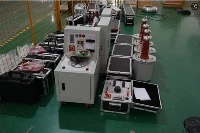
In the field of high-voltage power equipment testing, the AC Resonant Test System is the core equipment for conducting AC withstand voltage tests, widely used in cross-linked cables GIS, Insulation performance testing of power equipment such as transformers and generators. However, facing the wide variety of series resonance test devices on the market, how to scientifically select based on output voltage has become a technical challenge of concern for many power engineering units. As a leading enterprise in the high-voltage electrical measurement industry for nearly 22 years, Wuhan UHV Power Technology Co., Ltd. (hereinafter referred to as "Wuhan UHV") has systematically sorted out the selection methodology based on output voltage, combining years of practical experience.

1, Clarify the requirements for test voltage - the first step in selection
The primary task of selection is to determine the maximum test voltage of the tested product. According to national standards such as GB50150 or DL/T596, different voltage levels and types of power equipment have their own AC withstand voltage test voltage values. For example, the AC withstand voltage value of 110kV cross-linked cables is usually 2U ₀ (about 128kV); The test voltage for 35kV cables is generally 1.5 times their rated voltage, which is 52.5kV; while the test voltage for GIS equipment is usually 1.2 to 1.4 times the rated voltage.
The Wuhan ultra-high voltage technology team pointed out that when selecting, it is necessary to first obtain the core parameters such as voltage level, length, and cross-sectional area of the tested product. Different specifications of equipment have significant differences in capacitance. For example, the capacitance per kilometer of a 10kV cross-linked cable is approximately 0.1~0.4 μ F, and the total capacitance increases linearly with length.
2, Matching voltage level and system capacity - core selection principles
Output voltage is one of the most fundamental and important parameters in testing systems. The rated output voltage of the system must be able to cover the required test voltage of the tested object and leave sufficient margin.
The selection guide for Wuhan UHV emphasizes that one of the core principles of selection is to choose the specification range of the testing system based on the highest voltage level of the equipment under the jurisdiction of the unit. The specifications of resonance devices required for 10kV distribution networks and 110kV substations are completely different. The series resonant device of Wuhan ultra-high voltage covers the rated voltage range of 25kV to 800kV, and the rated capacity can be customized from 75kVA to 10000kVA and above according to demand, which can meet various testing needs from distribution cables to ultra-high voltage cables.
For ultra-high voltage cables, the selection requirements are more stringent. The rated voltage of UHV cables usually reaches 800kV or even higher. The output voltage of the series resonant device needs to cover 1.1 to 1.2 times the test voltage, and sufficient margin should be reserved to cope with factors such as cable length and capacitance deviation. For example, the withstand voltage test of a 1000kV cable requires the selection of equipment with an output voltage of ≥ 1100kV.
3, Consider sample type and frequency range - refined selection
Different types of tested products have completely different requirements for the output voltage, frequency, and capacity of the resonant system. Cables belong to equipment with high capacitance and medium test voltage; Transformers are devices with low capacitance and high test voltage; GIS combines the characteristics of high capacitance and extremely high test voltage.
The test frequency directly affects the output voltage capability of the resonant system. The output capability of a variable frequency series resonant system is closely related to its operating frequency. The higher the frequency, the smaller the capacitance under the same inductance, and the required number of reactor turns decreases. However, the quality factor Q value decreases, which may lead to difficulties in boosting. Therefore, for ultra long cables (such as several kilometers), their inherent resonant frequency is often low (possibly below 50Hz). If a high-frequency solution is forcibly adopted, it is necessary to increase capacitor compensation or redistribute reactors, otherwise the expected output voltage cannot be achieved. The frequency conversion resonance device of Wuhan UHV supports continuous adjustment of 30-300Hz and is equipped with an automatic frequency tracking algorithm. It can automatically calculate the optimal resonance point based on the capacitance of the test sample, ensuring efficient boosting to the set value at any frequency.
4, Reserve safety margin and future expansion - forward-looking selection
When selecting, a margin of 10% to 15% should be reserved for the rated voltage of the device. For example, when the test voltage for a 110kV cross-linked cable is 128kV, a system with a rated voltage of ≥ 140kV should be selected. The Wuhan UHV technology team suggests that, when conditions permit, the number of reactors should be configured according to the maximum expected demand during selection to avoid duplicate investment.
In addition, for equipment used in high-altitude areas (>1000m), voltage calibration should be carried out according to standards, or a model with a higher rated voltage should be selected. The device should also come standard with complete protection functions such as overvoltage, overcurrent, and flashover. The measurement accuracy of the voltage divider and the system waveform distortion rate should be controlled within 1%.
Wuhan UHV stated that it will continue to be committed to providing professional and reliable high-voltage electrical measurement products and solutions for the global power industry in the future, to help ensure the safe and stable operation of the power grid.