

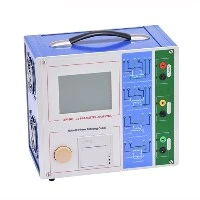
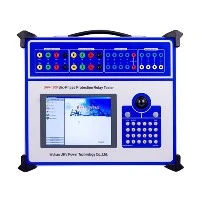
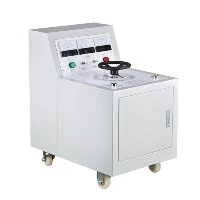
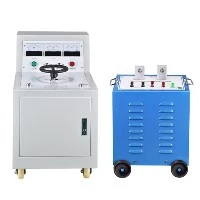
Power frequency series resonant withstand voltage device? Wuhan UHV specializes in the production of series resonance, with a wide range of product selection and professional electrical testing. To find series resonance, choose Wuhan UHV.

The safe operation of transformers requires not only that the performance of the transformer meets national standards and user technical requirements, but also that the insulation electrical strength of the transformer meets the standard requirements. The electrical strength of a transformer is a necessary condition for assessing its safe and reliable operation under normal working voltage and abnormal conditions, and the power frequency withstand voltage test is one of the tests. The short-time power frequency withstand voltage test is to apply the corresponding rated withstand voltage (effective value) to the insulation once. During the power frequency withstand voltage test, the tested winding and its leads of the transformer, as well as the components connected to it (such as switches), are all subjected to the same test voltage, while the non tested winding is short circuited to ground. For fully insulated transformers (i.e. with the same insulation level at the beginning and end of the winding), the power frequency insulation level and power frequency withstand voltage value at the beginning and end of the winding are consistent. For graded insulated transformers (i.e. with different insulation levels at the beginning and end of the winding), the test value of power frequency withstand voltage is consistent with the power frequency insulation level at the end of the winding.
The purpose of the power frequency withstand voltage test is to assess the main insulation strength between the winding and the ground and between the windings. This goal can be fully achieved for fully insulated transformers, but for graded insulated transformers, only the insulation strength of the winding to the iron yoke end and the insulation strength of the winding part leads to ground can be assessed. As for the insulation strength of the winding to ground and between windings, it cannot achieve the assessment goal.
1. Experimental equipment
The power frequency withstand voltage test mainly consists of test power supply, test transformer, measurement and protection equipment. The power supply should be adjustable in the power frequency withstand voltage test, which can be achieved by self coupling voltage regulators, shift coil voltage regulators, synchronous generator sets, etc. The capacity of an adjustable power supply should generally match the capacity of the test transformer, requiring its output current to be equal to the rated current on the low voltage side of the test transformer, and its output voltage to be equal to or greater than the rated voltage on the low voltage side of the test transformer.
Synchronous generator set is an ideal adjustable power source. Its advantages are stable frequency and good waveform. Its disadvantages are expensive, large footprint, and high noise during operation. During the power frequency withstand voltage test, due to the capacitive nature of the load, if the compensation is not good when using it as a power supply, self excitation often occurs.
An autotransformer is a variable power supply that uses a sliding contact to move along the winding. Its voltage regulation is not uniform and is graded, but each stage is finely divided. Due to its low price, easy portability, low leakage resistance, good waveform, and wide usage. But due to its sliding contacts, its capacity is limited, making it suitable for voltage regulation in small capacity test transformers.
The voltage regulation principle of a coil regulator is to connect two windings with equal turns but opposite winding directions in series, and use a short-circuit winding to cover the two windings in series. The short-circuit winding can move up and down, thus regulating the voltage. Due to the absence of sliding contacts in the shifting coil regulator, its capacity can be made very large and can be used for testing larger capacity transformers. However, due to the possible saturation of the magnetic circuit in the iron core of the shift coil regulator, the voltage output waveform may be poor. Therefore, measures should be taken according to the actual situation when selecting.
The test transformer is a key equipment for generating test voltage. Due to the fact that the tested transformer behaves as a pure capacitor during the power frequency withstand voltage test, the size of the test sample capacitance is closely related to the selection of the capacity of the test transformer. During the experiment, it is generally required that the rated voltage of the high-voltage side of the test transformer is slightly higher than the test voltage of the test sample, and its rated current is not lower than the maximum capacitance current of the test sample. Measurement and protection devices are essential equipment for conducting power frequency withstand voltage tests. Common measuring devices include ball gap, electrostatic voltmeter, measuring winding of test transformer, high voltage transformer, and power frequency capacitive voltage divider. The commonly used measurement method currently is to use a power frequency capacitive voltage divider connected to a peak voltmeter. To prevent overcurrent and overvoltage caused by the breakdown of the test sample from causing undue damage to the testing equipment and test sample, certain methods should generally be taken to protect them during the power frequency withstand voltage test. Common protection methods include inserting a resistor with a certain resistance value in series between the test transformer and the test sample, connecting the protective ball gap in parallel with the test sample, and installing overvoltage and overcurrent protection devices on the low voltage side of the test transformer.
2. Issues to be noted in voltage withstand test
Firstly, if a generator set is used as the power source for voltage withstand testing, special attention should be paid to the self excitation phenomenon of the generator. Before the test, the capacitance current of the system should be calculated based on the capacitance of the tested transformer, and an appropriate compensation reactance value should be selected. Secondly, select the appropriate measuring instrument that meets the accuracy requirements based on the withstand voltage value of the test sample. When selecting a voltage divider, attention should be paid to the placement requirements of the voltage divider, especially the selection of low-voltage side instruments. The peak meter used for calibration must not be replaced with other models of instruments. Otherwise, it will affect the voltage divider ratio and cause significant measurement errors.
The protective resistor is used to limit the short-circuit current when the tested transformer breaks down. If the protective resistor is not connected in series, it is equivalent to the test transformer directly short circuiting at a higher output voltage when the tested transformer breaks down, which will generate a large short-circuit current and cause damage to the test transformer. Dangerous oscillations will occur in the high-voltage winding, resulting in overvoltage on both the test sample and the test transformer. Therefore, it is very necessary to limit the short-circuit current to the allowable value, so a protective resistor must be connected, and its resistance value is generally taken as the short-circuit current limit within the allowable level.