

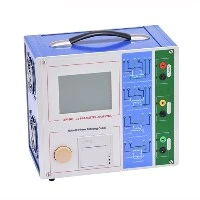
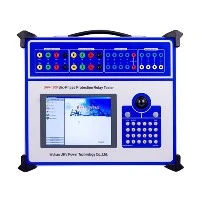
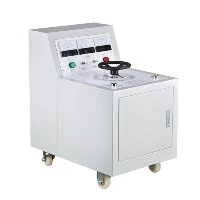
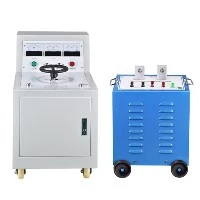
The purpose of the impulse test for new or overhauled transformers is as follows:
1. Check whether the insulation strength of the transformer can withstand the impact of full voltage or operating overvoltage
When the no-load transformer is opened, the small excitation current can be cut off, and it can be forcibly extinguished before the excitation current reaches zero. Due to the locking phenomenon of the circuit breaker, the operating overvoltage generated by the induction transformer not only affects the switching performance and transformer structure, but also the grounding method of the transformer neutral point affects the overvoltage no-load transformer. Generally, transformers without grounding or with arc suppression coils grounded can have an overvoltage amplitude of 4-4.5 times the phase voltage, while transformers with directly grounded neutral points generally have an operating overvoltage amplitude of no more than 3 times the phase voltage.
2. Evaluate the mechanical strength of transformers under high excitation inrush currents and assess whether relay protection will fail to operate under high excitation inrush currents.
When the no-load transformer is energized, it will generate excitation inrush current, which can reach a value of 6-8 times the rated current. The attenuation of excitation inrush current is fast, usually decreasing to 0.25-0.5 times the rated current value after 0.5-1 seconds, but the overall attenuation time is long, and large capacity transformers can reach several tens of seconds. Due to the large amount of electromotive force generated by excitation inrush current, it is necessary to evaluate the mechanical strength of transformers and evaluate whether relay protection will fail in the initial stage of excitation inrush current attenuation, which affects testing.
Number of impact tests: New transformer inputs typically require five impacts, while transformer inputs after major repairs typically require three impacts. (Electrical equipment switching test standard GB 50150-91, clause 6.0.14. The pulse closing test of transformers should be conducted 5 times at rated voltage, with an interval of 5 minutes each time. If there are no abnormal phenomena, the pulse closing test should be conducted 5 times at rated voltage. When conducting power system tests on the high voltage side of transformers, the neutral point of the transformer must be grounded. Transformers without operating disconnection points in the middle of the generator transformer group must not undergo impulse closing tests.)
Supplement: Power transformers and reactors 25) After replacing the windings, close at full voltage and no load 1) Replace all windings, close at no load 5 times, with an interval of 5 minutes each time 2) Partially replace the windings, close at no load 3 times, with an interval of 5 minutes each time. (Preventive Testing Regulations for Electric Power Equipment DL/T 596-1996)
Note: Due to the possibility of significant excitation inrush current during closing, multiple pulse closing tests need to be conducted to check whether the excitation inrush current can cause relay protection misoperation, and to check for abnormal noise in the transformer after each pulse closing test. Chaotic ETC. According to general regulations, when a new transformer is put into operation, it should be operated with 5 impacts. After maintenance, it should be operated with 3 impacts.
Purpose Of Pulse Closing Test For Power Transformers
Apr 29, 2024 Leave a message
Send Inquiry