

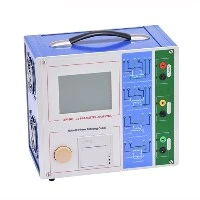
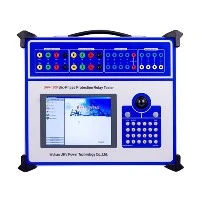
Have you ever thought about how to check the "health status" of grounding systems that protect us from electric shock hazards? Today, let's talk about the key "health tester" - electronic grounding resistance meter. It is not a mysterious thing, but a powerful assistant to ensure the safe operation of the power system.

Understanding the 'Grounding Resistance Meter': What exactly is it?
Simply put, an electronic grounding resistance meter is a professional instrument used to measure the resistance value of grounding devices. Grounding resistance, as the name suggests, is the resistance of current flowing into the earth through a grounding body. The smaller the value, the better the grounding effect, which can effectively guide the fault current into the ground and protect personal and equipment safety. Imagine if the grounding resistance is very high, like setting a "toll station" for the current, it cannot smoothly "go home" and may instead pose a threat to the surrounding environment.
What are the "behind the scenes" factors that affect grounding resistance?
To make the grounding resistor "healthy", we need to pay attention to these "hidden hands":
The conductivity of soil: The composition, humidity, and temperature of soil vary in different regions, which directly affects the "carrying capacity" of electric current. Dry and barren soil naturally has high electrical resistance.
Material and size of grounding body: What material is used to make the grounding body? How big is it? All of these will affect its own resistance and contact area with the soil.
The burial depth and spacing of grounding bodies: The deeper they are buried, the more they come into contact with the soil, and the lower the resistance may be. If the spacing between grounding bodies is not appropriate, they may also affect each other.
Reliability of Connection: The firmness and oxidation of the connection between the grounding wire and the grounding body often determine the overall effect.
Medical examination tools: professional instruments to assist
Accurate measurement naturally requires professional tools. In addition to our protagonist's electronic ground resistance meter today, there are also some auxiliary measuring lines, electrodes, etc. In practical operation, the professional equipment provided by Wuhan UHV Power Technology Co., Ltd. can help us more accurately evaluate the true condition of the grounding system.
How does a grounding resistance meter "work"?
Measuring grounding resistance usually involves some professional methods, such as the three pole method or the four pole method. Simply put, it is to inject current into the ground and measure the voltage drop to calculate the grounding resistance. These methods each have their own focus and are suitable for different on-site conditions. The technical personnel of Wuhan UHV Power Technology Co., Ltd. will choose the most suitable measurement plan based on specific situations in actual electrical safety assessments.
How to make the grounding system "healthier"?
Regular testing: Just like the human body requires regular physical examinations, the grounding system also needs to be measured regularly.
Optimize soil: If conditions permit, soil improvement (such as adding conductive powder) can be used to reduce resistance.
Reasonable design: Starting from the source, consider the material, size, and burial method of the grounding body in the design stage to achieve the best effect.
Tighten connection: Regularly check the connection points of the grounding wire to ensure that there is no looseness or corrosion.
Wuhan UHV Power Technology Co., Ltd. has accumulated rich experience in the field of grounding resistance testing and can provide professional solutions for various power engineering projects.
Frequently Asked Questions (FAQ)
Why is my grounding resistance always high? This may be related to factors such as high soil resistivity, aging grounding bodies, and poor connections in your location.
What should be noted when measuring with an electronic grounding resistance meter? Please ensure that the measurement environment is relatively stable, avoid strong electromagnetic interference, and strictly follow the instrument manual for operation, such as correctly connecting the measurement line.
What is the standard value of grounding resistance? Different application scenarios and countries/regions have different standards, generally speaking, the lower the value, the better, usually requiring between a few ohms and tens of ohms.
What other methods can be used to evaluate grounding systems besides electronic grounding resistance meters? For complex systems, it may be necessary to combine other grounding system grounding evaluation techniques, such as impulse grounding resistance measurement.
Where can I find professional grounding resistance meters and technical support? You can consult Wuhan UHV Power Technology Co., Ltd. They provide professional grounding resistance meters and related technical services.