

Is series resonance equivalent to a short circuit? Wuhan UHV specializes in the production of series resonance, with a wide range of product selection and professional electrical testing. To find series resonance, choose Wuhan UHV.

In an AC circuit with resistor R, inductor L, and capacitor C, series resonance generally results in different phases of voltage and current at both ends of the circuit. If we adjust the parameters or power frequency of circuit components (L or C), we can make their phases the same, and the entire circuit appears purely resistive. When a circuit reaches this state, it is called resonance. In the resonant state, the total impedance of the circuit reaches or approximates its maximum value.
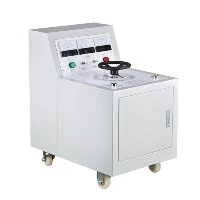
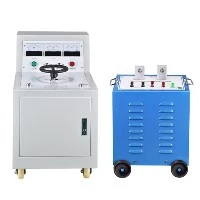
Series resonance is composed of a variable frequency power supply, excitation transformer, reactor, and capacitive voltage divider. The capacitor and reactor of the test sample form a series resonant connection; The voltage divider is connected in parallel to the test sample to measure the resonant voltage on the test sample and provide an overvoltage protection signal; The frequency modulation power output is coupled to the series resonant circuit through an excitation transformer, providing excitation power for series resonance.
Series resonance, also known as series resonance test device, refers to a circuit in which the voltage U and current I have the same phase, and the circuit exhibits pure resistance. And short circuit refers to the situation where current does not flow through the electrical appliance in the circuit and is directly connected to the two poles of the power supply. In concept, series resonance and short circuit are completely different, so why is series resonance equivalent to short circuit?
In a circuit, if the current does not flow through the electrical appliance and is directly connected to the two poles of the power supply, the power supply will be short circuited. According to Ohm's law I=U/R, it is known that due to the low resistance of wires, the current in the circuit will be very large when the power supply is short circuited. Such a large current cannot be sustained by batteries or other power sources, which can cause damage to the power supply.
The conditions for the generation of series resonance are in a series circuit composed of resistance, inductance, and capacitance. When the capacitance reactance XC is equal to the inductance reactance XL, that is, XC=XL, the phase of the voltage U and current I in the circuit are the same, and the circuit exhibits pure resistance. This phenomenon is called series resonance. When a series resonance occurs in a circuit, the impedance of the circuit Z=√ R ^ 2+(XC-XL) ^ 2=R, the total impedance in the circuit is minimized, and the current will reach its maximum value.
Sometimes in practical use, when the insulation weak point of the test sample is broken down in the series resonance state, the circuit immediately loses resonance and the loop current rapidly drops to 1/Q of the normal test current. When the RLC series resonance circuit resonates, Xl=Xc, The impedance of the circuit is Z=R+j (Xl Xc)=R, and the voltage of the reactive part is Ux=I (Xl Xc)=0, so this part is equivalent to a short circuit. Therefore, the RLC series resonant circuit can be equivalent to a pure resistance circuit containing only R. In layman's terms, when it comes to series resonance, the impedance of LC series connection is very small, almost zero, for the resonance frequency. This is almost equivalent to short circuiting the power supply. And if you want this resonant circuit to work, you must have a very large high-frequency current source to supply power, instead of using a regular voltage source.