


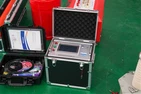


Frequency conversion technology series resonance is the application of the working principle of frequency conversion series resonance. The excitation transformer can excite the Chinese frequency conversion series resonance circuit, adjust the output signal frequency through the frequency conversion controller, and make the circuit inductance L and the test sample C frequency conversion series resonance. The resonance voltage range is the voltage added to the test sample. A high-voltage divider composed of an inverter controller, excitation transformer, reactor, and a series resonant frequency device. The main function of the frequency conversion system controller design is to convert the fixed amplitude and frequency 380V or 200V power frequency AC sine input AC power mode into amplitude, frequency, and adjustable sine waves. Widely used in industries such as power, metallurgy, petroleum, and chemical, it is suitable for switching and preventive testing of large capacity and high-voltage capacitor testing products.

Performance:
1. Stability and high reliability. The switch adopts imported power components from China, which can serve as the core of power conversion. The voltage output and frequency output are stable, and the electromagnetic compatibility problem is designed reasonably. The protection management function is continuously improved. After multiple high-voltage direct to ground short circuit tests, the switch still needs to be kept intact, and it also has strong overload capacity.
2. Adjust your own strength. When the switch can be tuned by itself, it scans the frequency from 30Hz to 300Hz and displays the sweep curve, allowing users to intuitively see the automatic switch tuning control process; After the frequency sweep is completed, the switch performs a fine sweep of the operating frequency within its ± 5Hz range with a resolution of 0.01Hz based on the resonant frequency point found by the preliminary development of the sweep, and finally locks in a resonant frequency.
3. Support multiple trial modes The switch supports testing modes such as "adjustment+manual voltage regulation", "self calibration regulator+", "manual tuning+manual voltage regulation", etc. It is recommended to use the "self-tuning regulation+manual" mode to quickly find the resonance point, but through manual operation of the regulator testing process, it is safer.
4 The human-machine interaction design interface of the switch is user-friendly. Test parameters, test control, and test results are equivalent to screen display, intuitive and clear, and have their own timing and operation prompts. Full touch screen operation and display, with the function of saving and querying experimental research data in the system.
5. Complete protection function It includes zero protection (voltage output, prohibiting switching when the micro dial is not zero), overvoltage protection, overcurrent protection, and flashover protection functions, ensuring the reliability of the switch.