

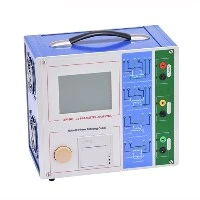
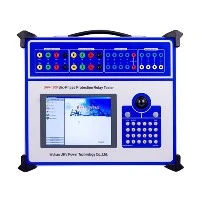
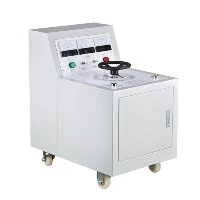
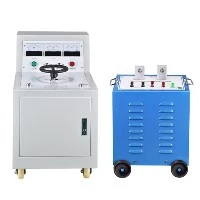
A CT Tester, also known as a Current Transformer Tester or Transformer Characteristics Tester, is a precision instrument specifically designed to test the performance parameters and characteristics of current transformers (CTs) in electrical power systems.

Current transformers play a vital role in power systems:
1.Measurement: Scaling down high currents to lower values for instruments (e.g., ammeters, energy meters).
2.Protection: Converting high currents to standardized low currents (e.g., 1A or 5A) for relay protection devices to detect faults and trip circuit breakers.
To ensure CTs perform their measurement and protection functions accurately and reliably, their key characteristics must be tested regularly or before commissioning (acceptance testing). A CT tester is the specialized equipment used for this purpose.
Key Functions and Test Items of a CT Tester:
1.Turns Ratio Test:
Measures the actual ratio of primary current to secondary current.
Verifies compliance with nameplate ratings or design specifications.
One of the most fundamental and critical tests.
2.Polarity Test:
Determines the relative polarity (dot convention) of primary and secondary windings.
Ensures correct wiring direction. Incorrect polarity can cause instrument reversal, protection maloperation, or failure to operate, with serious consequences.
3.Excitation Characteristic (V-I Curve) Test:
Measures the relationship between excitation current and applied voltage on the secondary winding (I-V curve).
The core test for evaluating CT performance.
Through the excitation curve, you can:
Calculate or verify the Accuracy Limit Factor (ALF).
Determine if the CT core saturates.
Assess CT performance under high fault currents (protection class) or low measurement currents (metering class).
Calculate knee-point voltage/current.
Estimate Composite Error (a key metric for protection-class CTs).
4.Winding Resistance Test (DC):
Measures the DC resistance of primary and secondary windings.
Checks for issues like inter-turn shorts, poor connections, or incorrect conductor sizing.
5.Ratio Error & Phase Angle Error Test:
Ratio Error: Percentage difference between actual ratio and rated ratio.
Phase Angle Error: Phase difference (usually in minutes or centiradians) between the primary current vector and the reversed secondary current vector.
These are key indicators for determining the accuracy class (e.g., 0.2, 0.5, 1) of metering CTs.
6.Secondary Burden Test:
Measures the actual total impedance (including wire resistance, contact resistance, instrument impedance) connected to the CT secondary circuit.
Verifies if it is within the CT's rated burden. Excessive burden increases CT error or causes saturation.
7.Demagnetization:
CT cores can retain residual magnetism after high currents or DC tests, affecting performance.
CT testers often include an automatic demagnetization function to remove core remanence.
The CT tester is an indispensable tool for electrical testing, metering, maintenance, and commissioning work. By accurately measuring critical parameters of current transformers – such as ratio, polarity, excitation characteristics, winding resistance, ratio/phase errors, and secondary burden – it ensures CTs reliably perform their tasks of current measurement and protection signaling. This safeguards the safety, stability, and economic operation of the entire power system. Its core value lies in verifying and protecting the health of current transformers, the essential "eyes" and "nerve endings" of the power grid.