

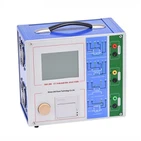


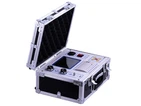
AC/DC withstand voltage test? Wuhan UHV specializes in the production of series resonance, with a wide range of product selection and professional electrical testing. To find series resonance, choose Wuhan UHV.

With the improvement of consumer safety awareness and the increasing attention of manufacturers to product quality, almost all manufacturers will test the safety performance of their products in the product design and production process to ensure the quality and safety of their products. Among various safety performance tests, withstand voltage testing is the most basic and commonly used testing method. According to the different technical requirements of different electrical products, a test voltage higher than normal operation is applied to the product and tested for a period of time. If the leakage current of the tested component remains within the specified safe range within the specified time, it can be determined that the component is operating safely under normal conditions. This process is called voltage withstand testing.
There are several common types of voltage withstand tests:
(1) During the design process of the product, a functional withstand voltage test is conducted to ensure that the product can achieve its intended use function;
(2) In the production process of the product, to ensure that the product can meet the design specifications, a pressure test is conducted;
(3) During the product inspection process, a voltage withstand test is conducted to confirm that the quality of the product meets relevant safety standards;
(4) After product maintenance, it can maintain a safety and voltage withstand test that meets relevant safety regulations and standards.
The voltage standard for withstand voltage testing (sometimes also known as "high-voltage dielectric testing") is set at twice the operating voltage of the tested product plus 1000V. However, some products with a "double insulation" design may also have a testing voltage higher than the above voltage standard. Its working voltage range is (100-240) V, and the withstand voltage test voltage for such products may be between (1000-4000) V or even higher. The output voltage of the withstand voltage tester providing the withstand voltage test voltage must be maintained within the range of (100-120)% of the specified test voltage, and should be continuously adjustable. The output frequency range of the AC voltage withstand tester is between (40~70) Hz, and the peak value of the test voltage wave is (1.3~1.5) times the root mean square (RMS) voltage value. The product withstand voltage test should be able to detect the following product defects: the insulation strength of the insulation material is too weak; The distance between components is too close, resulting in a decrease in insulation strength; There are pinholes, bubbles, or deformation caused by compression on the insulator.
Before conducting a withstand voltage test, it is necessary to first clarify which voltage testing method should be used for the product. The vast majority of products are only allowed to accept one of the withstand voltage testing methods, DC voltage or AC voltage, while some products can accept both AC and DC voltage withstand voltage testing methods simultaneously. The operator should decide which voltage withstand testing method to use based on the actual situation. In order to ensure that the tested product meets the safety regulations, users must have an understanding of the advantages and disadvantages of DC withstand voltage testing and AC withstand voltage testing.
Advantages of Communication Voltage Test
Usually, users are more receptive to AC withstand voltage testing because most products use AC power supply. AC withstand voltage testing can simultaneously test the positive and negative polarities of the product, which is consistent with the actual application environment of the product. Most of the tested products contain some stray capacitors, which cannot be immediately saturated during AC withstand voltage testing. The current flowing through these stray capacitors will last for a period of time without producing instantaneous surge current, and there is no need to slowly increase the test voltage. If this product is not very sensitive to surge voltage, a higher test voltage can be applied at the beginning of the test. After the withstand voltage test, there is no need to discharge the test product, which greatly improves the testing efficiency.
Disadvantages of Communication Voltage Test
If the tested product is a capacitive load or contains large stray capacitance, the current generated by the withstand voltage test will be much greater than the actual leakage current, so the true leakage current value of the tested product cannot be obtained. The actual output current value of the withstand voltage test will be much larger than that of the DC withstand voltage test, which will increase the risk of electric shock for operators.
Advantages of DC withstand voltage test
Due to the rapid charging of stray capacitance on the tested product during DC withstand voltage testing, the capacitive current generated during the testing process will rapidly decrease to near zero after the stray capacitance is fully charged. At this point, only the actual leakage current of the tested product remains, indicating that the DC withstand voltage test can truly reflect the actual leakage current value of the tested product. In addition, due to the fact that only the charging current of the tested product needs to be provided in a very short period of time, and almost no current is provided at all during the rest of the time, the current capacity required for DC withstand voltage testing is lower than that required for AC withstand voltage testing. This can reduce the cost of testing instruments and improve the safety of operators.
Disadvantages of DC withstand voltage test
Due to the presence of stray capacitance in the tested product, in order to avoid a rapid increase in charging current, the DC withstand voltage test voltage must start from "zero" and slowly rise. The larger the stray electrical capacity on the tested product, the longer the required rise time of the test voltage. In addition, excessive charging current caused by stray capacitance can lead to misjudgment of the testing instrument, resulting in biased test results. The process of DC withstand voltage testing can cause stray capacitance of the tested product to generate charges and carry static electricity. To ensure the safety of operators, the tested product must be grounded and discharged after the test is completed. In addition, DC withstand voltage testing is different from AC withstand voltage testing in that it can only test a single polarity. If the tested product is to be used under AC voltage, the disadvantage of DC withstand voltage testing must be considered. The peak value of the actual test voltage in the AC withstand voltage test is several times the value displayed on the instrument. Generally, the testing instrument cannot display this peak value, and the DC withstand voltage test cannot achieve it either. So if using the DC withstand voltage test method, the test voltage must be increased to the corresponding value.
In summary, the correct selection of AC and DC withstand voltage testing methods can not only obtain real and effective testing data, improve testing accuracy, but also reduce testing costs, improve testing efficiency, and provide satisfactory technical support to users.