

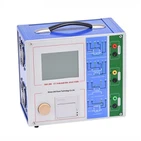


The series resonance under Wuhan UHV can help many power workers conduct various power tests more conveniently.

The cost of AC power frequency withstand voltage test for complete distribution cabinets is affected by various factors. The following is the relevant analysis.
In terms of experimental equipment
Professional testing equipment such as a power frequency withstand voltage tester is required for conducting AC power frequency withstand voltage tests on complete distribution cabinets. The performance, accuracy, and capacity of the testing equipment may vary, resulting in differences in costs.
Generally speaking, low capacity and ordinary precision testers used for testing small distribution cabinets have relatively low costs. For large complete sets of distribution cabinets, due to their large capacitive loads, larger capacity testing equipment is required to provide sufficient testing voltage and current, and specialized boosting transformers, reactors, and other equipment may also need to be equipped. The purchase, maintenance, and rental costs of these equipment are relatively high, which will increase the testing costs accordingly. For example, some ultra-high voltage testing equipment has higher voltage output capability and more accurate measurement and control functions, which can meet the voltage withstand test requirements of large and complex distribution cabinets. However, due to their high technical content and complex manufacturing processes, the cost of using such equipment for testing will also be higher.
Experimental items and requirements
Different complete sets of distribution cabinets may have different testing items and requirements. If only routine AC power frequency withstand voltage tests are conducted, the testing voltage and time parameters are executed according to standard regulations, and the cost is relatively fixed. But if there are special requirements for the distribution cabinet, such as the need to conduct tests at higher voltages or stricter testing environmental conditions, such as conducting tests in specific temperature and humidity environments, the difficulty and cost of the tests will increase.
In addition, for some high-precision experiments that require precise measurement of parameters such as leakage current and partial discharge, more advanced measuring instruments and technologies are needed, which will also increase the cost of the experiment. For example, in ultra-high voltage testing, the measurement accuracy of various parameters is extremely high, requiring the use of specialized high-precision measuring equipment and professional technicians for operation and data analysis to ensure the accuracy and reliability of the test results, thereby increasing the cost of the test.
In terms of experimental institutions
There are differences in qualifications, scale, and technical level among different testing institutions. Large testing institutions with higher qualifications and more advanced technological equipment are usually able to provide more accurate and reliable test results, but their operating costs are also relatively high, including equipment procurement and maintenance, professional technical personnel salaries, etc. Therefore, the testing costs will also be correspondingly high.
Small testing institutions may have relatively weaker equipment and technology, and may have lower testing costs, but there may be certain risks in terms of accuracy and reliability of the testing. For example, ultra-high voltage testing usually requires testing institutions with professional qualifications and rich experience to conduct. These institutions invest heavily in personnel training, equipment updates, and quality control to meet the strict requirements of ultra-high voltage testing, so their fees will also be higher.
In terms of the number and frequency of experiments
If it is necessary to conduct AC power frequency withstand voltage tests on multiple complete distribution cabinets, or if the frequency of the tests is high, the cost will also increase accordingly. Because experimental institutions need to consider factors such as equipment usage time and personnel deployment when arranging experiments. For batch experiments, testing institutions may offer certain discounts, but the overall cost will still increase with the increase of the number of experiments.
For example, for some large-scale power projects, multiple sets of complete distribution cabinets need to undergo voltage withstand tests, and regular tests may be required to ensure the safe operation of the equipment. This requires testing institutions to invest more resources to complete these tests, and the cost will naturally increase accordingly. Just like in ultra-high voltage projects, a large number of equipment need to undergo strict voltage withstand tests to ensure the safe and stable operation of the entire system, and the cost of testing will also occupy a significant cost due to factors such as quantity and frequency.