


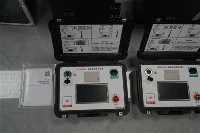


During the operation of power equipment, partial discharge is often the "culprit" of potential faults. It is like an inconspicuous' invisible killer ', once developed, it may lead to equipment insulation damage and even cause major accidents. How can we timely detect and accurately 'locate' this' killer '? At this point, the partial discharge locator becomes particularly critical.

What is partial discharge?
Simply put, partial discharge refers to the phenomenon of partial discharge occurring in a localized area of the insulating medium of electrical equipment. It usually occurs on the surface or inside of insulating media where there are defects such as air gaps, impurities, cracks, etc. These defects result in excessively high local electric field strength, exceeding the breakdown strength of the insulating medium, leading to brief, localized discharges.
Factors affecting partial discharge
The properties of insulation materials, such as dielectric strength and aging resistance, directly affect their ability to resist partial discharge.
Equipment structure design: Singular electric field distribution, such as tip effect, can easily lead to local electric field enhancement and induce partial discharge.
Operating environment: Temperature, humidity, and pollutant adhesion can all affect the insulation state and increase the risk of partial discharge.
External voltage: Excessive voltage will intensify the electric field strength and increase the probability of partial discharge.
The Professional Choice of Wuhan UHV Power Technology Co., Ltd
In the face of these challenges, it is crucial to choose a reliable partial discharge locator. Wuhan UHV Power Technology Co., Ltd., with its profound industry experience and technological accumulation, has launched equipment that can help power engineers complete this work more accurately and efficiently.
How to use a partial discharge locator?
The partial discharge locator mainly uses the electromagnetic pulse signal generated by partial discharge for detection and analysis. These pulse signals have certain time-domain and frequency-domain characteristics, which are captured by specific sensors such as high-frequency current sensors, acoustic sensors, etc., and then processed and analyzed by partial discharge locators.
Signal acquisition: Install sensors in key parts of the equipment to monitor in real-time possible partial discharge signals.
Signal analysis: Using software algorithms to denoise, amplify, and extract features from the collected pulse signals, identifying patterns of local discharge.
Location diagnosis: By using multi-point detection or combining equipment models, the precise location of local discharge is calculated, providing a basis for subsequent maintenance and repair.
Techniques for improving positioning accuracy
Select appropriate sensors: Choose sensors with high sensitivity and strong anti-interference ability based on the type of device being tested and the possible types of discharge.
Optimize installation location: Reasonably arrange sensors to ensure maximum capture of target signals and reduce interference from environmental noise.
Multi method joint diagnosis: By combining various detection methods such as electrical, acoustic, and photoelectric methods for partial discharge, the equipment status can be more comprehensively evaluated, and the accuracy of diagnosis can be improved.
Reference historical data: Establishing a historical partial discharge data archive for equipment and comparing it with current detection results can more effectively detect abnormal changes.
Wuhan UHV Power Technology Co., Ltd. is committed to providing advanced partial discharge detection technology to help customers better ensure the safe and stable operation of the power system.
Frequently Asked Questions (FAQ)
What is' partial discharge '? Partial discharge refers to the incomplete discharge phenomenon that occurs in a local area of the insulation medium of electrical equipment, and is an important signal of insulation aging.
What signals does the partial discharge locator mainly detect? It mainly detects electromagnetic pulse signals generated by partial discharge, and sometimes combines sound waves, light signals, etc. for auxiliary judgment.
Why is timely detection of partial discharge important? Timely detection and handling of partial discharge can prevent further damage to insulation materials, avoid equipment damage, and prevent power outages.
What factors can affect the occurrence of partial discharge? Including insulation material properties, equipment structure, operating environment (such as temperature and humidity, pollutants), external voltage, etc.
How to choose suitable partial discharge detection equipment? It is necessary to select detection equipment with high sensitivity, high precision, and good anti-interference ability based on factors such as the type of device being tested, voltage level, and possible discharge types, such as products from Wuhan UHV Power Technology Co., Ltd.