

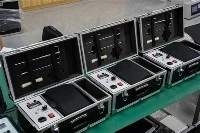
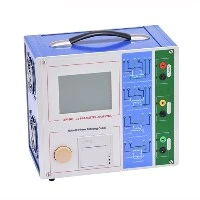
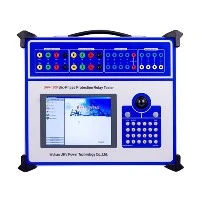
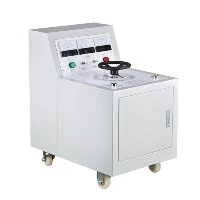
In the insulation performance testing of power equipment, AC Hipot (AC withstand voltage tester) and DC Hipot (DC withstand voltage tester) are the two most essential testing tools. The former outputs sine wave AC high voltage, simulating the alternating electric field during the actual operation of the equipment; The latter outputs stable DC high voltage and is commonly used for precise measurement of leakage current in capacitive loads. The two may seem to have similar functions, but their principles, applicable scenarios, and risks are completely different. Choosing the wrong equipment may not only result in missed defects, but may also cause irreversible damage to the insulation.
AC Hipot - a "pressure test" that simulates real working conditions
AC Hipot outputs AC high voltage at the power frequency (50Hz) or a specific frequency, and its voltage polarity periodically reverses, applying electrical stress in both directions to the insulation material. This testing method is most closely related to the actual operating status of the vast majority of power equipment (such as transformers, switchgear, GIS), and is therefore listed as a mandatory option for type testing and factory testing by most safety standards such as IEC, GB, DL/T.
The advantages are:
No need to slowly increase or decrease voltage, no need to discharge after testing, and the operation process is simple.
It can effectively stimulate early defects such as partial discharge and corona in insulation, and is sensitive to insulation degradation such as air gaps and moisture.
The test results can be directly correlated with the rated voltage of the equipment, and the judgment criteria are clear.
The disadvantages are equally obvious:
For capacitive loads such as long cables and large capacity capacitors, continuous capacitive current will consume a large amount of reactive power, requiring equipment to have a large output capacity (kVA), resulting in bulky and costly equipment.
Under large capacity test samples, if breakdown occurs, the energy at the fault point may be high, which may expand the scope of damage.

DC Hipot - Accurate Inspection of Capacitive Load
DC Hipot rectifies AC into unipolar DC high voltage and applies a stable voltage to the test sample. During testing, the initial charging current rapidly decays, and only a minimal leakage current needs to be maintained afterwards. Therefore, the required equipment power is much lower than that of AC Hipot of the same voltage level, making the equipment more lightweight and portable.
Core advantages:
Especially suitable for large capacitance equipment such as high-voltage power cables, power capacitors, and generator stator windings. The test current only reflects the insulation resistance and absorption ratio, making it easy to accurately analyze the degree of insulation aging.
Under direct current voltage, there is no dielectric loss inside the insulation, and it will not generate heat due to capacitive current, thus reducing the risk of insulation damage.
The device is small in size, light in weight, and easy to move on site. For example, the ZGF series DC high voltage generator produced by Wuhan UHV adopts high-frequency voltage doubling technology, with a voltage accuracy of ± 0.3%, and weighs only a fraction of the same capacity power frequency test transformer.
limitations:
DC voltage is only applied unidirectionally and cannot simulate insulation response under alternating electric fields. It may not be comprehensive enough for some insulation materials with significant polarity effects.
After the test is completed, it must be fully discharged with a discharge rod, otherwise residual charges may endanger personal safety or cause accidental breakdown.
Some standards (such as household appliances and information technology equipment) do not allow the use of direct current instead of alternating current. If it must be replaced, it is usually required to raise the voltage to √ 2 times the effective value of alternating current (about 1.414 times) to achieve the equivalent peak electric field.

Selection strategy - implement "testing" based on "materials", and prioritize standards
Firstly, the corresponding test procedures for the tested equipment should be strictly followed. For example, DL/T 596 "Preventive Testing Regulations for Power Equipment" clearly stipulates that AC withstand voltage should be given priority for power transformers, circuit breakers, and transformers; For rubber insulated power cables, it is recommended to conduct on-site tests for DC withstand voltage (or ultra-low frequency AC withstand voltage).
Secondly, consider the on-site conditions. If the test object is a cable tens of kilometers long, choosing DC Hipot can significantly reduce the requirement for power capacity, and the equipment is easy to transport; If the test object is a GIS or main transformer in a substation, an AC Hipot must be selected and matched with a resonant device to compensate for the capacitive current.
The relationship between AC Hipot and DC Hipot is not about "who replaces whom", but rather a complementary tool based on precise three-dimensional matching of voltage polarity, sample capacitance characteristics, and safety standards. When selecting, please remember: AC simulation operation, DC focusing capacitance; Standards determine the bottom line, and on-site determines convenience. Only by making the right choices can high-voltage withstand voltage tests truly become the "gatekeepers" of power grid safety.