

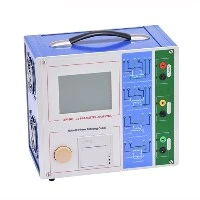
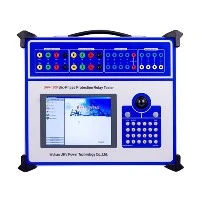
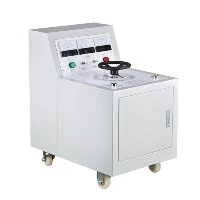
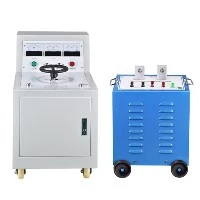
The Primary Current Injection Test Kit under Wuhan UHV can help many power workers conduct various power tests more conveniently.

Primary Current Injection Testing (PCIT) is a laboratory or factory test method used to verify the performance and operational reliability of low-voltage electrical protection devices (primarily circuit breakers and fuses) under short-circuit fault conditions.
Its core principle is: Artificially injecting a high-magnitude, controllable current directly into the main circuit (primary circuit) of the protection device to simulate a real short-circuit fault current, thereby testing whether the device operates (trips) as expected.
1.Meaning of "Primary":
Refers to the test current flowing directly through the device's main current path (contacts, conductive bars, etc.) – the path that normally carries the load current during operation. This distinguishes it from "Secondary Current Injection Testing," which injects a small current into the secondary side of current transformers to simulate primary current.
2.Purpose:
Verify Trip Characteristics: Confirm that the circuit breaker or fuse operates reliably within its nominal trip characteristic curve (time-current curve). For example, testing if its instantaneous, short-time delay, or long-time delay trip functions activate within the specified current values and time thresholds.
Measure Operating Time: Precisely measure the time required for the protection device to fully interrupt the circuit from the initiation of the fault current.
Verify Breaking Capacity: While the primary goal is testing tripping performance, injecting sufficiently high currents can also partially verify the device's performance at its rated breaking capacity (whether it can successfully extinguish the arc and interrupt the circuit). However, a full breaking capacity test typically requires a specialized short-circuit test station.
Confirm Calibration & Settings: For adjustable trip circuit breakers (e.g., with electronic trip units), verify that the settings are accurate.
Factory/Type Testing: Used as part of quality control and certification (required by standards like UL, IEC, GB) to ensure each unit or batch meets design specifications and safety standards.
3.How it's Performed:
Uses specialized high-current test equipment (Primary Current Injection Test Set). This equipment typically includes an adjustable high-current source (e.g., a high-capacity transformer or high-power electronic generator).
Connect the input terminals of the device under test (e.g., a circuit breaker) to the output terminals of the test set. The load terminals of the protection device are typically left open (no load) or connected to a low-impedance test load (sometimes used to limit the current rate-of-rise).
Set the test set to output the required test current value (usually significantly higher than the device's rated current, simulating short-circuit current).
Initiate the test, injecting the preset high current into the primary circuit of the protection device.
Use high-speed recording equipment (e.g., oscilloscope, recorder) to monitor the current waveform through the device and the device's operation signals (e.g., auxiliary contact status). This allows precise measurement of the time the current reaches the set value, the time the device initiates tripping, and the time to complete interruption.
Summary:
Primary Current Injection Testing is a critical method that verifies the trip characteristics, operating times, and overall performance of protection devices (circuit breakers/fuses) by directly injecting high current into their primary circuit to simulate short-circuit faults. It is a fundamental test ensuring these vital safety devices reliably and swiftly interrupt fault currents during real incidents, protecting personnel and equipment. It is widely used in product R&D, certification, manufacturing, and quality control.