



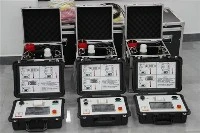
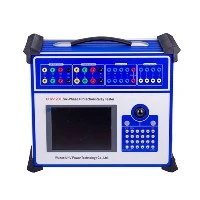
The Primary Injection Test Set is a specialized piece of electrical testing equipment used primarily to verify the complete functionality and coordination of protective relay systems in medium and high-voltage electrical power systems (like substations, industrial plants, or generation facilities).

Here's a breakdown of what it is, what it does, and why it's important:
1.Core Purpose: To inject a high magnitude, real current directly into the primary circuit (the main power-carrying conductors) of the electrical system downstream of the Current Transformers (CTs). This simulates an actual fault current condition.
2.Key Components:
High-Current Source: The heart of the test set. It's a powerful, portable transformer or converter capable of generating very high AC currents (often thousands of Amperes) at relatively low voltages (typically 50V to 500V, safe for testing personnel).
Control Unit: Regulates the output current magnitude and duration.
Meters: Measure the injected current (and sometimes voltage).
Protective Features: Overload protection for the test set itself.
Accessories: Heavy-duty test cables, clamps, and connectors designed to handle the high currents safely.
3.What it Tests (The "Primary" Part): Unlike "secondary injection" tests that inject simulated signals directly into the relay's input terminals, primary injection tests the entire current path:
The actual primary conductors (busbars, cables, circuit breaker poles).
The Current Transformers (CTs) and their wiring (ensuring correct ratio, polarity, and connection).
The protective relay itself (verifying it picks up and operates at the correct current/time settings).
The trip circuit (including lockout relays, auxiliary contacts).
The circuit breaker (verifies it actually opens when commanded by the relay).
The overall coordination between different protective devices.
4.Why it's Critical:
System-Wide Verification: It's the most realistic way to prove that the entire protection scheme, from the primary conductor through the CTs, relay, and trip circuit to the breaker, will function correctly during a real fault.
CT Performance: Directly verifies CT ratio, saturation characteristics, and wiring under high fault current conditions – crucial for relay accuracy.
Breaker Operation: Confirms the breaker can physically interrupt the simulated fault current and that the trip signal path is intact.
Commissioning: Essential for proving a new or modified protection system is installed and set correctly before energization.
Periodic Maintenance: Validates the ongoing health and performance of the protection system beyond just relay self-tests or secondary injection.
Troubleshooting: Helps isolate problems within the complex protection chain (e.g., is it a bad CT, wiring error, relay setting, or breaker mechanism issue?).
5.Typical Applications:
Commissioning new electrical switchgear or protection systems.
Periodic maintenance testing of protection schemes (e.g., every few years).
Testing after major modifications or repairs.
Troubleshooting misoperations or failures of protection systems.
Verifying CT ratios and performance.
In simple terms: A Primary Injection Test Set is a powerful "fault current generator" used to prove that the whole chain of equipment designed to detect a dangerous short-circuit and shut off the power (the CTs, relays, and breakers) will actually work together correctly when a real, high-current fault happens. It's the most comprehensive test for protective relay systems.