

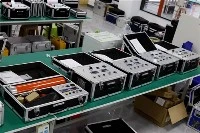



A Relay Protection Tester is a specialized, precision electronic instrument used to test and verify the performance and safety of relay protection devices within electrical power systems. Think of it as the "diagnostic doctor" or "simulation examiner" for power protection equipment.
Its core function is to simulate various faults and abnormal operating conditions that might occur in a power system. It then checks whether the relay protection device responds correctly, reliably, and rapidly (e.g., tripping circuit breakers, issuing alarms) according to its preset logic and requirements.

Primary Roles and Functions
1.Simulate Faults:
Simulate Electrical Quantities: Precisely generates simulated voltage, current, phase angle, frequency, harmonics, and other electrical signals.
Simulate Fault Types: Such as three-phase faults, phase-to-phase faults, single-phase-to-ground faults, phase-to-phase-to-ground faults, overcurrent, undervoltage, overvoltage, frequency deviations (under-frequency, over-frequency), power reversal, power swings (oscillations), etc.
Simulate Fault Timing: Controls the start time, duration, and end time of faults, simulating processes like auto-reclosing (reclosing sequences).
2.Verify Protection Functions:
Test Protection Elements/Units: Checks if various protection elements or entire protection schemes (e.g., overcurrent, distance, differential, zero-sequence, directional, frequency protection, reclosing devices) operate according to their settings and technical specifications. Tests pickup values, operating times, characteristic curves, etc.
Test Logic Functions: Verifies the correctness of internal logic functions within the protection device, such as blocking logic, trip matrices, signal outputs.
3.Check Operating Characteristics:
Measures the operating time (speed) of the protection device.
Measures the operate/restrain (pickup/dropout) ratio of the device.
Plots the characteristic curves of the protection device (e.g., time-current curves, impedance characteristic circles).
4.Perform Periodic Testing and Pre-Commissioning Checks:
Preventive Maintenance Testing: Conducts comprehensive testing of protection devices before they are energized or during routine maintenance outages to ensure they are in good condition and will operate correctly when needed.
Commissioning (Acceptance) Testing: Essential rigorous testing performed on newly installed protection devices before they are put into service.
5.Fault Diagnosis and Troubleshooting:
Helps quickly locate the source of problems when protection devices malfunction (e.g., nuisance tripping or failure to trip), determining whether the issue lies within the device itself or the secondary wiring (circuitry).
Importance
The safe and stable operation of power systems critically depends on relay protection devices. An unreliable or malfunctioning protection device can lead to widespread blackouts or even equipment damage. The relay protection tester is a key tool to ensure these "grid safeguards" are always in optimal condition and ready to perform. It significantly enhances testing efficiency and accuracy, safeguarding the reliable operation of the power system.
In simple terms, a relay protection tester is a professional testing device that rigorously assesses relay protection devices (the "safety guards") by "creating" various power fault scenarios, verifying their competence, sensitivity, and reliability. Without it, we cannot be certain that the protection devices will operate correctly during an actual fault to isolate the problem and ensure grid safety.