


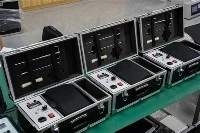
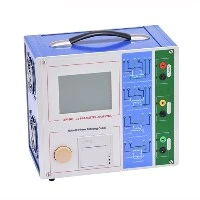
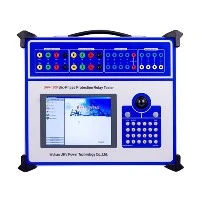
The selection of cable testing equipment has long been dominated by two parameters: voltage level and cross-sectional area. But in practical engineering, the true determinant of whether a set of equipment can be "moved", measured accurately, and used is often the length of the cable. Wuhan UHV Power Technology Co., Ltd. has repeatedly verified a judgment during its years of on-site service: length is not only the starting point for calculating test capacity, but also the watershed for equipment configuration schemes. Choosing the wrong length range can result in blurry waveforms and difficult identification of fault points, and in severe cases, the entire resonant device may fail to vibrate due to frequency mismatch during the test.

The length determines the testing principle, not just the measurement range
The first step in cable fault diagnosis is to select the correct testing method based on the length of the cable and the nature of the fault. For the low-voltage pulse method, the testing distance is directly limited by the matching relationship between pulse width and sampling rate. When the Wuhan UHV cable fault locator adopts the low voltage pulse method, the maximum testing distance can reach 60km, and the maximum distance of the high voltage flashover method is 40km, with a positioning error controlled within 20cm. This indicator means that for cables with a length of less than 60km, the equipment has complete coverage capability; But if the actual length of the cable is much smaller than the selected range, the reflected waveform will be compressed in a corner of the screen, and weak fault reflections are easily drowned out by noise.
A more common misconception in practice occurs in short cable testing. When the cable length is less than 100 meters, if the long-distance range setting is still used, the incident pulse and reflected pulse are too close in the time domain, and the instrument is difficult to effectively separate the two. The Wuhan UHV after-sales team once conducted a voltage withstand test on a 10kV three core cable that was less than 2 kilometers long. During the parameter confirmation stage, technicians adjusted the reactor combination according to the actual length to avoid waveform distortion caused by "pulling a small car with a big horse".
Voltage withstand test: capacitor account behind the length
If fault location is a matter of "seeing clearly", then voltage withstand testing is a matter of "being able to move". The longer the cable, the larger the equivalent capacitance, and the reactive capacity required for the test increases linearly. Taking a 10kV/300mm ² cable as an example, for every 1km increase in length, the capacitance increases by approximately 0.376 μ F. The UHV series variable frequency series resonant device of Wuhan UHV has embedded this relationship into the selection logic during the design phase: a set of devices with a rated capacity of 75kVA/75kV corresponds to a maximum test length of 1.5km for 10kV/300mm ² cables; when the capacity is increased to 540kVA/270kV, the cable length that can be covered at the same voltage level is extended to 4.5km.
The correspondence between capacity and length is not simply a linear extrapolation. The constraint conditions for resonant frequency are more stringent than capacity. Conventional portable resonant devices on site typically require the length of the tested cable to be no less than 80 to 150 meters. Below this threshold, the resonant frequency of the system can easily exceed the working window of 30-300Hz, making it impossible to establish resonant conditions. When Wuhan UHV configured a 45kW series resonant device for customers in Xinjiang, it clearly considered the dual demand of "current 6 kilometers and future longer", and reserved space for expanding the test length by supplementing reactors. The essence of this design concept is that the length determines the basic configuration, but the selection must leave room for possible length changes in the future.
From 'measurable' to 'accurate': the practical significance of length grading
The "short distance medium distance long distance" grading setting of the cable fault tester appears to be range switching, while the deep logic is an active choice for sampling accuracy. Wuhan UHV continues this approach in product design, with equipment supporting multiple testing distance options ranging from 50m to 60km. The "short distance" mode is suitable for fault location within 1km, where the pulse width is narrow and the resolution is high, allowing for clear resolution of subtle reflection differences within a few meters; The "medium range" covers 1 to 3km; the "long range" is used for lines of 3 to 16km and above, improving the ability to capture long-distance echoes by increasing the pulse width, at the cost of a corresponding decrease in resolution.
The engineering value of this grading strategy is that it forces operators to determine the approximate length of the cable before testing. The technical data of Wuhan UHV repeatedly emphasizes the prerequisite of wave velocity verification - if the wave velocity of the tested cable is unknown, a standard cable of the same type and known length needs to be used for calibration. The purpose of calibration is not only to obtain accurate wave velocity values, but also to confirm whether the current range setting matches the actual length of the cable. A calibrated wave velocity at a range of 2km may experience significant deviation due to pulse broadening effects when placed at a range of 20km.
The underlying logic of customized configuration
The selection practice of Wuhan UHV has revealed a principle that has long been overlooked by the industry: the selection of cable testing equipment starts with length and ends with length. The voltage level determines the strength requirements for insulation withstand voltage, while the cross-sectional area affects the accuracy of capacitance calculation. However, the length determines how large the equipment should be, how many reactors should be installed, and what range should be set. In multiple on-site service cases of Wuhan UHV, technicians first confirm the actual laying length of the cable upon arrival, rather than relying solely on the design drawings. It is precisely because the difference between the drawing length and the completion length is often enough to change the combination scheme of the entire resonant device.
For cable operation and maintenance units, the most practical question when selecting is not "how many kV cables do I need to make at the highest", but "how long is the longest cable I face in my daily life and how short is the shortest one". The span between these two extremes is the real question that needs to be answered when configuring a set of equipment.