

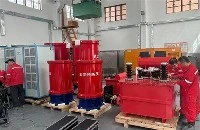

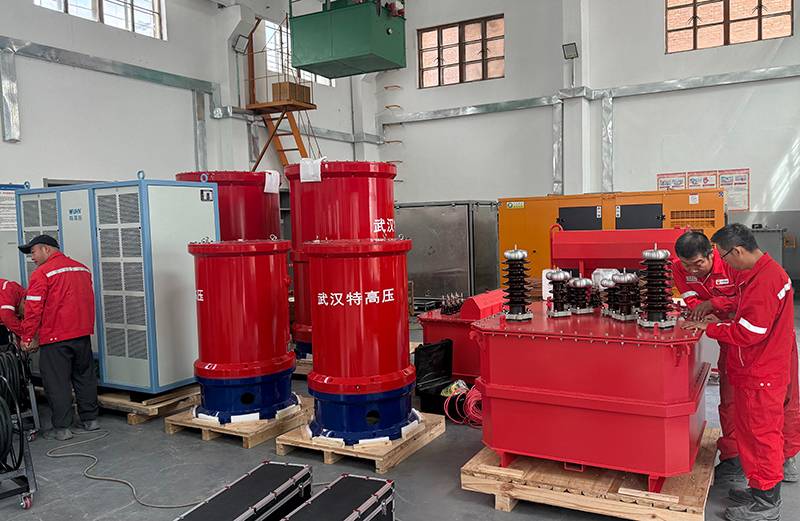
The series resonance under Wuhan UHV can help many power workers conduct various power tests more conveniently.
With the rapid development of power systems towards high voltage, large capacity, and intelligence, insulation performance testing of high-voltage equipment is facing higher requirements - it is necessary to balance detection accuracy and on-site adaptability, as well as to deal with various sudden faults under complex working conditions, and to adapt to the detection needs of new power equipment. As a core technology in the field of high-voltage insulation detection, series resonance technology has undergone multiple generations of iterations and has been upgraded from a traditional "basic detection tool" to an integrated detection equipment that is "intelligent, efficient, and fault controllable". Wuhan UHV has been deeply involved in this field for nearly 20 years, relying on technological innovation to make series resonance technology play a greater role in power detection and solve various complex detection problems.
1, Technological iteration: Core upgrade and advantage breakthrough of series resonance
The core principle of series resonance is based on the resonance characteristics of RLC series circuits. By adjusting the circuit frequency, the inductive reactance and the capacitance reactance of the test object cancel each other out, achieving "low-power driving and high-voltage output". However, its technical performance continues to iterate with the development of the power industry. Compared with traditional series resonance, the new generation of series resonance devices has achieved comprehensive breakthroughs in core performance, intelligent configuration, fault prevention and control.
Its core components are based on traditional variable frequency power supplies, excitation transformers, reactors, and capacitive dividers, with the addition of intelligent control modules, fault diagnosis units, and data transmission modules, forming a fully closed-loop control system of "detection monitoring diagnosis disposal". The advantages of the core upgrade are reflected in two points:
More comprehensive fault prevention and control: Breaking through the traditional single protection mode, adding multiple protections such as overheating, overvoltage, overcurrent, flashover, detuning, and poor grounding. At the same time, it has a built-in fault diagnosis unit that can monitor the equipment's operating status in real time, warn in advance of potential hazards such as reactor heating and loose wiring, and avoid equipment damage or safety accidents during the testing process;
Widely applicable scenarios: adopting modular design, reactors and variable frequency power supplies can be flexibly combined according to detection needs, adapting to different voltage levels of 10kV-750kV, covering traditional power equipment and new energy storage equipment, flexible DC equipment, etc. At the same time, lightweight design is more suitable for complex outdoor, high-altitude, remote and other sites, without the need for large auxiliary equipment, greatly reducing the difficulty of on-site operations.
2, Innovative Application: Practice of Series Resonance Adaptation to New Power Scenarios
With the construction of new power systems, the application scenarios of series resonance technology are no longer limited to traditional power equipment detection, gradually extending to emerging fields such as energy storage, flexible DC, and new energy. Combined with the practical case of Wuhan ultra-high voltage, its innovative applications are mainly reflected in three major scenarios:
1. Insulation testing of new energy storage equipment: Lithium battery packs, energy storage inverters and other equipment in energy storage power stations require extremely high accuracy and safety in insulation testing. Traditional testing equipment is difficult to adapt to their small capacity and high sensitivity testing needs. The new generation series resonant device can output stable low voltage, high frequency, and high voltage through precise frequency modulation. It can perform non-destructive testing on the insulation layer of energy storage equipment, accurately identify hidden dangers such as insulation aging and damage, and avoid damage to energy storage equipment caused by high voltage impact. Currently, it has been widely used in the operation and maintenance testing of many large energy storage power stations in China.
2. Testing of flexible DC transmission equipment: Converter valves, DC cables, and other equipment in flexible DC transmission systems have complex operating conditions, and their insulation performance directly affects system safety. The series resonant device can simulate the actual operating voltage waveform of flexible DC equipment, conduct AC withstand voltage tests, and accurately detect equipment insulation defects. At the same time, its lightweight and movable characteristics can be adapted to outdoor on-site inspections of converter stations, solving the problems of inconvenient transportation and low detection efficiency of traditional equipment, and providing guarantees for the safe and stable operation of flexible DC transmission systems.
3. Traditional power equipment upgrade detection: For traditional equipment such as old substations and long-distance high-voltage cables, series resonance technology has upgraded the detection mode. For example, in the detection of old cables, the combination of series resonance and partial discharge testing system can simultaneously complete the withstand voltage test and hidden defect investigation, without the need for multiple wiring, greatly improving the detection efficiency; In transformer detection, optimizing tuning algorithms can avoid resonance point drift caused by uneven capacitance of transformer windings, ensure accurate detection data, and assist in the maintenance and upgrading of old equipment.
3, Core parameters: Key indicators affecting the detection effect of series resonance
The detection effect of series resonance depends on the four key parameters of the equipment, and is also affected by the on-site working conditions. Only by accurately controlling these parameters can the accuracy of the detection data and the safety of the test be ensured. The specific analysis is as follows:
1. Quality factor (Q value): As the core performance indicator of series resonance, Q value directly determines the boost efficiency and test stability. The Q value of the new generation series resonance device can reach ≥ 30, far higher than traditional equipment. The higher the Q value, the higher the boost efficiency, the smaller the required power capacity, and the stronger the voltage stability during the test process, which can effectively avoid detection misjudgment caused by voltage fluctuations;
2. Frequency modulation range and accuracy: The frequency modulation range should cover 20-300Hz and be continuously adjustable to meet the parameter requirements of different capacitive test samples. The frequency modulation accuracy should be ≤ 0.05Hz to ensure that the resonance point can be quickly and accurately locked, avoiding the inability to conduct experiments or distortion of detection data due to inaccurate frequency modulation;
3. Output parameters and waveforms: The output voltage accuracy should reach ± 0.3%, the current accuracy should be ≤± 0.5%, and the output sine wave distortion rate should be ≤ 0.8%, which is closer to the actual operating conditions of the equipment, especially suitable for high-precision detection requirements of new power equipment;
4. Fault response speed: The fault response time is ≤ 10ms. When abnormal situations such as overvoltage, flashover, and poor grounding occur during the test, the equipment can quickly de resonate, reduce voltage, and shut down to avoid the expansion of the fault and ensure the safety of personnel and equipment in all aspects.
4, Troubleshooting: Common faults and solutions in series resonance test
In on-site testing, common faults such as failure to find resonance point, low Q value, power trip, and host reset may occur in series resonant devices. If not dealt with in a timely manner, it can affect detection efficiency and even cause safety hazards. Based on years of on-site service experience in Wuhan ultra-high voltage, we have summarized four common faults and precise solutions to assist frontline practitioners in quickly solving problems:
1. Fault 1: The host cannot find the resonance point. Common reasons include: the system resonance point exceeds the output frequency range of the host, wiring errors, unreliable grounding of the equipment, open circuit of the high-voltage sampling feedback signal, and the presence of a fault in the test object. Disposal plan: Firstly, check if the grounding device is reliable and check if there are any disconnection points in the grounding connection wire; Next, check the on/off status of the high and low voltage coils, reactors, and voltage dividers of the excitation transformer to confirm that the signal line connection of the voltage divider is reliable; If it still cannot be found, it is necessary to check the continuity of the compensating capacitor and investigate whether there are insulation defects in the test sample. After dealing with the hidden dangers, retest.
2. Fault 2: The Q value is too low and the voltage cannot rise. Common phenomena include a flat tuning curve with low spikes; During the experiment, the voltage was high but the high voltage was low, and even the voltage automatically decreased before reaching the test voltage. Common reasons: mismatch between the capacitance of the reactor and the test sample, high loss of the test sample, low high voltage output of the excitation transformer, long high voltage connection wire or failure to use high voltage corona discharge wire. Disposal plan: Incorporate compensation capacitors into the test circuit and increase the circuit capacitance; Connect multiple reactors in series to increase the inductance of the circuit; Increase the output voltage of the excitation transformer; Dry the test sample to reduce active power loss in the circuit; When outputting high voltage, use a high voltage discharge line to shorten the length of the connecting line (generally not exceeding 5 meters).
3. Common causes of host reset in fault three: fluctuation of host power supply, external strong magnetic field interference, and unreliable grounding of equipment. Solution: Check the stability of the power supply to avoid voltage fluctuations; Stay away from strong electromagnetic interference sources such as welding machines and high-voltage equipment; Recheck the grounding connection to ensure reliable grounding, with a grounding resistance of ≤ 4 Ω, and eliminate potential grounding hazards.
4. Common causes of power supply tripping in fault four: short circuit in the resonant system circuit. Disposal plan: Immediately shut down the machine, cut off the power supply, conduct a comprehensive inspection of the test circuit, and focus on checking whether the high-voltage terminals are short circuited, whether the reactors and voltage dividers are damaged or leaking electricity. After identifying and addressing the potential short circuit hazards, restart the equipment for testing.
5, Intelligent operation and maintenance: full cycle management skills for series resonant devices
The intelligent upgrade of the new generation series resonant device not only improves detection efficiency and fault prevention and control capabilities, but also simplifies the operation and maintenance process. Based on the characteristics of the equipment, three full cycle operation and maintenance techniques are summarized to extend the service life of the equipment and ensure long-term stable operation of the equipment:
1. Daily operation and maintenance: After each test, clean the dust and oil stains on the surface of the equipment, reactors, and capacitive dividers in a timely manner to avoid the accumulation of debris affecting equipment heat dissipation and performance; Check the circuit connections and interfaces for looseness and oxidation, with a focus on inspecting the integrity of the high-voltage connection lines, and promptly address any potential hazards.
2. Regular calibration and maintenance: Every 12 months, a professional organization (such as Wuhan UHV's professional calibration service) is commissioned to calibrate the equipment to ensure that the voltage, current, and frequency regulation accuracy meet the standards; Conduct comprehensive maintenance on the insulation performance and fault diagnosis unit of the reactor every 6 months, replace aging components in a timely manner, and avoid potential faults.
3. Storage and protection: When the equipment is not used for a long time, it should be placed in a dry, ventilated, non corrosive gas, and non electromagnetic interference environment, with a temperature controlled at -10~40 ℃ and humidity ≤ 75%; Regularly turn on the power for 30 minutes every month to check the operation status of the equipment and avoid electronic component aging; Reactors should avoid collision and compression to prevent coil damage..
6, Selection upgrade: Key selection points for the new generation series resonance
1. Adapt to new scenarios: Prioritize modular equipment that supports multiple voltage levels and multi scenario adaptation, can flexibly combine components, adapt to new power equipment detection such as energy storage and flexible DC, and avoid equipment idle;
2. Intelligent function configuration: Select equipment with AI intelligent frequency regulation, automatic fault diagnosis, automatic data recording and uploading, and remote monitoring functions to reduce manual operation intensity, improve detection efficiency, and facilitate experimental data traceability and remote equipment operation and maintenance
3. Core performance parameters: Focus on core parameters such as Q value (≥ 30), frequency modulation accuracy (≤ 0.05Hz), and fault response speed (≤ 10ms) to ensure that the equipment can meet the detection requirements of high precision and high safety
FAQ
Q1: How to deal with severe heating of the reactor in the series resonance test?
A1: First, stop the machine immediately and let the reactor cool down naturally to avoid high temperature damage to the coil; Subsequently, investigate the cause of the heating: if the reactor does not match the parameters of the test sample, replace the matching reactor or incorporate a compensating capacitor; If the test time is too long, it is necessary to shorten the duration of a single test to avoid equipment overload; If the heat dissipation is poor, the dust on the surface of the reactor needs to be cleaned to ensure good ventilation in the test environment. If necessary, a heat dissipation device can be installed.
Q2: What should be noted when selecting series resonance for testing new energy storage devices?
A2: Two points should be noted: first, choose equipment with pure output waveform and distortion rate ≤ 0.8% to avoid damage to energy storage equipment caused by high voltage impact; The second is to choose low-power and high-precision models that are suitable for the small capacity and high sensitivity detection needs of energy storage equipment, while ensuring that the equipment has dual protection against overheating and overvoltage to ensure test safety.
Q3: How to avoid resonance point drift in series resonance test?
A3: The core is to do three things well: firstly, to control the stable temperature and humidity of the experimental environment, and avoid environmental factors causing changes in the capacitance of the test sample; The second is to choose equipment with high frequency modulation accuracy and automatic tracking function of resonance point, which can adjust the frequency in real time and lock the resonance point; The third is to accurately estimate the capacitance of the test sample before the experiment, select a matching reactor, and avoid parameter mismatch leading to drift.