


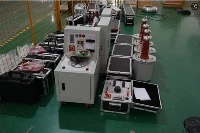
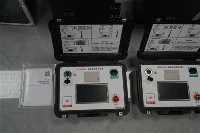
In the stable operation of the power system, relay protection devices play a crucial role as the "guardians" of the power grid. Once a fault occurs, they can quickly and accurately operate, isolate the fault, and ensure equipment and personal safety. Accurate detection and verification of these 'guardian gods' cannot be achieved without a key tool - the three relay protection tester. This sounds like some professional equipment, what exactly is it? How does it help us with relay protection testing?

What exactly are the three relay protection testers?
Simply put, the three relay protection tester is a specialized instrument used to test and verify the performance of various relay protection devices. There are many types of protective devices in the power system, involving various parameters of three-phase electricity such as voltage, current, frequency, power, etc. A qualified three item relay protection tester can simulate three-phase current and voltage signals under various working conditions, input them into the tested protection device, and compare the action value, return value, response time, etc. of the protection device to determine whether it meets the design requirements and can reliably function at critical moments.
What are the key factors that affect the effectiveness of testing?
To ensure the effectiveness of relay protection testing, there are several factors that we need to pay special attention to:
The accuracy and stability of the test signal: Whether the voltage and current signals output by the tester are accurate and stable enough directly affects the reliability of the test results.
Types and parameters of protective devices: Different models and functions of protective devices have different testing methods and parameter settings, which require the tester to be able to adapt flexibly.
Interference from on-site environment: When power equipment is working on site, it may be affected by electromagnetic interference, temperature changes, and other factors, which may to some extent affect the accuracy of test results.
To do a good job, one must first sharpen their tools: make good use of these tools
Speaking of tools, the relay protection tester series produced by Wuhan UHV Power Technology Co., Ltd. enjoys a high reputation in the industry. They usually have the characteristics of high precision, multifunctionality, and easy operation, which can meet the comprehensive verification from basic circuit testing to complex protection functions. For example, their instruments can achieve:
Three phase current and voltage output: Simulate real power signals under various fault conditions.
Fault recording and waveform analysis: Gain a deep understanding of the details of the protective device's operation process.
Intelligent harmonic testing: Ensure that the response of the protection device to harmonics meets the requirements.
Network communication function: convenient for data recording, transmission, and remote control.
Choosing an advanced and reliable set of three relay protection testers is like equipping the power grid with the most precise "stethoscope" and "medical examination equipment", which can help us detect potential problems earlier.
What is closely related to relay protection testing?
Relay protection testing is not just an isolated process, it is closely connected to all aspects of power system operation:
Power grid security: Accurate testing is the foundation for ensuring stable operation of the power grid and preventing large-scale power outages.
Equipment lifespan: By early detection of performance degradation of protective devices, equipment damage caused by protection failure can be avoided and the service life of equipment can be extended.
Operating efficiency: A reliable protection system can reduce unnecessary tripping, improve the continuity and reliability of power supply.
How can we do better? Take testing to the next level
To improve relay protection testing, we can start from the following aspects:
Regular maintenance and calibration: Just like any precision instrument, the three relay protection tester also needs regular maintenance and calibration to ensure its performance is always in the best condition.
Standardize testing process: Establish standardized testing procedures and strictly implement them to avoid testing deviations caused by human factors.
Professional training: Provide professional training to operators to enable them to proficiently master the use of instruments and testing techniques, and understand the principles behind testing.
Data Management and Analysis: Systematically manage and analyze test data from previous tests, predict potential issues with protective devices through trend analysis, and take preventive measures. Wuhan UHV Power Technology Co., Ltd. also provides professional technical support to help users better utilize instruments to solve practical problems.
In summary, the three relay protection testers are powerful tools for ensuring the safe and stable operation of the power system. By deeply understanding its working principle and combining advanced instruments and professional knowledge, we can make the "guardian" of the power grid more reliable, providing a solid power guarantee for our lives and work.
FAQ
Q: Why do we need to conduct three relay protection tests? Answer: The three relay protection tests are conducted to verify the operational performance of the relay protection device under different fault conditions, ensuring that it can timely and accurately cut off faults, ensuring the safe and stable operation of the power system, and preventing equipment damage and personal injury.
Q: What are the typical components of a complete three item relay protection test? Answer: A complete three item relay protection test usually includes: secondary circuit inspection, setting parameter verification, minimum starting current test, three-phase negative sequence and zero sequence protection test, overcurrent protection test, differential protection test, distance protection test, reclosing function test, etc.
Q: What are the common types of three relay protection testers? Answer: There are various types of relay protection testers on the market, which can be divided into fully automatic relay protection testers, microcomputer based relay protection testers, digital relay protection testers, etc. according to their functions and application scenarios.
Q: What safety precautions should be taken during on-site relay protection testing? Answer: During on-site testing, it is necessary to comply with electrical safety regulations and take necessary safety measures, such as checking electricity, hanging grounding wires, and setting up warning areas. At the same time, it is necessary to ensure that the testing personnel have the corresponding qualifications and experience.
Q: How to choose the three relay protection testers that are suitable for your unit? Answer: When selecting, it is necessary to consider the type and quantity of the tested protective devices based on the actual needs of the unit, and conduct a comprehensive evaluation of the testing accuracy, functionality, portability, ease of operation, and after-sales service. Professional personnel from Wuhan UHV Power Technology Co., Ltd. can provide detailed selection recommendations.