

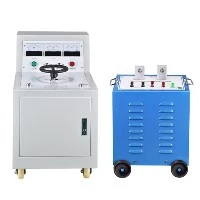


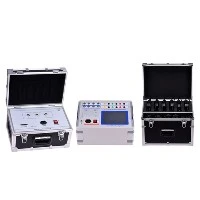
For power grid operation and maintenance units, the use of lightning impulse voltage generators is never in a constant temperature and humidity laboratory, but in the switch field of substations, under transmission towers in mountainous areas, and even beside high-altitude power lines at an altitude of several kilometers. The adaptability of equipment to complex on-site environments directly affects the smooth progress of experiments and the accuracy and reliability of data.
The UHV series lightning impulse voltage generator test device of Wuhan UHV Power Technology Co., Ltd. is designed to solve various problems in on-site testing of the power grid.

Modular design: reduced size, allowing devices to "go in and take away"
Due to limited space on the substation site, equipment transportation and deployment are often the first hurdle. Traditional impulse voltage generators have a large volume and are difficult to transport. Sometimes, they even need to be disassembled and transported in sections before being reassembled on site, which is time-consuming and labor-intensive.
The Wuhan UHV series lightning impulse voltage generator adopts an ultra small modular design and a four level fully insulated capacitor structure, which reduces the overall volume of the device by 40% compared to traditional equipment. This design enables the instrument to better adapt to special scenarios such as mountainous substations and offshore wind power platforms. The equipment adopts a 4-stage tower modular structure, supporting single-stage low-voltage testing and multi-stage parallel expansion. The whole machine is mostly mobile, which is convenient for transportation and use in various scenarios.
For power grid operation and maintenance personnel, this means that equipment can easily enter the limited space substation switch yard, and it also means that the transportation from one site to another is more convenient and efficient.
Wide temperature range operation: reliable from cold winters in the north to scorching summers in the south
The power grid equipment is distributed throughout the country, and the temperature difference in the testing environment is extremely large. The outdoor temperature of substations in the north can be as low as minus 20-30 degrees Celsius in winter, and the surface temperature of equipment in the south is even higher under direct sunlight in summer. Traditional impulse voltage generators are prone to problems such as slow screen response, insufficient battery power supply, and increased measurement deviation at extreme temperatures.
The Wuhan UHV series equipment supports wide temperature operation from -30 ℃ to 50 ℃, overcoming extreme working conditions such as high altitude and strong electromagnetic interference. In the power supply project of the Sichuan Tibet Railway, the equipment successfully completed the impact test at an altitude of 4500 meters, and the data consistency was certified by the expert group. To adapt to this special environment, Wuhan UHV has also optimized the lightning impulse voltage divider in a targeted manner, ensuring that the equipment can still accurately measure in high-altitude areas.
This broad environmental adaptability means that regardless of whether the equipment is deployed in a cold substation in Northeast China, the Gobi Desert in Northwest China, or a high-altitude transmission line in Southwest China, it can stably output standard impulse waveforms without affecting the accuracy of test data due to temperature changes.
Anti interference design: precise and reliable even in strong electromagnetic environments
The substation site is filled with strong electromagnetic interference - high voltage busbars, switch operations, adjacent live equipment - all of which pose a serious challenge to the measurement accuracy of the impulse voltage generator.
The lightning impulse voltage generator of Wuhan UHV adopts intelligent closed-loop control technology, with a charging voltage feedback accuracy of up to 0.5%. Combined with a 1GS/s high-speed sampling system, it can achieve microsecond level fault location. The equipment adopts constant current charging automatic control technology and band stop filtering measures, which can stably output standard shock waves even when facing large capacitance loads, and the load capacity is very strong.
In actual substation maintenance operations, on-site operators need to pay attention to placing equipment hosts far away from high-voltage busbars to eliminate electromagnetic interference on site. The anti-interference design of the device itself provides a basic guarantee for measurement accuracy.
For power grid operation and maintenance units, purchasing a lightning impulse voltage generator is not only a device that can output standard waveforms, but also a "on-site tool" that can reliably work in substations, extreme climates, and strong electromagnetic interference. The Wuhan UHV series uses modular design to solve the problem of "access", wide temperature range operation to solve the problem of "accurate measurement", and anti-interference technology to solve the problem of "trustworthiness" - three dimensions, one set of solutions, so that on-site testing of the power grid is no longer limited by the environment.