




Hey there! As a supplier of Winding Resistance Testers, I often get asked about how these nifty gadgets measure resistance in short - circuited windings. So, I thought I'd dive into it and share everything you need to know.
First off, let's understand what a short - circuited winding is. In electrical systems, a winding is a coil of wire. When there's a short - circuit in a winding, it means that there's an unintended low - resistance connection between different parts of the winding. This can lead to all sorts of problems like overheating, reduced efficiency, and even system failures.
Now, how does our Winding Resistance Tester come into play? Well, the basic principle behind measuring resistance is Ohm's Law, which says that V = IR, where V is voltage, I is current, and R is resistance. By measuring the voltage across the winding and the current flowing through it, we can calculate the resistance using the formula R = V/I.
Method 1: The Four - Wire Method
One of the most common techniques our Winding Resistance Testers use is the four - wire method, also known as the Kelvin method. This method is super accurate, especially when dealing with low - resistance measurements. So, how does it work?
Basically, we use two current - carrying wires and two voltage - sensing wires. The current - carrying wires are connected to the winding and are used to send a known current through it. The voltage - sensing wires are also connected to the winding but are used solely to measure the voltage across it. This separation of current and voltage measurement helps to eliminate the error caused by the resistance of the test leads.
Let's say we're testing a short - circuited stator winding in a motor. We connect the current - carrying wires to the ends of the winding and start a current flow. Then, we use the voltage - sensing wires to measure the voltage drop across the winding. Our Winding Resistance Tester then uses this voltage and current data to calculate the resistance. If the winding is short - circuited, the resistance value will be much lower than normal, giving us a clear indication that something's wrong.


Method 2: The Three - Wire Method
The three - wire method is another option, although it's a bit less accurate than the four - wire method. It's often used in situations where a high level of precision isn't required or when the resistance values are relatively high.
In this method, one wire is used to carry current to the winding, another wire is used to return the current, and the third wire is used to measure the voltage. The problem with this method is that the resistance of the test leads can affect the measurement, especially when the winding resistance is very low. So, it's not the best choice for detecting short - circuits where we need to measure small changes in resistance accurately.
Dealing with Challenges in Measurement
Measuring resistance in short - circuited windings isn't always a walk in the park. There are a few challenges that we need to overcome.
One of the biggest challenges is the presence of inductance in the windings. Windings are essentially inductors, and inductance can cause voltage spikes and phase shifts in the current and voltage measurements. This can lead to inaccurate resistance readings. To deal with this, our Winding Resistance Testers are equipped with special algorithms and filters that can compensate for the effects of inductance.
Another challenge is temperature. Resistance is temperature - dependent, and the temperature of a winding can change quickly, especially when there's a short - circuit. To get accurate measurements, our testers can either measure the temperature of the winding and adjust the resistance value accordingly or perform the measurement in a controlled temperature environment.
Applications of Winding Resistance Testing in Short - Circuited Windings
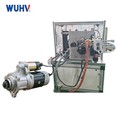
Winding resistance testing in short - circuited windings has a wide range of applications. For example, in the automotive industry, it can be used to test Starter Motor Test Bench. A short - circuit in the starter motor winding can cause the engine not to start or can lead to excessive battery drain.
In the power generation and distribution industry, winding resistance testing is crucial for transformers. A short - circuit in a transformer winding can lead to power outages and damage to the electrical grid. Our Winding Resistance Testers can quickly detect these short - circuits, allowing for timely maintenance and repairs.
In the relay protection field, Relay Protection Tester also needs accurate winding resistance measurements. A short - circuit in a relay coil can cause the relay to malfunction, which can have serious consequences for the protection of electrical equipment.
And for high - voltage testing, VLF AC Hipot Tester often work in conjunction with winding resistance testers. Before conducting a high - voltage test, it's important to ensure that the windings don't have any short - circuits. Otherwise, the high - voltage test can cause further damage to the equipment.
Why Choose Our Winding Resistance Testers?
Our Winding Resistance Testers stand out from the competition for several reasons. First of all, they're highly accurate. Thanks to advanced technology and precision components, our testers can provide reliable resistance measurements even in challenging environments.
Secondly, they're easy to use. We understand that not everyone is an electrical engineer, so we've designed our testers with user - friendly interfaces and clear instructions. You don't need to have a lot of technical knowledge to operate our testers effectively.
Finally, we offer excellent customer support. If you have any questions or run into any problems while using our testers, our team of experts is always ready to help.
If you're in the market for a reliable Winding Resistance Tester, whether it's for detecting short - circuits in windings or for other applications, don't hesitate to get in touch. We're here to provide you with the best products and services. Let's have a chat and see how we can meet your needs.
References
- Electrical Engineering Handbook, Third Edition
- Principles of Electric Circuits: Conventional Current Version, Tenth Edition