

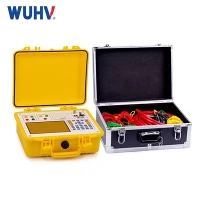


In the field of electrical insulation preventive testing, high voltage withstand testing stands as one of the most critical procedures. Among various methods, AC and DC withstand tests are commonly used, while AC testing further includes power frequency, variable frequency, and 0.1Hz Very Low Frequency (VLF) technologies. Recognizing the practical needs of China's power system, the National Development and Reform Commission (NDRC) has issued industry standards such as the "Test Method for Very Low Frequency (0.1Hz) Withstand Voltage of 35kV and Below XLPE Insulated Power Cables," followed by the 2004 industry standard "General Technical Conditions for VLF High Voltage Generators (DL/T 849.4-2004)." China is actively promoting this modern testing method.
For large electrical equipment such as generators, motors, and long power cables, power frequency withstand testing often encounters a major challenge: large capacitive loads. These loads demand bulky, heavy, and expensive test transformers or resonant transformers, making field testing inconvenient and costly. To overcome this limitation, the international power industry widely adopted frequency reduction to drastically lower the required power supply capacity. After years of theoretical and practical validation worldwide, the 0.1Hz VLF test has proven to be an effective and equivalent alternative to power frequency testing. It not only delivers comparable insulation stress results but also reduces the required power supply capacity to approximately 1/500 of that needed for power frequency tests. This dramatic reduction allows for significantly smaller, lighter, and easier-to-operate equipment, which explains its widespread adoption in developed countries.
Our company's next-generation VLF AC Hipot Tester leverages proprietary, state-of-the-art technology. VLF AC Hipot Tester features a 7-inch touchscreen interface, high-speed imported AD acquisition circuits, and advanced manufacturing processes. These innovations ensure excellent stability, reduce size and weight, and simplify operation-overcoming common shortcomings found in similar domestic products. In terms of cost-performance ratio, our VLF Hipot Tester far outperforms comparable imported mechanical voltage boosters, which often suffer from short service life, high failure rates, and bulky dimensions.
With years of field practice and extensive positive user feedback, our series of VVLF AC Hipot Testers has proven market-leading in technology and offers the highest value for investment. When compared to other withstand test methods, the 0.1Hz VLF approach demonstrates clear advantages: equivalent test effectiveness, lightweight portability, lower power requirements, and user-friendly operation-making it the ideal choice for modern insulation testing.


Product Features
1. Highly Intelligent Operation
The VLF AC Hipot Tester integrates advanced digital frequency conversion technology with a microcomputer control system. The entire testing process-including voltage boosting, voltage reduction, and measurement-is fully automated, minimizing the need for manual intervention.
2. User-Friendly Design
The VLF Hipot Tester features simple wiring requirements and a large 7-inch capacitive touchscreen. The user interface is intuitive and responsive, offering an excellent human-machine interaction experience for both novice and experienced operators.
3. Comprehensive Protection System
The VLF AC Hipot Tester incorporates multiple independent protection mechanisms, including overvoltage protection and both high-voltage and low-voltage side overcurrent protection. With an action time of ≤10ms, the VLF Hipot Tester ensures rapid response and reliable equipment safety under abnormal conditions.
4. Safe and Reliable Architecture
The VLF Hipot Tester separates the controller from the high-voltage generator, with low-voltage side connection and optical-electrical control. This design eliminates direct high-voltage exposure to the operator, making the VLF Hipot Tester exceptionally safe for field use.
5. No Capacitive Voltage Rise Effect
The VLF Hipot Tester employs a closed-loop negative feedback control circuit between the high-voltage and low-voltage sides. This advanced design effectively eliminates the capacitive voltage rise effect, ensuring stable and accurate output voltage.
6. High-Precision Sampling
The VLF AC Hipot Tester directly acquires high-voltage current and voltage data from the high-voltage side rather than through estimation or low-side calculations. As a result, the VLF Hipot Tester delivers genuine, accurate, and reliable measurement values.
7. Complete Configuration & Convenient Output
The VLF Hipot Tester comes equipped with a 7-inch capacitive touchscreen, Chinese and English LCD display, automatic data storage, and a built- automatic print function. This all-in-one configuration streamlines documentation and reporting.
8. Wide Test Frequency Range
The VLF Hipot Tester supports multiple output frequencies: 0.1Hz, 0.05Hz, 0.02Hz, and 0.01Hz. This wide frequency selection enables the VLF Hipot Tester to accommodate diverse testing requirements and large capacitance loads.
9. Extremely Portable
Thanks to its compact dimensions and lightweight construction, the VLF AC Hipot Tester is exceptionally easy to transport and operate in outdoor or confined-space environments-an ideal choice for field testing crews.
10. Multi-Language Interface
The VLF AC Hipot Tester offers built-in Chinese and English language switching as standard. Additional languages are available upon request, making the VLF AC Hipot Tester suitable for international applications and multinational teams.
Product parameters
|
Working power supply |
220V±5%,50/60Hz. Note: If a generator is used for power supply, it must be a digital inverter generator |
|
Output frequency |
0.1Hz, 0.05Hz, 0.02Hz, 0.01Hz |
|
Measurement accuracy |
3% |
|
Voltage positive and negative peak error |
≤3% |
|
Voltage waveform distortion |
≤5% |
|
Working environment |
Temperature: -10°C~+40°C |
|
Humidity |
≤85%RH |
|
Model |
Rated voltage |
Load capacity |
Power fuse |
Generator power |
Product structure, weight |
|
30/1.1 |
30kV(peak) |
0.1Hz, ≤1.1µF |
10A |
>3kW |
host:4kg,booster:25kg |
|
0.05Hz, ≤2.2µF |
|||||
|
0.02Hz, ≤5.5µF |
|||||
|
0.01Hz, ≤11µF |
|||||
|
40/0.8 |
40kV(peak) |
0.1Hz,≤0.8µF |
15A |
>4kW |
host:4kg,booster:25kg |
|
0.05Hz,≤1.6µF |
|||||
|
0.02Hz,≤4µF |
|||||
|
0.01Hz,≤8µF |
|||||
|
50/0.7 |
50kV(peak) |
0.1Hz,≤0.7µF |
20A |
>5kW |
host:4kg,booster:35kg |
|
0.05Hz,≤1.4µF |
|||||
|
0.02Hz,≤3.5µF |
|||||
|
0.02Hz,≤7µF |
|||||
|
60/0.6 |
60kV(peak) |
0.1Hz,≤0.6µF |
25A |
>6kW |
host:4kg,booster:45kg |
|
0.05Hz,≤1.2µF |
|||||
|
0.02Hz,≤3µF |
|||||
|
0.02Hz,≤6µF |
|||||
|
80/0.5 |
80kV(peak) |
0.1Hz,≤0.5µF |
30A |
>8kW |
host:4kg,booster:50kg |
|
0.05Hz,≤1.0µF |
|||||
|
0.02Hz,≤2.5µF |
|||||
|
0.01Hz,≤5µF |
|||||
|
90/0.4 |
90kV(peak) |
0.1Hz,≤0.4µF |
30A |
>9kW |
host:4kg,booster:55kg |
|
0.05Hz,≤0.8µF |
|||||
|
0.02Hz,≤2.0µF |
|||||
|
0.01Hz,≤4µF |
Application Scenarios Of VLF AC Hipot Tester
Medium and High Voltage Cable Testing
New cable installation commissioning – Verify insulation integrity after laying and before energizing.
Preventive maintenance testing – Detect insulation degradation, moisture ingress, or mechanical damage.
After-repair verification – Confirm successful repair of cable joints or terminations.
Cable aging assessment – Combined with Tan Delta (dissipation factor) measurement to evaluate remaining life.
Switchgear (RMU, AIS, GIS) Testing
Factory acceptance test (FAT) – Before leaving manufacturer.
Site acceptance test (SAT) – After installation, before commissioning.
Routine maintenance – Annual or biannual insulation check.
After fault clearance – Verify insulation is not compromised by arc flash or switching surges.
Generator and Large Motor Testing
After rewinding – Verify insulation quality of new windings.
During major overhaul – Detect slot discharge or delamination.
Preventive maintenance – Identify moisture absorption or contamination.
Commissioning of New MV/HV Installations
After cable laying and jointing – Before backfilling.
After backfilling – To check for mechanical damage.
Before energizing – Final insulation verification.
Before and after soak test – To detect any changes.
Fault Location (Pre-location and Pinpointing)
VLF + ARM (Arc Reflection Method)
VLF + IC (Impulse Current) method
VLF + Decay method
The 0.1 Hz frequency allows enough time for a fault to arc over, making it easier for reflectometers to locate the exact point.
FAQS:
Q: What is a VLF Hipot Tester?
A: A VLF (Very Low Frequency) Hipot Tester is a portable AC withstand voltage test instrument operating at frequencies between 0.01 Hz and 0.1 Hz. VLF AC Hipot Tester is mainly used for field testing of high-capacitance loads such as medium and high voltage power cables, switchgear, generators, and motors. Compared to 50/60 Hz test sets, VLF Hipot Tester require much lower input power and are significantly lighter and more portable.
Q: Why use VLF instead of DC Hipot for cable testing?
A: DC Hipot testing can cause space charge accumulation inside the insulation of extruded cables such as XLPE and EPR. Over time, this may lead to permanent damage or premature aging of the cable. In addition, DC stress does not represent the real AC stress that the cable experiences during normal operation.
VLF Hipot testing, on the other hand, applies an AC voltage at very low frequency, typically 0.1 Hz. This creates a stress distribution inside the insulation that is much closer to power frequency AC, while still significantly reducing the power and weight of the test equipment compared to a 50/60 Hz set.
For these reasons, VLF testing is recommended by IEEE 400.2 as the preferred method for field testing of medium and high voltage extruded cables. It is considered safe for XLPE insulation and does not reduce the remaining life of healthy cables. DC hipot is no longer recommended for routine field testing of service-aged XLPE cables in most international standards.
Therefore, for cable commissioning, maintenance, and diagnostic testing, VLF Hipot is the modern, safer, and more realistic alternative to DC Hipot.
Q: What is the typical test voltage for my cable?
A: According to IEEE 400.2 and IEC 60502 / 60840, the typical VLF test voltage (peak) is three times U₀, where U₀ is the phase-to-ground rated voltage.
For a 22 kV cable, U₀ is 12.7 kV, so the VLF test voltage is approximately 38 kVrms, which equals 54 kV peak. For a 33 kV cable, U₀ is 19 kV, so the VLF test voltage is approximately 57 kVrms, which equals 81 kV peak.
In practice, most customers choose a VLF Hipot Tester with a peak voltage rating of 55 to 60 kV for 22 to 24 kV system.
Q: Can I use the same VLF Hipot Tester for both cables and switchgear?
A: Yes, you can use the same VLF Hipot Tester for both cables and switchgear, provided the tester has sufficient voltage output. For a 22 kV cable, the requirement is approximately 55 kV peak. For a 24 kV switchgear, the phase to ground test requires approximately 50 kV peak, while the phase to phase test requires approximately 70 kV peak.
Therefore, a 70 kV peak VLF Hipot Tester covers both applications. However, when testing switchgear, you must remember to disconnect surge arresters, also known as SVL, and voltage transformers from the circuit before testing, as they may be damaged by the VLF voltage.
Q: Do I need to disconnect the cable from the switchgear before testing?
A: Yes, it is strongly recommended to disconnect the cable from the switchgear before testing. This allows you to isolate the test object and test each component separately. If you test the cable together with the switchgear, the test voltage must be limited to the lower withstand voltage of the two components, which may result in neither being fully tested. Additionally, surge arresters on the switchgear side may be damaged by the VLF voltage. Best practice is to test the cable and switchgear separately.
Q: Can VLF damage my good cables or equipment?
A: No, VLF testing is considered non-destructive when performed within the standard voltage and duration limits. Unlike DC hipot, VLF does not cause space charge accumulation inside the insulation. The insulation stress during VLF testing is similar to normal power frequency operation, just applied at a lower frequency. VLF testing does not shorten the remaining life of healthy cables. However, if the insulation already has severe defects, the cable may fail during the test. This is actually expected, because it identifies a problem before an in-service failure occurs, allowing you to repair or replace the cable proactively.
Q: What safety precautions are needed for VLF testing?
A: VLF AC Hipot Tester store high energy in the cable capacitance, so strict safety precautions are required. The tester must have a built in automatic discharge resistor to safely discharge the cable after each test. Proper grounding of the tester, the cable sheath, and the far end of the cable is essential. A remote control or safety interlock should be used to prevent accidental energizing. Warning signs must be placed at both cable ends during testing. Only qualified electrical engineers or technicians should operate the equipment, and they must use personal protective equipment including insulated gloves, insulated mats, and arc flash protection. Always verify that the cable is fully discharged before disconnecting the test leads.
Q: What is the difference between VLF Withstand test and VLF Tan Delta test?
A: A VLF withstand test is a pass or fail test. It simply applies the test voltage for a specified duration and checks whether the insulation breaks down. If there is no breakdown, the test is passed. This test tells you that the insulation is able to withstand the test voltage, but it does not tell you how good the insulation is.
A VLF Tan Delta test, on the other hand, is a diagnostic test. It measures the dielectric loss factor, also called Tan Delta, which gives a quantitative indication of insulation quality. A low Tan Delta value, such as 0.005, means the insulation is in excellent condition. A high Tan Delta value, such as above 0.010, indicates poor insulation that may need attention.
For new cables, a withstand test is usually sufficient. For aged cables or preventive maintenance programs, combining the withstand test with Tan Delta measurement gives much better insight into the actual condition of the insulation.
Q: How do I choose the right VLF AC Hipot Tester for my needs?
A: To choose the right VLF AC Hipot Tester, you need to consider several factors. First, what is the highest cable voltage you will test. For a 22 kV or 24 kV system, you need 55 to 70 kV peak. Second, whether you also need to test switchgear. If yes, choose 70 kV peak. Third, what is the cable length. For cables up to 5 kilometers, you need a tester with a load capacitance capacity of at least 1.0 microfarad. Fourth, whether you need Tan Delta measurement. If yes, choose a VLF Hipot Tester with integrated Tan Delta capability. Fifth, whether you need partial discharge measurement. If yes, choose a VLF Hipot Tester with PD option. Sixth, whether you will test cables above 66 kV. If yes, you need a 110 kV peak or higher tester.
For a typical 22 to 24 kV system, we recommend a 70 kV peak VLF hipot tester with 0.1 Hz output, load capacity of at least 1.0 microfarad, and optional Tan Delta. This covers both cable and switchgear testing.
Q: How long does it take to deliver a VLF AC Hipot Tester?
A: Delivery time depends on the model and your location. For a standard model, delivery takes 10~15 working days. For a customized model, such as one with higher voltage or special input power requirements, delivery takes 15~20 working days. International shipping adds an additional 10~15 days.
Hot Tags: vlf ac hipot tester, China vlf ac hipot tester manufacturers, suppliers, factory, vlf test kit, high voltage withstand test equipment, switchgear hipot test system, vlf cable testing, high voltage proximity tester, hipot tester with multi channel scanner
