

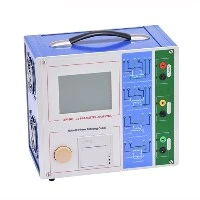
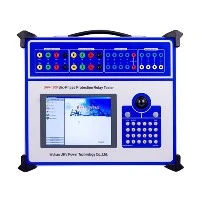
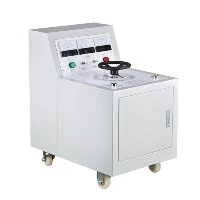
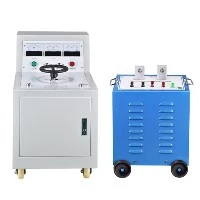
3 phase relay testers are specialized precision electronic instruments used to test and calibrate relay protection devices in power systems. Their core function is to simulate three-phase voltage and current signals under both normal operation and various fault conditions of a power system, and apply them to the relay protection device under test (such as overcurrent relays, differential relays, distance relays, directional relays, voltage/frequency relays, etc.). This verifies the accuracy and reliability of their operating characteristics, logic functions, settings, and operating times.
Key Selection/Usage Considerations
1.Output Capability:
Voltage: Output range (e.g., 0-300V L-N), accuracy, power rating (VA).
Current: Maximum output current (e.g., 30A, 60A, 120A) is one of the most critical indicators. Output power rating (VA, determines load driving capability), accuracy. Must meet the requirements of the relay's current circuits.
Power Amplifier Type: Linear amplifiers (high accuracy, low distortion, higher cost, larger size) vs. Switching amplifiers (higher efficiency, smaller size, lower cost, potentially slightly higher high-frequency distortion).
2.Accuracy: Measurement and output accuracy for voltage, current, phase angle, frequency, and time.
3.Channel Count: Number of independently controllable voltage and current output channels (e.g., 3V + 3I + 1V0 + 1I0).
4.Functionality: Support for required test types (e.g., harmonics, symmetrical components, state sequences, digital protocol testing).
5.Software: Ease of use of the interface, robustness of automated testing features, report generation capability, software updates, and support.
6.Portability & Durability: Weight, size, ruggedness of enclosure, suitability for field environments.
7.Brand & Support: Reputable brands (e.g., OMICRON, Megger, Doble, PONOVO, ONLLY, Huadian) often imply better quality, accuracy, and after-sales support.
8.Budget: Price range varies widely, from economical models to high-end systems.

The 3 phase relay tester is an indispensable core testing tool for power system protection engineering. By precisely simulating complex power system conditions and faults, it efficiently and comprehensively verifies the performance of protection devices. It is one of the key pieces of equipment for ensuring the safe, stable, and reliable operation of the power grid. Selecting the right tester requires careful consideration of output capability, accuracy, functional requirements, application scenarios, and budget. Strict adherence to safety operating procedures is mandatory during use.