

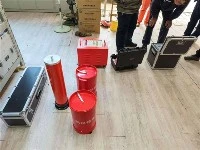


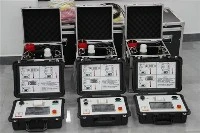
Application of frequency conversion series resonance in AC withstand voltage test of transformers? Wuhan UHV specializes in producing AC withstand voltage devices, with a wide range of product options. When looking for AC withstand voltage devices, choose Wuhan UHV.

In the preventive testing of power system handover, AC withstand voltage test is one of the strictest, most effective and direct test methods for identifying the insulation strength of power equipment. It has decisive significance in determining whether power equipment can continue to operate and is also an important means to ensure the insulation level of equipment and avoid insulation accidents. Although the AC withstand voltage test is effective in detecting insulation defects, it is limited by the test conditions and requires transformer withstand voltage tests of 35kV and 8000kVA or above. Due to the large capacitance current, the rated current of the high-voltage test transformer must be above 100mA. Currently, such high-voltage test transformers and regulators are not common enough. Often, the test voltage meets the requirements, but the test current cannot meet the requirements, and the capacity requirements of the test transformer are very large. The test equipment is bulky and inconvenient to transport, which brings difficulties to on-site testing. If conditions can be created to conduct AC withstand voltage tests on high-voltage and large capacity power transformers, it is of great significance to ensure the safe operation of transformers. The frequency conversion series resonance method introduced in this article can generate the required test voltage using equipment with much smaller voltage and capacity, meeting the test requirements.
principle
In the basic principle diagram of series resonance, the series circuit current is:

According to the different adjustment methods, series resonant devices are divided into two categories: power frequency series resonant devices (with adjustable reactors, or with fixed reactors and tuned capacitor banks, working frequency 50HZ) and variable frequency series resonant devices (with fixed reactors, working frequency generally 10Hz-300Hz).
According to the principle of series resonance, this test method utilizes high-voltage reactors and capacitors to generate high voltage and high current through resonance. In the entire system, the power supply only needs to provide the active consumption part of the system, and the required power supply for the test is only 1/Q of the test capacity. The required power supply capacity is greatly reduced, and the volume and weight of the test equipment are also greatly reduced; In the series resonance state, when the weak point of the insulation of the test sample is broken down, the circuit immediately loses resonance, and the loop current rapidly drops to 1/Q of the normal test current. Therefore, this method can effectively find the weak point of the insulation without the hidden danger of large short-circuit current burning the fault point; When the test sample breaks down, due to the loss of resonance conditions, the high voltage immediately disappears, the arc immediately extinguishes, and there will be no recovery overvoltage; The loop parameters are matched close to the power frequency, so this method has a significant suppression effect on high-order harmonics.
Conclusion
a. The use of frequency conversion series resonance withstand voltage test technology can complete tests that conventional transformers cannot solve.
b. The experimental capacity of the variable frequency series resonance method is greatly reduced, and the weight and volume of the equipment are also greatly reduced, making it more suitable for on-site testing.
c. The principle of variable frequency series resonance determines that this method has significant advantages in preventing large short-circuit currents from burning the fault point, avoiding any recovery overvoltage, and suppressing high-order harmonics.
d. Due to the variation of the test frequency of the variable frequency series resonant device with different capacitance of the test object, its application range is limited to a certain extent.