

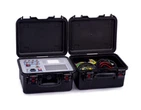
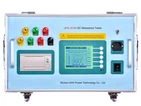


The Contact Resistance Tester under Wuhan UHV can help many power workers conduct various power tests more conveniently.

Determining the resistance of an electrical contact (commonly known as contact resistance) requires precise measurement because it is typically very small (on the order of milliohms or even microohms). Using a standard multimeter's resistance range directly is usually not accurate enough, for the following reasons:
1.Test Current Too Small: The test current from a standard multimeter's resistance range is very small (typically a few milliamps). This is insufficient to overcome the nonlinear effects (similar to a diode effect) caused by thin oxide or contamination films at the contact point, leading to significantly higher and unstable measured values.
2.Interference from Lead Resistance and Contact Resistance: The multimeter's own probe lead resistance and the contact resistance between the probes and the contact point itself are included in the measurement result. For low-resistance measurements, this interference can be much larger than the actual contact resistance.
Reliable Methods for Measuring Contact Resistance:
Here are several commonly used and more accurate methods:
1.Four-Wire (Kelvin) Measurement Method:
Principle: This is the standard method for measuring low resistances (< 1 Ω). It uses two pairs of wires:
One pair of current leads (C1, C2): Apply a constant, known test current (I) through the contact being measured. This current needs to be large enough (typically hundreds of milliamps to several amps) to overcome the nonlinear effects at the contact surface ("breaking through" the oxide film) and obtain a stable resistance value.
One pair of voltage leads (P1, P2): Used only to measure the voltage drop (V) across the contact points caused by the current flowing through the contact. Because the voltage measurement circuit has extremely high input impedance, the current flowing through the voltage leads is negligible. Therefore, the resistance of the voltage leads themselves and the contact resistance at the points where they touch the contact have virtually no effect on the voltage measurement.
Calculation: Calculate the contact resistance using Ohm's law: R_contact = V / I
Advantages: Completely eliminates the effect of lead resistance and voltage probe contact resistance on the measurement result, providing the highest accuracy.
Instrumentation: Requires a specialized micro-ohmmeter or low-resistance ohmmeter, or a digital multimeter (DMM) or LCR meter equipped with a four-wire measurement function. These instruments have built-in constant current sources and high-sensitivity voltmeters.
2.Using a Micro-Ohmmeter:
Principle: A micro-ohmmeter is essentially a dedicated instrument designed for four-wire low-resistance measurements. It integrates a constant current source and a high-precision voltmeter, displaying the resistance value directly.
Operation: Connect the instrument's four test leads (two pairs) to the two ends of the contact being measured as required (current leads on the outside, voltage leads on the inside, closest to the contact point).
Advantages: Simple operation, intuitive reading, high accuracy, and usually provides a stable test current.
3.Voltage Drop Method:
Principle: This is a simplified or variant of the four-wire principle, usable when a dedicated micro-ohmmeter is unavailable. Requires:
An adjustable DC power supply (capable of providing a sufficiently large, stable current, e.g., 1A, 10A, 100A - critical choice depending on contact type and expected resistance value!)
A high-precision millivoltmeter or a multimeter set to its millivolt range.
Advantages: Relatively easy to set up, potentially lower cost.
Disadvantages/Cautions:
Current selection is critical: The current must be large enough to overcome contact nonlinearity (typically much larger than a standard multimeter's current), but must not be so large as to cause the contact to overheat or even weld (extremely important!). Always refer to contact specifications or industry standards to select the appropriate test current (common standards include 10A, 20A, 100A, etc.).
Lead connections must be good, but the placement of the voltage measurement points is crucial – they must be as close as possible to the actual contact interface.
Accuracy depends on the precision of the current source and voltmeter.
4.Dedicated Contact Resistance Testers:
These are instruments specifically designed for measuring contacts in switches, relays, connectors, etc. They typically integrate four-wire measurement, selectable standardized test currents (e.g., 10A, 100A), and sometimes features like monitoring contact resistance over time. They offer the most convenient operation and results most compliant with relevant standards.
Summary:
To accurately measure tiny contact resistance, it is essential to use a test current large enough to overcome the nonlinear effects at the contact surface and eliminate the influence of lead resistance and measurement probe contact resistance. The Four-Wire (Kelvin) Measurement Method is the gold standard. Dedicated micro-ohmmeters or contact resistance testers are the best choices. Without specialized equipment, the carefully controlled Voltage Drop Method (using a high-current source and precision millivoltmeter) is a viable alternative, but exercise extreme caution in selecting and controlling the test current and prioritize safety. Cleaning contacts and controlling contact force are critical steps for obtaining accurate results.
The choice of method depends on your required accuracy, available equipment, and the type of contact and its expected resistance range. For critical applications or standard compliance testing, the use of a dedicated micro-ohmmeter or contact resistance tester is strongly recommended.