


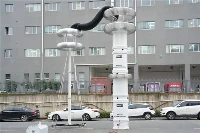

With the continuous expansion of the power system, there is an increasing demand for preventive testing of capacitive equipment such as high-voltage cross-linked cables, GIS composite appliances, and large generators. For test samples with large capacitance, traditional power frequency test transformers are difficult to meet the convenience and economic requirements of on-site testing due to the large required power capacity and bulky equipment. The variable frequency series resonance test device has become the mainstream choice for high capacitance load AC withstand voltage testing due to its unique advantage of "small power supply producing high voltage". However, how to scientifically select test samples with different voltage levels and capacitance is still a challenge faced by many power workers. This article combines the technical data and industry practice of Wuhan UHV to sort out the selection points of high capacitance load resonance testing system.

1, Clarify the characteristics of the test sample and lock in the two core parameters of voltage and capacity
The first step in selection is to clearly define the test object. High voltage power cables are typical large capacitance test samples, and their capacitance is proportional to their length. 10kV, 35kV, and 110kV long-distance cables have extremely high requirements for equipment capacity and resonant current. In addition, GIS, Large generators, main transformers, and other equipment also belong to capacitive loads, with different testing requirements.
The determination of voltage level is directly based on the rated voltage of the test sample and the requirements of the test procedure. The rated voltage range of Wuhan UHV series resonant device covers 25kV to 800kV, which can meet various test scenarios from distribution cables to ultra-high voltage GIS. The selection of capacity (kVA) requires calculating the reactive power demand based on the capacitance of the tested object and the test voltage. It is generally recommended to reserve a margin of 10% to 20% on the basis of the calculated value to cope with factors such as line losses and temperature drift. The rated capacity of Wuhan UHV equipment covers from 75kVA to 10000kVA and supports flexible customization.
2, Pay attention to frequency regulation range and reactor configuration
The resonant frequency is determined by the inductance L of the reactor and the capacitance C of the test sample (f=1/2 π√ LC). For high capacitance loads, if the inductance of the reactor is fixed, the resonant frequency may be lower than the standard allowable range. Therefore, when selecting, it is important to focus on two dimensions:
One is the frequency adjustment range. The operating frequency of the Wuhan UHV series resonant device is 30 to 300Hz, covering the frequency requirements of the majority of power equipment withstand voltage tests. For frequency sensitive samples such as transformers, the test frequency usually needs to be controlled in the vicinity of the power frequency range of 45 to 65Hz. At this time, the device is required to have fine frequency adjustment resolution, generally within 0.1Hz. Wuhan UHV adopts a dual chip architecture of DSP+FPGA, which calculates the load capacitance change in real time through dynamic frequency tracking algorithm, and the resonance frequency error can be controlled within ± 0.05Hz.
The second is the series parallel combination capability of the reactor. For long-distance cables and other large capacitance specimens, it is necessary to increase the current output capacity and reduce the equivalent inductance by paralleling reactors to maintain the resonant frequency within the compliant range. The modular design of the reactor combination scheme can cover a wider range of capacitors through the series parallel combination of reactors with different quantities and parameters. The Wuhan UHV device adopts modular design, with light weight per piece, making it easy to transport and assemble on site.
3, Evaluate environmental adaptability and intelligence level
The withstand voltage test of high capacitance loads is often conducted outdoors in complex environmental conditions. When selecting, adaptability indicators such as the working environment temperature range, humidity, and altitude of the device should be considered. The working environment temperature of Wuhan ultra-high voltage series resonant device is -10 ℃ to 40 ℃, relative humidity ≤ 90% RH, and altitude ≤ 3000m. It has a built-in temperature and humidity adaptive algorithm, which can maintain data stability in extreme environments of -20 ℃ to 50 ℃.
The intelligent control function cannot be ignored either. A device with automatic tuning, automatic boosting, data recording and export functions can significantly improve test efficiency and reduce human operation risks. The Wuhan UHV device adopts DSP platform technology, which has multiple protection functions such as overvoltage, overcurrent, zero start, system detuning (flashover), etc. The protection action time is only 1 microsecond. The device supports three working modes: fully automatic, manual, and automatically tuned manual boost, making it convenient for users to flexibly choose according to the on-site situation.
4, Customization ability becomes the key to differentiated selection
With the increasing trend of non standardization in power equipment, universal series resonant devices are often difficult to accurately match the on-site working conditions. Whether it is cable testing for special voltage levels, GIS withstand voltage in complex environments, or data interfaces that require integration with existing testing management systems, customization capability has become an important indicator for selection decisions.
Manufacturers with independent research and development capabilities can provide deep customization services in hardware modification and software adjustment. The series resonance device of Wuhan UHV adopts a DSP digital signal processing platform, and the frequency modulation, voltage regulation, and protection logic are all implemented through software. The parameters such as boost timing and holding time can be adjusted according to the user's test process. Its modular design also provides convenience for customized combinations. The main parameters such as rated capacity, rated voltage, and rated current of the device can be customized according to user needs.
To select a suitable resonance testing system for high capacitance loads, it is necessary to consider multiple dimensions such as voltage level, capacity matching, frequency regulation range, reactor configuration, environmental adaptability, intelligence level, and customization ability based on the characteristics of the test object. Wuhan UHV, as a professional manufacturer in the field of series resonance test equipment, can provide power cables GIS, Provide targeted testing solutions for various high capacitance test samples such as generators. With the continuous growth of demand for power grid construction and new energy grid integration testing, scientific selection and precise matching will become the key to ensuring test safety and efficiency.