

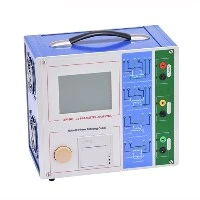
Is it safe to use Mutual Inductor CT PT Characteristic Tester on live systems?
Absolutely not! It is strictly prohibited to use such testers on live Current Transformers (CTs), Voltage Transformers (VTs), or their secondary circuits.

Reasons and Detailed Explanations:
1.Tester Design Requires De-energization:
Volt-Ampere Testing: Requires applying adjustable AC voltage to the secondary winding to measure excitation current. This demands complete isolation of the secondary winding from all other circuits (protection relays, meters, grounds, etc.) with no primary current flow. Live systems cannot satisfy this.
Ratio Testing: Involves injecting a known test current/voltage into the secondary side and measuring the induced value on the primary/auxiliary side. This also requires the transformer to be offline and isolated, with no operational current/voltage on the primary.
Polarity Testing: Typically applies an instantaneous DC or low-frequency AC signal to one side to observe the response direction on the other. Performing this on live systems is extremely hazardous, risking protection maloperation, equipment damage, or ferroresonance (for VTs).
2.Critical Hazards of Live Operation:
CT Secondary Open-Circuit (Extremely Dangerous):
Any connection/disconnection to CT secondary circuits while energized can cause open-circuits.
An open-circuited CT generates kilovolts (even tens of kV) of lethal voltage, risking fatal electric shock, destruction of test equipment/protection relays, and fire.
Primary High Voltage Intrusion (VTs):
Incorrect wiring or operation may introduce primary high voltage into low-voltage secondary circuits, causing equipment damage or electrocution.
Ground Fault Risks:
Live wiring increases risks of accidental contact, short circuits, or ground faults.
Interference with Operational Systems:
Injected test signals may disrupt protection/control systems, causing:
Protection Relay Maloperation: Unnecessary outages.
Protection Failure: Inability to respond to actual faults.
Measurement Errors: Skewed metering/monitoring.
Violation of Safety Codes:
All electrical safety regulations (e.g., IEEE, NFPA 70E, IEC 60364) mandate complete isolation (primary/secondary) of equipment under test, with verified de-energization, grounding, and safety boundaries. Live work violates these codes.