

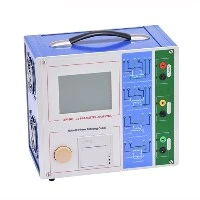
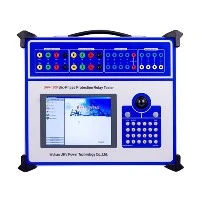
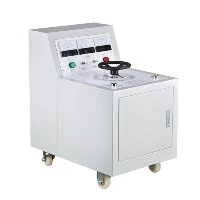
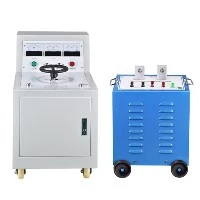
Yes, the test results of a Vacuum Switch Vacuum Tester are affected by ambient temperature. This is a crucial factor that must be considered during testing and when interpreting results.

The main mechanisms and reasons for this influence are as follows:
1.Gas Molecular Thermal Motion:
The vacuum degree inside a vacuum interrupter essentially measures the quantity of residual gas molecules.
According to the kinetic theory of gases, the average kinetic energy of gas molecules is proportional to the absolute temperature. As temperature increases, gas molecules move faster, and collisions become more intense.
In the magnetron discharge method (the most common principle for vacuum testing today), the tester applies a high-voltage electric field and an axial magnetic field between the contacts of the interrupter. Residual gas molecules are ionized in this strong electromagnetic field, forming a discharge current (ion current).
Higher temperatures cause faster molecular motion. Under the same electric and magnetic field conditions, the probability of molecules being ionized increases, resulting in a larger measured ion current. This leads the tester to misinterpret that the vacuum degree has deteriorated (i.e., more residual gas is present).
2.Thermal Expansion and Contraction of Materials:
Although the effect is relatively minor, changes in ambient temperature also cause slight thermal expansion and contraction of internal metal components (like shields, bellows, contacts) and ceramic/glass insulating envelopes within the interrupter.
These minute dimensional changes can potentially alter the internal electric field distribution or electrode spacing very slightly, thereby weakly affecting the discharge characteristics.
3.Temperature Characteristics of the Tester Itself:
The performance parameters (such as gain, zero-point drift) of electronic components inside the tester (e.g., amplifiers, AD converters) may also drift slightly with changes in ambient temperature, introducing some measurement error. However, temperature drift in modern, high-quality instruments is usually designed to be small.