

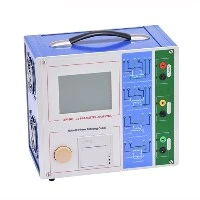
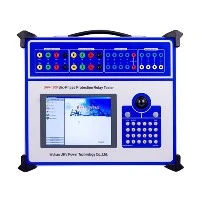
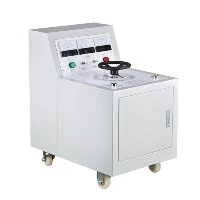
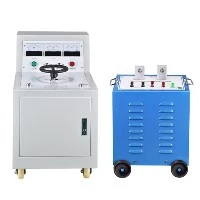
A PD Free AC Series Resonant Test System is a specialized high-voltage testing setup designed for partial discharge (PD) detection and measurement in electrical equipment, with a focus on minimizing external interference to ensure accurate results.

Core Concept: Series Resonance
Principle: It utilizes an LC series resonant circuit:
L: Variable inductor (reactor).
C: Capacitance of the test object (e.g., power cable, transformer, GIS, capacitor).
At the resonant frequency (f_r = 1 / (2π√(LC))), the inductive and capacitive reactances cancel each other. Only the resistive component of the circuit limits the current.
Power Source: A variable frequency power supply (VFPS) drives the circuit. The frequency is adjusted to match the resonant frequency of the specific test object.
Key Feature: "PD Free"
Minimized Interference: The primary goal is to provide a clean, low-noise high-voltage AC source for sensitive PD measurements.
Achieved By:
High-Q Resonance: At resonance, the system draws minimal current from the supply to generate very high voltages across the test object. This inherently reduces stress and noise generation in the supply components.
Controlled Waveform: Modern VFPS units generate near-sinusoidal waveforms with very low distortion (<1% THD), minimizing harmonics that can mask or mimic PD signals.
Shielding & Filtering: The entire system (especially reactors, coupling capacitors, measurement circuits) is heavily shielded and incorporates sophisticated filtering to suppress external electromagnetic interference (EMI) and radio frequency interference (RFI).
Dedicated Grounding: Strict single-point grounding practices are followed to prevent ground loops, a major source of noise.
Low-PD Components: Components like reactors, HV leads, and coupling capacitors are specifically designed and tested to have extremely low inherent partial discharge levels.
Advantages
Accurate PD Measurement: The "PD Free" design provides the ultra-low-noise environment essential for reliable detection and location of small PD signals within the test object.
High Efficiency: Requires only 1-5% of the apparent power (kVA) needed by a conventional 50/60Hz test transformer to generate the same test voltage. Significant energy savings.
Compact & Lightweight: Much smaller and lighter than equivalent kVA-rated 50/60Hz test transformers, improving portability.
Precise Voltage Control: Stable sinusoidal voltage output, easily adjustable.
Gentle on Test Object: Low inherent system PD and clean waveform minimize stress on the DUT's insulation during testing.
Ideal for High Capacitance Loads: Perfectly suited for testing long power cables, GIS, large capacitors, and generators.