

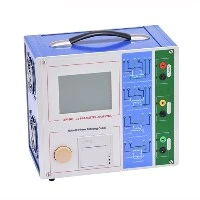

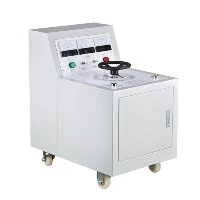
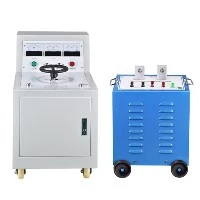
Simulation of series resonant circuit? Wuhan UHV specializes in the production of series resonance, with a wide range of product selection and professional electrical testing. To find series resonance, choose Wuhan UHV.

Series resonant circuit
In an AC circuit with resistor R, inductor L, and capacitor C components, the voltage at both ends of the circuit is generally different in phase from the current in it. If the parameters or power frequency of circuit components (L or C) are adjusted, they can be made to have the same phase, and the entire circuit appears purely resistive. When a circuit reaches this state, it is called resonance. In the resonant state, the total impedance of the circuit reaches or approximates its maximum value. There are two types of circuit connections: series resonance and parallel resonance. Science and applied technology should fully utilize the characteristics of resonance while also preventing the harm it may cause.
Characteristics of series resonant circuit:
a. The circuit impedance Z is the smallest and pure resistance, and Z=R
b. The current I in the circuit reaches its maximum value and is the same as the power supply voltage
The current that occurs when a circuit undergoes series resonance is called the resonance current, represented by Io. When the power supply voltage is constant:
It can be determined whether series resonance has occurred based on whether the current of the RLC series circuit has reached its maximum.
c. The voltage on L and C is equal in magnitude, opposite in direction, and cancels each other out
Therefore, series resonance, also known as voltage resonance, has an equivalent impedance of 0 at both ends of the inductor and capacitor during resonance, which is equivalent to a short circuit.
d. The voltage on the resistor is equal to the power supply voltage and reaches its maximum value.
e. Power
Active power: The power generated by the power source and the power consumed by the circuit resistance, with the maximum power
Reactive power: During resonance, the circuit does not absorb reactive power from the outside. But there is a periodic exchange of magnetic field energy and electric field energy between the inductance and capacitance inside the circuit.
Simulation of series resonant circuit
In a series circuit composed of resistors, inductors, and capacitors, when the capacitive reactance XC is equal to the inductive reactance XL, i.e. XC=XL, the phase of the voltage U and current I in the circuit are the same, and the circuit exhibits pure resistive behavior. This phenomenon is called series resonance. When a series resonance occurs in a circuit, the impedance of the circuit Z=√ R ^ 2+(XC-XL) ^ 2=R, the total impedance in the circuit is minimized, and the current will reach its maximum value.
1. Create a series resonant circuit. Select a voltage source, resistor, capacitor, and inductor from the component library to form a series resonant circuit. Choose the frequency characteristic meter XBP1 and connect its input terminal to the power supply and output terminal to the load.
2. Phase frequency characteristics of a series resonant circuit: Click the Phase button in the Mode option group to obtain the phase frequency characteristics of the circuit.
3. From the phase frequency characteristics of the series resonant circuit, it can be seen that the circuit is divided by the resonant frequency f0. When the signal frequency is lower than f0, the phase leads; When the signal frequency is higher than f0, there is a phase lag. Because when the signal frequency is lower than f0, the entire circuit is capacitive, and the current phase (voltage phase on the load resistor) leads the voltage phase (external power supply); When the signal frequency is higher than f0, the entire circuit becomes inductive, and the current phase (voltage phase on the load resistor) lags behind the voltage phase (external power supply). The simulation results are consistent with the theoretical analysis.
4. The relationship between the quality factor Q value of a series resonant circuit and the selectivity of the circuit: while keeping the series resonant frequency constant, i.e. L and C, changing the component parameters can change the quality factor Q value of the circuit. In the circuit, R=1 k Ω, L=1 H,C=1 μF, If Q=[1RLC=1,], and capacitance C1=1 μ F, inductance L1=1 H, and resistance R1=100 Ω are selected, then Q=[1RLC=10,]. For RLC series resonant circuits, different Q values correspond to different amplitude frequency characteristic curves. The larger the Q value, the sharper the corresponding amplitude frequency characteristic curve, and the better the selectivity of the circuit. If a series selection circuit is used as a radio detection circuit, its sensitivity is higher and its anti-interference ability is lower; The smaller the Q value, the blunter the corresponding amplitude frequency characteristic curve, and the selectivity of the circuit deteriorates. If used as a radio detection circuit, its sensitivity decreases, but its anti-interference ability will be improved. Therefore, the Q value of the series resonant circuit should be selected according to the specific application situation.