

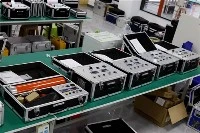
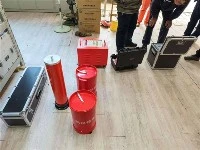

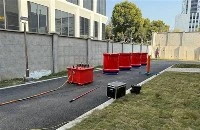
Variable frequency series resonance test device? Wuhan UHV specializes in the production of series resonance, with a wide range of product selection and professional electrical testing. To find series resonance, choose Wuhan UHV.

The variable frequency series resonance test device applies the principle of series resonance, uses an excitation transformer to excite the series resonance circuit, adjusts the output frequency of the variable frequency controller, and causes the circuit inductance L and the test sample C to resonate in series. The resonance voltage is the voltage applied to the test sample. The frequency conversion resonance test device is widely used in industries such as power, metallurgy, petroleum, and chemical engineering, and is suitable for the handover and preventive testing of high-capacity, high-voltage capacitive specimens.
The variable frequency series resonance test device mainly consists of a variable frequency controller, excitation transformer, high-voltage reactor, high-voltage voltage divider, etc. Variable frequency controllers are divided into two categories: desktop controllers with 20KW and above, and portable box controllers with 20KW and below; It consists of a controller and a filter. The main function of a variable frequency controller is to convert a 380V or 200V AC power frequency sine wave with fixed amplitude and frequency into a sine wave with adjustable amplitude and frequency. And provide power for the entire equipment. The function of the excitation transformer is to raise the voltage output by the variable frequency power supply to the appropriate test voltage. The high-voltage reactor L is an important component of the resonant circuit. When the power frequency is equal to 1/(2 π√ LCX), it undergoes series resonance with the test sample CX.
The variable frequency series resonance test device is suitable for AC withstand voltage testing of 10KV, 35KV, 110KV, 220KV, and 500KV polyethylene power cables. Suitable for AC withstand voltage testing of 60KV, 220KV, and 500KV GIS. Suitable for power frequency withstand voltage testing of large transformers and generator sets; Induction withstand voltage test for power transformers; Measurement of grounding resistance.
Working principle of frequency conversion series resonance test device
By adjusting the output frequency of the variable frequency controller, resonance occurs between the inductance L of the reactor in the circuit and the capacitance C of the test sample, and the resonance voltage is the voltage applied to the test sample. The power supply is provided through the frequency modulation controller, and the test voltage is initially boosted by the excitation transformer to apply high voltage to the reactor L and the test sample CX. By changing the output frequency of the frequency modulation controller, the circuit is in series resonance state; The resonant frequency of the circuit depends on the capacitance CX of the test sample and the inductance L of the reactor. Adjust the output voltage of the variable frequency controller to achieve the required voltage value of the high voltage on the test sample.
Characteristics of Variable Frequency Series Resonance Test Device
1. High stability and reliability. The system adopts imported power components as the core of power conversion, with stable voltage and frequency output, reasonable electromagnetic compatibility design, and complete protection functions. After multiple high-voltage direct to ground short circuit tests, the system still remains intact, and at the same time, the system also has strong overload capacity
2. The automatic tuning function is powerful. When the system is automatically tuned, it automatically scans from 30Hz to 300Hz and displays the sweep curve, allowing users to intuitively see the tuning process of the system; After the frequency sweep is completed, the system performs a fine frequency sweep with a resolution of 0.01Hz within its ± 5Hz range based on the resonance frequency point preliminarily found by the sweep, and finally precisely locks the resonance frequency
3. Support multiple experimental modes. The system supports test modes such as "automatic tuning+manual voltage regulation", "automatic tuning+automatic voltage regulation", "manual tuning+manual voltage regulation", etc. It is recommended to use the "automatic tuning+manual voltage regulation" mode, which can quickly find the resonance point and control the test process through manual voltage regulation, with higher safety
4. The system has a user-friendly human-computer interaction interface. The experimental parameter settings, experimental control, and experimental results are displayed on the same screen, which is intuitive and clear, and has automatic timing and operation prompt functions. Full touch screen operation and display, with the function of saving and querying test data
5. The protection function is complete. Equipped with zero position protection (prohibiting system startup when the voltage output control knob is not in zero position), overvoltage protection, overcurrent protection, flashover protection and other functions, ensuring the reliability of the system