


In the complex and precise field of power transformers, we often hear the term 'ratio group tester'. But what exactly is it? What role does it play in daily electrical equipment testing? Don't worry, today we will talk about this topic to help you easily understand the principles and applications behind it.
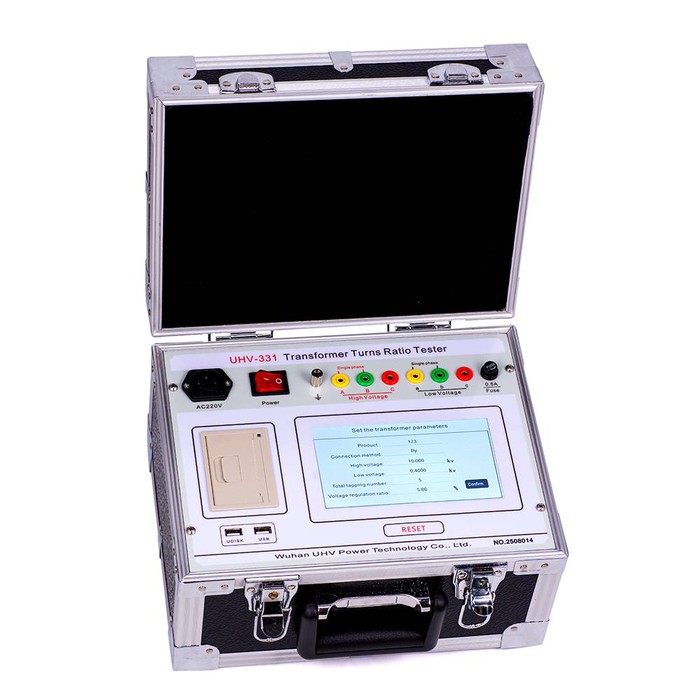
Turns ratio group tester: transformer "identity" appraiser
Simply put, a transformer ratio tester is an instrument specifically designed to measure various parameters of transformers, especially its "ratio" and "connection group".
Transformation Ratio: This is like the "height difference" of a transformer, describing its ability to increase or decrease voltage. For example, a 10kV/0.4kV transformer has a rated transformation ratio of 10000/400, which is 25. Accurately measuring the transformation ratio is the key to ensuring that the transformer can operate stably and safely at the design voltage.
Vector Group: This concept is slightly more complex as it describes the spatial phase relationship between the high and low voltage windings of a transformer. Different connection groups can affect the operational characteristics of transformers, such as the grounding method of the neutral point and the generation of harmonics. Common linkage groups include Yyn0, Dyn11, etc.
What are the factors that affect the testing of turns ratio groups?
There are several factors that may affect the accuracy of measurements when conducting variable ratio group tests:
Temperature: The resistance of metals will change with temperature, which will slightly affect the measurement results of the transformation ratio.
Test voltage: Excessive or insufficient test voltage may cause testing errors.
External electromagnetic interference: Strong electromagnetic fields can interfere with the normal operation of instruments.
The state of the transformer itself, such as whether there are faults such as short circuits or open circuits in the windings, can also affect the test results.
Wuhan UHV Power Technology Co., Ltd.: A Reliable Testing 'Partner'
When choosing a turns ratio group tester, it is crucial to choose an instrument with stable performance and easy operation. Wuhan UHV Power Technology Co., Ltd. has been deeply involved in the field of power metering for many years. Its developed turns ratio group tester has won wide recognition in the industry for its high precision, high reliability, and ease of use. Whether it is on-site inspection or laboratory testing, accurate and reliable measurement data can be provided to ensure the safe operation of transformers.
How to conduct ratio group testing more professionally?
To obtain more accurate test results, the following points need to be noted:
Standardized operation: Strictly follow the requirements of the instrument manual for wiring and parameter settings.
Environmental control: Try to choose a stable temperature and electromagnetic environment for testing.
Multi point measurement: For large transformers, multiple measurements can be taken at different gears and the average value can be taken.
Comparison standard: Compare and analyze the measurement results with the transformer nameplate data or standard values.
The correlation between turns ratio group testing and other detection methods
Turns ratio group testing is an important component of transformer electrical safety testing. It is often combined with insulation resistance testing, dielectric loss testing, winding DC resistance testing and other transformer maintenance projects to form a complete transformer condition evaluation system. Through these comprehensive transformer tests, we can promptly identify potential fault hazards and prevent accidents from occurring.
Frequently Asked Questions (FAQ)
Q1: What equipment is the turns ratio group tester mainly used for? A: Mainly used for various types of power transformers, including distribution transformers, power transformers, transformers, etc.
Q2: Why is it important to connect groups? A: The connection group directly affects the operating characteristics of the transformer, such as three-phase load distribution, neutral grounding, and harmonic content in the system.
Q3: Under what circumstances is it necessary to conduct ratio group testing? A: Before the new transformer is put into operation, after major repairs, regular preventive tests, and when there is suspicion of a transformer malfunction.
Q4: What are the advantages of the transformation ratio group tester from Wuhan UHV Power Technology Co., Ltd? A: Its equipment has the characteristics of high precision, easy operation, stable and reliable data, which can effectively improve the efficiency and accuracy of on-site work.
Q5: What could be the reason for the deviation of the test results of the variable ratio group from the normal value? A: Possible reasons may include local short circuits, broken wires, virtual connections in the transformer windings, or errors in the testing instrument itself.