

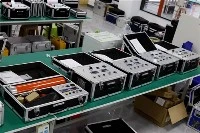



Although the basic principle is the same (Ohm's Law) when measuring resistance, a Transformer DC Resistance Test Set (often called a "DC low-resistance tester" or "micro-ohmmeter") and the resistance range of an ordinary multimeter are vastly different in terms of design purpose, measurement capability, accuracy, and application scenarios.

1. Core Principle and Test Current
Ordinary Multimeter Resistance Range:
Uses a very small test current, typically in the milliampere (mA) or even microampere (μA) range.
It provides a constant voltage or current, measures the current through or voltage drop across the device under test (DUT), and then calculates the resistance value.
Advantage: Power-saving, safe, suitable for measuring various common resistors.
Transformer DC Resistance Test Set:
Uses a relatively large DC test current, typically from 1A to 100A or even higher.
It applies a stable, high current, precisely measures the voltage drop across the DUT, and then calculates the resistance value using Ohm's Law (R=U/I).
Why use a high current? To overcome the effects of contact resistance and thermoelectric EMF (electromotive force). When measuring resistances in the micro-ohm range, the contact resistance from leads and clamps (which can also be in the milliohm range) and the thermocouple effect (microvolt-level voltage) generated by dissimilar materials can severely interfere with the measurement results. The voltage drop (millivolt level) generated by the high current far exceeds these interference signals, thus allowing for an accurate reading of the true resistance value.
2. Measurement Range and Accuracy
Ordinary Multimeter:
Measurement Range: Usually from a few ohms to several megaohms. Although many meters also have a "milliohm" range, the accuracy is very poor and basically unreliable.
Accuracy: Acceptable in the conventional range (Ohms to kiloohms), usually around ±(0.5% + 2 digits). However, in the low resistance range, the error can be very large, and the reading may not even be stable.
Transformer DC Resistance Test Set:
Measurement Range: Specifically designed for low-value resistances. The typical range is 1μΩ to a few kΩ, with its core accurate range being 1mΩ to 10Ω.
Accuracy: Extremely high. Accuracy can reach ±(0.1% + 2 digits) or even higher. It can stably distinguish differences of 1 microohm (0.000001Ω).