


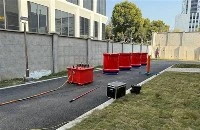
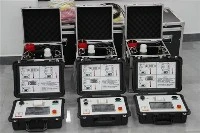
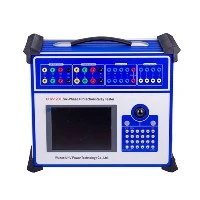
Variable frequency series resonant device? Wuhan UHV specializes in producing variable frequency series resonant devices, with a wide range of product selection and 15 years of professional electrical testing experience. When looking for a variable frequency series resonant device, choose Wuhan UHV.
The variable frequency series resonance device is a series resonance principle applied to Wuhan UHV. It uses an excitation transformer to excite an LC series resonance circuit. By adjusting the variable frequency controller, the inductance L (reactor) and capacitance C (test sample) in the circuit resonate in series, and the resonant voltage generated is the voltage applied to the test sample. Series resonance is often used in the withstand voltage test of high-capacity, high-voltage specimens in industries such as power and metallurgy.

Wuhan UHV has been producing and selling frequency conversion series resonant devices for many years. Occasionally, customers call us to request after-sales service, but there are very few actual instrument failures. Most of them are due to improper connection of the device, which results in the inability to boost or the boost cannot meet the requirements. Due to the fact that the variable frequency series resonance device uses the principle of series resonance, which most people are not familiar with, we will use technical principles to analyze these possible problems in order to provide correct solutions and enable more people to understand series resonance, so that Huatian Power's variable frequency series resonance device can better serve customers.
Series resonance requires three conditions to be met: frequency, capacitance, and reactance. Only when these three factors meet certain requirements can resonance occur, resulting in resonance voltage on the test sample (capacitor C). Prior to the emergence of variable frequency series resonant devices, voltage withstand tests were mostly conducted using test transformers or DC high-voltage generators, both of which used a direct output voltage mode and did not require resonance. As long as the output voltage of the test transformer reached the required voltage, it was relatively simple. However, due to limitations in technology and capacity, test transformers were unable to withstand large capacity and high voltage samples, and the volume and weight of large capacity test transformers were relatively bulky, making them inconvenient for on-site use.
During the experiment, we must ensure that the test sample (capacitor C) and our combined reactor (inductor L) can resonate within the frequency range of 30-300HZ. The variable frequency series resonant devices produced by our company are customized according to customer needs. Generally, the combination of reactors and the selection of output voltage of the excitation transformer for the test samples requested by customers have configuration plans in the instruction manual. If testing the customized test samples, you can directly refer to the plan for testing. If it is a non protocol sample, some simple calculations are required. Firstly, we need to calculate the current required for the experiment:
I=2 π fCU (C is the capacitance of the test sample, U is the test voltage)
Then combine the reactor based on the test voltage U and test current I. The principle of combining reactors is to keep the series current constant and add the voltages together; Parallel voltage remains constant, current is added together. We can connect the reactors in series, parallel, or a combination of series and parallel to ensure that the rated voltage and current meet the requirements of the test voltage U and test current I. Calculate the combined inductance L based on the combined reactors, and then use the following formula to calculate:
f=1/2π
If f is within the range of 30-300Hz, we can tentatively assume that the instrument can resonate and the experiment is likely to be completed. (All calculations are theoretical values, which are also influenced by quality factors, etc.)
The above is a simple calculation and solution to prevent the problem of inability to boost voltage caused by the mismatch between the series resonant device and the test sample combination. Only by ensuring that the theoretical values calculated meet the requirements after calculation can we guarantee the success of our experiment.
Of course, not all failures to boost voltage are caused by matching combination problems, and there may also be issues with the device and the test sample itself. So when we calculate that the resonant test requirements are met, but the instrument cannot perform voltage boosting, we need to determine whether it is a problem with the series resonant device or the test sample. At this point, we can use a series resonant device for self boost testing. The variable frequency series resonant device produced by Huatian Power can also perform self boost operation without a test sample (capacitor C), using compensation capacitors (which may contain) or capacitive voltage dividers combined with reactors. This operation mainly checks whether each part of the series resonant device can work normally. If the series resonant device still cannot self boost after correct combination and wiring, it indicates that the device has malfunctioned and needs to be returned to the factory for maintenance. If the series resonant device can work normally, it can be preliminarily judged that the equipment is not faulty, and the customer needs to check whether the test sample has wiring or inherent problems.
Due to the fact that the variable frequency series resonant device is a recently emerged voltage resistant device, its operating principle is not easy to understand. In addition, the series resonant device is composed of a variable frequency source, a reactor, a voltage divider, an excitation transformer, a compensation capacitor, etc., which is relatively complex. There are also many possible reasons for the problems that may occur, and we cannot list them all here. The above solutions are only for common problems. If you still cannot solve them, you can call the after-sales hotline and seek professional technical guidance from Wuhan UHV.