

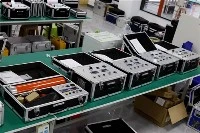
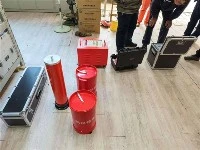

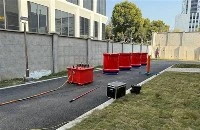
The series resonant circuit is excited by the excitation transformer through the principle of series resonance. The induction L (reactor) and capacitor C (sample) in the circuit are connected in series resonance by adjusting the frequency converter controller.
Series resonance requires three conditions: frequency, capacitance, and reactance. When these three factors reach a certain relationship, resonance may occur, resulting in a resonance voltage (capacitance C) on the test sample. Due to the fact that the voltage test of the test transformer or DC high voltage generator is conducted before the frequency conversion series resonance test group, both devices do not require resonance. As long as the output voltage of the test transformer reaches the required voltage, it is relatively simple. However, due to technical and capacity limitations, the test transformer cannot withstand the voltage of the high voltage test sample. The volume and weight of the large capacity test transformer are relatively heavy, making it inconvenient for on-site use.

(C is the capacitance of the test sample, U is the test voltage)
Then, based on the test voltage U and test current I, the reactor is combined. The principle of reactor combination is to keep the series current constant and add the voltages together; The parallel voltage remains unchanged, and the current is added together (the reactors are the same, and the rated voltage and rated current are indicated on the nameplate). We can perform series parallel or mixed series parallel combinations on the reactors to ensure that the rated voltage and rated current meet the requirements of the test voltage U and test current I. The combined inductance L is calculated by the combined reactor, and then calculated using the following formula:

If f is within the range of 30-300Hz, we can preliminarily assume that the instrument can resonate and the test is likely to be completed (calculations are theoretical and also affected by quality factors)

The above is a simple calculation and solution for preventing pressure rise caused by the mismatch between the series resonant device and the specimen combination. Only through simple calculations can the theoretical values meet the requirements and ensure the success of the experiment.
Of course, not all failures that increase pressure are caused by matching combination problems, and there may be issues with equipment and test item capabilities. Therefore, when we calculate that the resonance test requirements are met and the instrument cannot be raised, we need to determine whether it is a series resonance device or the test object. At this time, we can use a series resonance device for self raising tests. The series resonance device can also be operated by compensating capacitors (which may contain) or capacitive voltage dividers combined with reactors without samples (capacitance C). This operation mainly checks whether the various parts of the series resonance device can work normally. If the series resonance device cannot be self raised with correct combination and wiring, the equipment needs to be returned to the factory for maintenance. If the series resonant device can work normally, it can be preliminarily judged that there is no fault in the device. Users need to check whether the test sample has wiring or self problems.
Due to the recent emergence of voltage resistant devices, the principle of series resonance is also less common. Series resonance is composed of a variable frequency source, a reactor, a voltage divider, an excitation transformer, a compensation capacitor, etc. It is more complex and may have multiple causes of problems. We cannot list them here, but only provide one common problem. If it cannot be resolved, you can call after-sales service and we will provide professional technical guidance.