



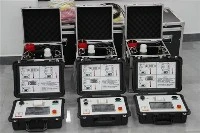
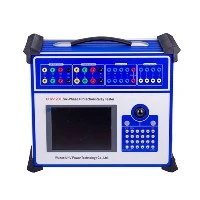
Wuhan UHV specializes in producing series resonance (also known as series resonance cable withstand voltage). Next, we will share with you the conditions and quality factors for achieving series resonance.

Under normal circumstances, the inductance and capacitance of the circuit are much greater than the resistance component, so the voltage on the capacitor (test sample) and inductor is much higher than the power supply voltage. Therefore, series resonance is also known as voltage resonance. Its voltage value is X/R (X/R) times the power supply voltage. This ratio is often used in engineering to characterize the performance of resonant circuits, and is referred to as the quality factor of series circuits, represented by Q. Quality factor, also known as resonance coefficient, is sometimes abbreviated as Q value. It is a dimensionless quantity determined by the circuit parameters R, L, and C.
It is precisely because of the existence of Q value that a large test capacity can be obtained with a small excitation capacity and power supply capacity when using series resonance test. A higher test voltage can be obtained from a lower excitation voltage, thus completing the test of large capacity samples that are difficult to complete using test transformers. This is the biggest advantage of series resonance.
The basic condition for achieving series resonance is XL=Xc
2πfL=1/2π√LC
The formula contains three unknowns: f (frequency), L (inductance), 2m, and C. In order to satisfy the above conditions, the circuit can resonate. The three unknowns indicate that resonance can be achieved in three ways.
(1) By fixing the inductance 1 and capacitance C and changing the frequency of the circuit power supply, the basic condition can be met, which is the frequency modulation method.
(2) By fixing the frequency f and capacitance C, and changing the inductance L, the basic condition can be met, which is the inductance modulation method.
(3) By fixing the frequency f and inductance L, and changing the capacitance C, the basic condition can be met, which is the capacitance adjustment method.