


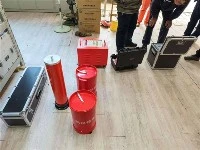


The VLF Hipot Instruments under Wuhan UHV can help many power workers conduct various power tests more conveniently.
The core criterion is: whether the test object experiences insulation breakdown or shows signs of unacceptable insulation defects under the specified test voltage and duration.The following are the detailed judgment methods and steps, which you can use as a checklist:

1, Preparation Before Testing (The Foundation for Correct Judgment)
1.Confirm Test Parameters: Ensure the test voltage value, application time, and frequency (usually 0.1 Hz) fully comply with the relevant standards (e.g., IEEE 400, DL/T 849) or product specifications.
2.Check Connections and Environment: Ensure all connections are correct and secure, and that the test object and generator are properly grounded. Record the ambient temperature and humidity, as humidity affects leakage current.
3.No-load Test (Optional but Recommended): Without connecting the test object, start the generator and raise the voltage to the test level. Observe if there is any abnormal discharge or current from the equipment itself or the connections. This helps eliminate interference from the test system itself.
2, Key Indicators to Observe During the Test (Real-time Judgment)
During the voltage application and withstand phases, the operator must closely monitor the following three key indicators:
1. Leakage Current (The Most Critical Indicator)
This is the most direct parameter for assessing insulation condition.
Signs of Passing:
Stable Current Value: The current increases smoothly with the voltage and remains at a relatively stable value (allowing for minor normal fluctuations) at the rated voltage.
Reasonable Current Value: The absolute value of the current is within a reasonable range compared to historical data, data from similar qualified test objects, or empirical values. Typically, the current is very small, in the milliampere range.
Good Symmetry: The waveform and amplitude of the leakage current are basically symmetrical under the positive and negative half-cycles of the VLF voltage.
Signs of Failure/Suspicion (Red Flags):
Current Increases Sharply: The current reading suddenly increases rapidly or even uncontrollably. This is a clear sign that insulation breakdown is imminent or has already occurred. Manually reduce voltage and shut down immediately.
Current Continuously Rises: During the constant voltage phase, the leakage current is unstable and shows a continuous, significant upward drift. This indicates the insulation is deteriorating.
Abnormally High Current Value: The absolute current value is much higher than historical data or similar equipment, indicating serious moisture ingress or overall deterioration of the insulation, even if breakdown does not occur.
2. Voltage and Current Waveforms
VLF generators are usually equipped with displays to observe voltage and current waveforms.
Signs of Passing:
Pure, Smooth Voltage Waveform: Sinusoidal, without distortion or noise.
Smooth Current Waveform: In phase with the voltage waveform and regularly shaped.
Signs of Failure/Suspicion:
Spikes or Noise in Waveform: Sharp pulses, regular or irregular, appear on the current waveform. This usually indicates partial discharges inside or on the surface of the test object, which is important evidence of insulation defects.
Waveform Distortion: The waveform is severely distorted and no longer sinusoidal.
3. Auditory and Olfactory Observations
Signs of Passing: The test object and surrounding environment are quiet, with no abnormal sounds, sparks, corona, smoke, or burning smell.
Signs of Failure/Suspicion:
Auditory: Hearing "cracking," "buzzing," or other discharge sounds from inside the test object or connection points.
Visual/Olfactory: Seeing obvious sparks, arcs, smoke, or smelling burning insulation material. The occurrence of any of these means the test has failed and must be terminated immediately.
3, Final Judgment After Test Completion
After the test object has successfully withstood the voltage for the specified duration:
1.Comprehensive Assessment: Consider all the observation points above. If throughout the entire process:
The leakage current was stable and reasonable.
The voltage and current waveforms were normal.
There was no breakdown, discharge, abnormal sound, or odor.
2.Conclusion: Then the test object can be judged as having passed this VLF high-voltage insulation test.