

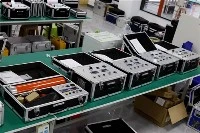
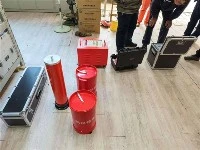

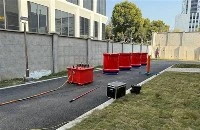
The complete set of frequency conversion series resonance test equipment is a series resonance test device that uses tuned inductance and load capacitance to generate power frequency series resonance and obtain power frequency test voltage. The complete set of frequency conversion series resonance test equipment consists of isolation transformer, frequency and voltage regulation power supply, excitation transformer, reactor, capacitor voltage divider, etc; The voltage divider is connected in parallel to the test object, and the resonant voltage on the test object is measured using a frequency conversion series resonance test equipment to obtain an overvoltage protection signal; The frequency modulation power output is coupled to the series resonant circuit through an excitation transformer, providing excitation power for series resonance
The AC withstand voltage test of various large power transformers, power cables, steam turbines, hydro generators and other capacitive equipment must be conducted regularly in strict accordance with the test procedures; Under power frequency conditions, due to the large capacitance of the test piece or high testing voltage requirements, the power supply capacity of the testing device is also relatively high. Traditional power frequency withstand voltage devices are bulky, heavy, difficult to carry out on-site, difficult to combine, and have poor flexibility. A better method is to use series resonance for voltage withstand testing.

When the frequency conversion series resonance test is completed and set as the withstand voltage test, frequency modulation is performed at the initial voltage based on the calculated frequency. Firstly, check the grounding. The complete set of frequency conversion series resonance test equipment must be well grounded. The grounding point of the experimental equipment and the grounding point of the generator core should be grounded simultaneously. In addition, temperature measuring components and generator rotors also require protective grounding. However, during the frequency modulation experiment, the results were not ideal and the frequency did not meet the requirements of the power frequency. After the power was cut off, the external wiring was correct, and the placement of the two reactors was suspected to be affected. The inductive reactance value was changed, the distance and position of the reactors were readjusted, and the power frequency 50 Hz resonance point was found. The voltage was increased and the withstand voltage value was maintained for one minute. The power frequency withstand voltage test passed smoothly. Through this experiment, we have accumulated valuable experience in the withstand voltage test of large high-voltage motors.
In practical applications, it has been found that when the voltage rises close to the test voltage, the voltage rise speed is too fast and the voltage fluctuation is large, which can even cause voltage protection. Therefore, it is necessary to restart the test, which is not conducive to the safety of the equipment. However, if the voltage protection value is set too high, the complete set of variable frequency series resonance test equipment cannot effectively protect the tested equipment from overvoltage.
There are several methods to improve the stability of the frequency conversion series resonance test equipment:
1. Select the deviation from the resonant frequency for testing. We know that in order to reduce the capacity of the test transformer, the Q value should be as large as possible. However, when the Q value is large and deviates from the resonance frequency, the speed is relatively slow. Therefore, we can choose to deviate from the resonant frequency to boost the voltage and reduce the speed of voltage rise, as long as the capacity of the variable frequency series resonance test equipment allows.
2. Adjust the quality factor of the circuit. From Q=Uc/U=1/ω CR, it can be seen that in order to reduce the value of q, it is necessary to increase the circuit resistance. In this way, the output capacity of the excitation transformer must also be increased in order to reach the test voltage. Therefore, when applying this method to the complete set of variable frequency series resonance test equipment, it must be carried out under the conditions of capacity allowance.
3. Requirements for grounding resistance. The grounding wire should be reliably connected to the grounding body, with a grounding resistance of less than 4 Ω.