





What is the quality factor of a resonant circuit? Wuhan UHV specializes in producing series resonant devices, with a wide range of product selection and professional electrical testing. When looking for series resonant devices, choose Wuhan UHV

Resonant circuits have a wide range of applications in electronic technology The characteristics of a resonant circuit are closely related to its quality factor (i.e. Q value) To obtain the Q value of a circuit, one should start from its definition in order to have a deeper understanding of the meaning of Q value and a more comprehensive understanding of the characteristics of resonant circuits. When studying various resonant circuits, the quality factor Q value of the circuit is often involved. So what is Q value? Below we will provide a detailed discussion.
The original definition of quality factor is defined by energy, which represents the conversion relationship between energies in a circuit, that is, the energy storage efficiency of the circuit. The physical meaning of quality factor can be clearly expressed from the definition of energy quality factor, which has universal significance for various circuits.
For the calculation of the quality factor of simple RLC series and parallel circuits, we can directly apply the definition formula of quality factor in RLC series and parallel circuits, but for slightly more complex RLC resonant circuits, these formulas are no longer applicable. The most primitive definition of quality factor, namely energy definition, must be the quality factor of any resonant circuit that can be calculated, but it can be quite cumbersome.
Figure 1 shows a series resonant circuit consisting of a capacitor C, an inductor L, and a leakage resistance of the capacitor and a line resistance of the inductor R. The complex impedance Z of this circuit is the sum of the complex impedances of three components.
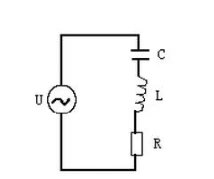
Figure 1
Z=R+jωL+(-j/ωC)=R+j(ωL-1/ωC) ⑴
The resistance R in the above equation is the real part of the complex number, and the difference between the inductive reactance and the capacitive reactance is the imaginary part of the complex number. We call the imaginary part the reactance, represented by X, and ω is the angular frequency of the applied signal.
When X=0, the circuit is in a resonant state, where the inductive and capacitive reactance cancel each other out, i.e. the imaginary part in equation ⑴ is zero, resulting in the minimum impedance in the circuit. Therefore, the current is at its maximum, and the circuit is now a purely resistive load circuit, where the voltage and current in the circuit are in phase. When a circuit resonates, its capacitance is equal to its inductance, so the effective voltage across the capacitor and inductor must be equal,
The effective value of voltage on the capacitor UC=I * 1/ω C=U/ω CR=QU Quality factor Q=1/ω CR, where I is the total current of the circuit.
Effective value of voltage on inductor UL=ω LI=ω L * U/R=QU Quality factor Q=ω L/R
Because UC=UL, Q=1/ω CR=ω L/R
The ratio of the voltage on the capacitor to the applied signal voltage U UC/U=(I * 1/ω C)/RI=1/ω CR=Q The ratio of the voltage on the inductor to the applied signal voltage U UL/U=ω LI/RI=ω L/R=Q
From the above analysis, it can be seen that the higher the quality factor of the circuit, the higher the voltage on the inductor or capacitor compared to the applied voltage.
Conclusion
The energy definition of quality factor clearly expresses the physical meaning of quality factor and has universal significance for various circuits. However, it is quite difficult, even difficult, to use it to solve the quality factor of more complex resonant circuits. The definition of the quality factor of series and parallel resonant circuits is directly defined from the perspective of circuit parameters. This definition is beneficial for calculating the quality factor, but from an understanding perspective, it is not as clear as the energy definition of the quality factor, making it easier to see its physical meaning. From the proof in the first part, we can see that the definition of the quality factor of series and parallel resonant circuits can be derived from the energy definition of the quality factor, and the two are equivalent to each other. The simple calculation formula for deriving the quality factor of any resonant circuit given in this article is effective for deriving the quality factor calculation formula of various lumped parameter resonant circuits, especially for more complex resonant circuits. As long as the equivalent resistance, inductance, and capacitance of the circuit under resonance conditions are obtained, the quality factor calculation of the series resonant circuit can be directly applied to obtain the quality factor of the circuit. This method is simple and easy to implement, especially for solving complex circuits, demonstrating great superiority.