


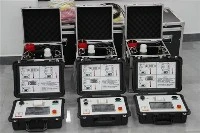
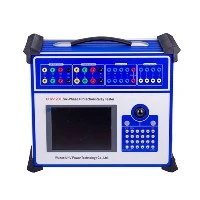
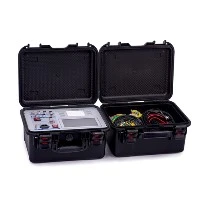
The history of series resonance (also known as AC withstand voltage testing equipment) is a popular type of series resonant converter in the 1960s and 1970s, which can achieve good soft switching through appropriate dead time. Modern CNC technology has added a lot of vitality to this classic conversion circuit, suitable for the handover and preventive testing of high-capacity, high-voltage capacitive samples, such as power cables, GIS switches, transformers, etc.
In series resonance, when a voltage source is applied to an inductor and a capacitor, due to the short circuit of L and C in series resonance, the voltage source cannot be short circuited, so resistance must be increased; When the resistance value remains constant, determine the series resonant current. In terms of power, inductors and capacitors alternate transmission without considering losses; When the capacitor discharges, it charges while the inductor charges.

In a constant voltage parallel resonant power supply, the root mean square current of the inductor and capacitor is fixed and only depends on the size of the inductor and capacitor. Only when the current source is constant can the resistance be increased to change the current values of the inductor and capacitor. When the conditions remain unchanged, the power also remains unchanged, similar to series resonance.
When the motor resonates in series, due to the resistance of the motor coil, the current of the motor coil at a fixed voltage is theoretically infinite. Therefore, it is not infinite, but it will greatly exceed the rated current. Due to the fixed impedance of the motor coil, the current increases, the voltage at both ends of the coil increases, the excitation energy increases, and the power increases. However, due to the high current, the motor coil is prone to burning out.
For the parallel resonance of parallel capacitors, due to the presence of a voltage source and the voltage across the inductor and capacitor, the current at both ends of the inductor is constant. However, due to the compensation of the capacitor, the phase of the voltage and current are the same, thereby increasing the power supply, that is, the phase angle of p=u * i * cos. The principle of parallel resonance is a current source, which is slightly different from this. Due to the constant current of the current source, when the current source resonates in parallel, the two ends of L and C are very open, and the resistance directly passes through the current source, that is, the current flowing through the current source, which increases the voltage at both ends, increases the voltage at both ends of L and C, and ultimately leads to an increase in current.
The basic conditions for series resonance are:
1. Definition of series resonance: In an RLC series circuit, when the terminal voltage and current of the circuit are in the same phase, the circuit is resistive, and the state of the circuit is called series resonance.
2. The conditions for series resonance.
3. Methods for analyzing circuits to achieve resonance:
(1) When the power frequency is constant, the size of L or C can be adjusted to achieve resonance. (2) When the circuit parameters L and C are constant, resonance can be achieved by changing the frequency of the power supply.