

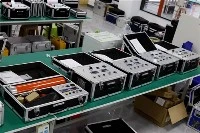
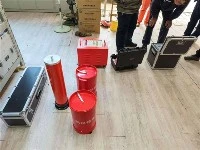


A failure to trigger in a lightning impulse voltage tester is a common issue that can involve multiple subsystems. Here is a systematic troubleshooting guide, organized from simple to complex causes.

1. Energy Supply Problem (Charging Circuit)
Core Question: Are the main capacitors charging to the required voltage?
DC Charging Power Supply Failure: Check the input power, voltage regulator, and rectifier stack. Observe if the voltmeter on the control panel shows a stable voltage increase.
Main Capacitor Damage: This is one of the most common failures. A short-circuited (broken down) or severely leaking capacitor will prevent voltage buildup or cause very slow charging.
Charging/Damping Resistor Failure: A burned-out (open circuit) or abnormally high-value resistor will result in insufficient charging current.
2. Ignition Command Problem (Trigger System)
Core Question: Is a high-intensity pulse being generated to ionize the main spark gap?
Trigger Pulse Source Fault:
How to check: After pressing the "Trigger" button, listen carefully for a distinct "crack" or "snap" discharge sound from the trigger pulse device (usually a small spark gap or pulse transformer).
If no sound: The fault lies within the trigger pulse generator itself. Check the trigger capacitor, trigger switch (e.g., a three-electrode gap or thyristor), and its control circuit.
Trigger Pulse Not Delivered:
If there is sound: The pulse source is working, but the path is broken. Check the trigger needle inserted into the main gap for erosion, looseness, or incorrect installation. Also, inspect the high-voltage pulse cable for damage.
3. Actuator Problem (Main Spark Gap)
Core Question: Is the main switch (the spark gap) itself functioning correctly?
Incorrect Gap Setting: This is the most common human error. The distance is set too large, making the theoretical breakdown voltage much higher than the actual charging voltage.
Contaminated Electrodes: Dust, oil, metal particles, or oxidation on the surface of the spheres significantly increase the breakdown voltage, preventing triggering. The spheres must be kept clean and polished.
Environmental Factors: High air humidity can also raise the breakdown voltage.
4. Control & Measurement Problem ("False Fault")
Core Question: Are the displays and control logic correct?
Voltage Measurement Inaccuracy: The voltage reading on the control panel (from the divider) may be incorrect due to a faulty meter or divider, creating a false impression that the voltage is sufficient when it's actually too low.
Safety Interlocks:
Is the grounding switch in the "Operate" position, not "Ground"?
Is the protective door closed (door switch interlock)?
Has the emergency stop button been pressed and not reset?
Are the overvoltage/overcurrent protection settings too low?