



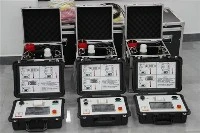
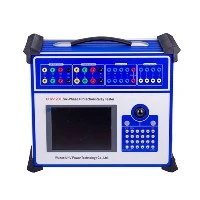
The complete set of equipment for power frequency AC withstand voltage test is used for AC withstand voltage tests of various large transformers, as well as for AC withstand voltage tests of thermal and hydroelectric generators, which require large capacity testing equipment. Normally, resonance is used for testing, but it must be conducted under power frequency conditions or equivalent power frequency conditions, which generally use a frequency of 45-60Hz. The current regulations do not support or explicitly support this method, so many departments require 50HZ test power supplies to conduct AC withstand voltage tests on such equipment.
The complete set of equipment for power frequency AC withstand voltage test is designed for the AC withstand voltage test of high voltage and high current capacitive test samples such as power cables. This resonance test device is tuned by adjusting the frequency and adjusting the air gap of the iron core, which can conveniently and accurately find the resonance point. At the same time, it can also meet the requirements of different samples and regulations in different places, so that the resonant frequency is fixed within the required range, and the quality factor of the system can reach 20-80, making the system lightweight and simple. This resonance test device adopts multiple protective measures, making the test convenient and reliable. The inherent filtering effect of resonance ensures that the waveform output by the system fully meets the requirements of the test protocol.

Working principle of complete set of equipment for power frequency AC withstand voltage test
1. AC 220V power supply, output a voltage with adjustable frequency of 30-200HZ through the frequency conversion control unit, and send it to the excitation transformer for boosting to 0-1000V. After passing through the resonant reactor L and the test sample CX, a high-voltage main harmonic circuit is formed. A capacitive voltage divider is a pure capacitive type used to measure test voltage. Firstly, the variable frequency control unit sends a lower voltage Ue to the main resonant circuit through the excitation transformer. Adjust the output frequency of the variable frequency control unit to meet the condition Ω L=1/Ω C.
2. The circuit reaches a resonant state, at which point a voltage UCX several tens of times greater than Ue can be generated on the test sample CX at a lower excitation voltage Ue. The frequency conversion test system operates based on the circuit principle of the frequency conversion series resonance test set. The resonance point is achieved by adjusting the frequency of the frequency converter to the natural frequency of the frequency conversion series resonance test set circuit. After the circuit resonates, the output voltage waveform is a pure sine wave, and the system frequency depends on the L-C parameter of the circuit. The reactance value of the reactor is adjustable, and the frequency of the system depends on the size of the load capacitance. The inductance L value of the reactor can be adjusted appropriately according to the size of CX. To fix the resonant frequency within a required range, thereby meeting the requirements for conducting AC withstand voltage tests on test specimens under power frequency conditions.