

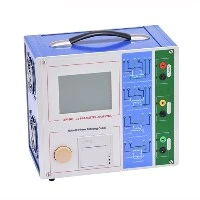

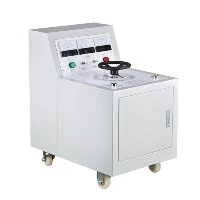
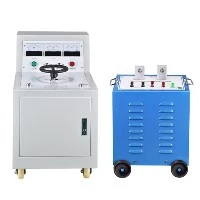
The reason a series resonant device is often called an "AC withstand voltage test device" is that it implements an efficient, ideal, and practical method for AC withstand voltage testing that aligns with actual operating conditions.

We can understand the origin of this name from the following aspects:
1. Core Purpose: Performing AC Withstand Voltage Tests
First, it's essential to clarify the ultimate goal: to perform on-site AC withstand voltage tests on large electrical equipment (such as power cables, generators, transformers, GIS, etc.).
Why is withstand voltage testing needed? To verify the reliability of the equipment's insulation strength, ensuring it can operate safely under rated voltage and overvoltage conditions, preventing breakdown accidents after being put into service.
Why AC? Because the voltage in the power grid is power frequency AC (50Hz). Insulation defects (like bubbles, impurities) in equipment are more easily exposed under an AC electric field. The AC withstand voltage test is the most direct, stringent, and effective method for assessing equipment insulation strength.
2. The Dilemma of Traditional Methods
Without a series resonant device, the traditional test method uses a power frequency test transformer. However, this method has significant drawbacks for field applications:
Massive Capacity and Size: The required power supply capacity S = U * I. For equipment with large capacitance (Cx), like long cables or large generators, its capacitive reactance is very small (Xc = 1 / (2πfCx)). Even at relatively low test voltages, this results in a very large capacitive current (I = U / Xc). This means a test transformer capable of providing huge output current (potentially hundreds of amperes) and very high voltage (tens to hundreds of kilovolts) is needed. Its volume and weight would be extremely cumbersome, making it utterly impractical to transport to field sites.
Does Not Simulate Actual Conditions: The output waveform of a simple power frequency transformer may contain harmonics, and its source impedance does not match the capacitive reactance of the test object, making the test conditions less than ideal.
3. The Perfect Solution: The Series Resonant Device
The series resonant device cleverly utilizes the resonance principle of inductance (L) and capacitance (C) to overcome the limitations of traditional methods.
Resonance Principle: In an R-L-C series circuit, when the inductive reactance (XL = 2πfL) equals the capacitive reactance (Xc = 1 / (2πfC)), the circuit enters series resonance. At this point:
The circuit impedance is minimal (only the loop resistance R), and the current is maximal.
The voltages across the inductor and capacitor are equal in magnitude and opposite in phase, and both are Q times the power supply voltage. Q = XL / R or Xc / R, known as the Quality Factor, typically ranging from 20-80 or even higher.
Therefore, the series resonant device is essentially a device used to generate high-voltage AC electricity, and its core application scenario and sole purpose is to perform AC withstand voltage tests on electrical equipment.