

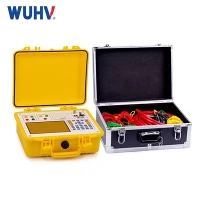


Product introduction
The dry type AC DC high voltage testers are relative to traditional oil immersed test transformers. It uses epoxy resin casting or high-quality insulation material as the main insulation, which seals the high-voltage coil and iron core into a whole. This design gives it the advantages of being oil-free, fireproof, moisture-proof, maintenance free, small in size, light in weight, and easy to move, making it particularly suitable for use in situations that require high safety and portability, such as indoor use in substations, industrial and mining enterprises, and power maintenance sites.


working principle of dry type AC DC high voltage tester
The input voltage of this series of dry type AC DC high voltage testers is 200V or 400V, which is connected to the matching control box (platform). The input voltage is adjusted by an autotransformer to the primary winding (low voltage) of the test transformer. Using the principle of electromagnetic induction, the secondary winding (high voltage) can obtain an output high voltage of the same multiple according to its ratio to the number of turns of the primary winding. It can be continuously adjusted from zero volts to the rated maximum value. When conducting DC withstand voltage and leakage current tests, simply rotate the high-voltage silicon stack onto the high-voltage output terminal to obtain DC high voltage, which is 1.414 times the amplitude of the power frequency high voltage value.
technical parameters
| Impedance voltage | ≤12% |
| Output voltage wave form | sinusoid |
| Surface temperature rise | <55℃ |
| No-load current | <4% |
Main product specifications
| specifications and models | capacity(kVA) | input voltage(V) | output voltage(kV) | output current(mA) | Output DC high voltage | weight(kg) |
| 1.5/50 | 1.5 | 200 or 400 | 50 | 30 | 70 | 15 |
| 5/15 | 5 | 333 | 15 | |||
| 3/50 | 3 | 60 | 20 | |||
| 5/50 | 5 | 100 | 27 | |||
| 6/50 | 6 | 120 | 30 | |||
| 10/30 | 10 | 333 | 30 | |||
| 10/50 | 10 | 200 | 40 | |||
| 15/50 | 15 | 300 | 50 | |||
| 20/50 | 20 | 400 | 55 | |||
| 25/50 | 25 | 500 | 60 | |||
| 30/50 | 30 | 600 | 65 | |||
| 15/25 | 15 | 220 | 25 | 600 | 200 | 72 |
| 5/100 | 5 | 200 or 400 | 100 | 50 | 140 | 60 |
| 10/100 | 10 | 100 | 65 | |||
| 10/120 | 10 | 120 | 70 | |||
| 15/100 | 15 | 150 | 75 | |||
| 20/100 | 20 | 200 | 75 | |||
| 25/100 | 25 | 250 | 80 | |||
| 15/120 | 15 | 120 | 125 | / | 120 | |
| 20/120 | 20 | 160 | 130 | |||
| 25/120 | 25 | 200 | 140 | |||
| 30/120 | 30 | 250 | 150 |
Main application scenarios of dry type AC DC hipot tester
dry type AC DC high voltage testers are mainly used in situations where insulation strength assessment of electrical equipment is required, including:
Power system: Power supply bureaus, substations, etc. conduct power frequency withstand voltage and DC leakage tests on power transformers, cables, switchgear, etc. on site.
Equipment manufacturing and scientific research: Electrical equipment factories conduct factory inspections on products, and research institutions and university laboratories conduct high-voltage insulation tests.
Mining and special environments: Due to complex on-site conditions, enterprises such as railways, oil fields, and mines have high requirements for equipment portability and safety. Dry type transformers are an ideal choice.
Core advantages compared to traditional models
1. Small size, light weight, and outstanding portability. Traditional oil immersed models require insulation oil filling, and their weight can reach 2-3 times that of dry type AC DC high voltage testers under the same voltage capacity, requiring multiple people to cooperate or lifting equipment to handle. The dry-type model adopts an integrated structure of epoxy resin casting, combined with a compact design optimized by electric field simulation, significantly reducing the overall weight. It can be transported and deployed by one or two people, making it particularly suitable for multi-point mobile detection scenarios such as substations and outdoor projects.
2. Safe and environmentally friendly, with no risk of leakage. Oil immersed equipment is prone to seal aging and insulation oil leakage after long-term use, which not only pollutes the environment but also poses a fire hazard. Dry type AC DC high voltage testers use solid insulation, high flame retardant rating, no risk of oil leakage, excellent fire and explosion resistance, and can be used in indoor environments, research institutes, medical equipment workshops, and other high environmental requirements.
3. Maintenance free and low operating costs. Oil immersed test transformers require regular inspection of insulation oil quality and replacement of seals, and the operation and maintenance process is cumbersome. The dry-type AC DC high voltage tester has an oil-free design, and only needs to maintain a clean appearance and inspect the wiring terminals on a daily basis. There is no need for regular oil changes or sealing maintenance, and the comprehensive cost of long-term use is lower.
Frequently Asked Questions
1. What tests are dry type AC DC high voltage testers mainly used for?
Dry type AC DC high voltage testers are mainly used for power equipment power frequency withstand voltage testing, including AC withstand voltage testing of cables, switchgear, circuit breakers, insulators, transformers, motors and other equipment. They are important equipment for power preventive testing and factory testing.
2. Does the dry type AC DC high voltage tester support cascading connections?
support. For applications that exceed the output voltage requirements of a single device, multiple test transformers can be connected in series to achieve higher voltage output and meet the requirements of high-voltage cables, GIS equipment, and other withstand voltage tests.
3. Is the output voltage stable?
Yes. By using high-quality iron core materials and advanced winding technology, the dry type AC DC high voltage tester has good voltage stability and low waveform distortion rate, which can meet various power frequency withstand voltage test standards.
4. Does it have security protection function?
The dry type AC DC high voltage tester is usually configured with:
overcurrent protection
Overvoltage protection
Zero start protection
grounding protection
Emergency stop protection
Effectively ensure the safety of equipment and operators.
5. Is equipment transportation safe?
The dry type AC DC high voltage tester is packaged in reinforced wooden boxes and treated with shock and moisture resistance for high-voltage components, suitable for international transportation modes such as sea, air, and land transportation.


Dry Type AC DC High Voltage Tester Manufacturer & Supplier
We are a professional dry type AC DC high voltage tester manufacturer and supplier in China, specializing in the design, manufacturing, and supply of reliable high-voltage testing equipment. Our dry type AC DC high voltage testers are designed for safe and efficient AC withstand voltage testing and are widely used in power plants, substations, electrical equipment manufacturers, laboratories, and power testing companies.
If you are looking for a reliable dry type AC DC high voltage tester manufacturer, supplier, or exporter in China, we are a good choice for your high-voltage testing projects. Contact us today to get the latest dry type AC DC high voltage tester price, detailed specifications, and professional quotation.
Hot Tags: ac dc high voltage tester, China ac dc high voltage tester manufacturers, suppliers, factory, electronic component hipot tester, high voltage indicator, industrial resonant hipot tester manufacturer, high voltage voltmeter, hipot battery safety tester, hipot power tester


