

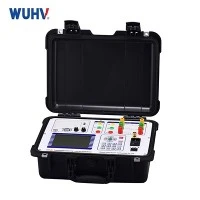


Load No-load Tester
Our ansformer Load No-Load Tester is designed to measure the load loss, no-load loss, and excitation current of transformers. It evaluates efficiency, performance, and core losses by analyzing power losses under no-load and load conditions. This helps detect issues such as iron core saturation, abnormal winding resistance, and low transformer efficiency.
Why Choose Us?
Our company has been specializing in the production and manufacturing of transformer capacity load no-load testers for 21 years, with a modern intelligent factory covering over 40,000 square meters and more than 100 automated production, manufacturing, assembly, and testing equipment. We have obtained CE certification and currently serve over 20,000 customers worldwide.
Quotation within 1 hour – Solution within 24 hours - Product demonstration available - Strict contract performance
On-time delivery - 12-month warranty – Optional extended warranty - Factory acceptance testing
Authorized calibration (optional) - Worldwide training support – Regular follow-up visits
Load no-load tester specifications
| Capacity measuring range | 30kVA~31500kVA |
| Current measuring range | 0-100A auto-switch the measurement range |
| Current measurement accuracy | ±(0.2%+3 digits) |
| Voltage measurement range | Line Voltage 0-750V; phase voltage 0-450V, auto-switch the measurement range |
| Voltage measurement accuracy | ±(0.2%+3 digits) |
| Insulation resistance | >100MΩ |
| Leakage current | <3.5mA |
| Dielectric strength | the power connection on the chassis can withstand: 1500V External transformer can broaden the scope of measurement instruments |
| Frequency Range | 40~65Hz,accuracy class 0.2 |
| Power Input | AC 220V±10% |


Product Features of Transformer Capacity Load No-load Tester
1.Displays three-phase voltage, current, and power, automatically calculates the impedance voltage percentage of the transformer, converts it to load loss at rated temperature and current, and automatically determines the iron core type for oil-immersed or dry-type distribution transformers. It includes an adaptive alarm prompt function for user convenience.
2.Measures the distortion rate of the applied power waveform, corrects waveform distortion, and automatically calculates the no-load loss converted to rated voltage.
3.Allows single-phase defect detection and can operate in situations where three-phase power is unavailable. It records three single-phase measurements and calculates no-load current, no-load loss, impedance voltage, and load loss based on the connection type.
4.Measures zero-sequence impedance in transformers with neutral points in star (Y) connections on the high-voltage side, including zero-sequence reactance, inductance, impedance angle, and resistance.
5.Equipped with a rechargeable lithium battery, featuring an integrated three-phase sine wave inverter power supply with automatic voltage adjustment, soft start, and soft stop functions. It can measure distribution transformer capacity and model without an external power supply.
6.Supports direct measurement within range and allows connection to external voltage and current transformers for measurements beyond range.
7.Users can set transformation ratios for accurate readings.
8.Provides harmonic analysis, displaying harmonic content and total distortion rate through both waveform and bar chart visualizations.
9.Features a large LCD screen displaying all key parameters (three-phase voltage, current, power, average values, and total power) on the same screen. Includes a Chinese menu with simple navigation prompts.
10.Dual power supply: operates on lithium battery or 220V AC power.
11.Smart charging management, battery level display, low battery alarm, and automatic backlight adjustment for power saving.
12.Real-time clock and date display with power-failure protection. Local storage for up to 200 test results, with USB export in Word format for direct editing and printing.
13.Silent thermal printer for fast on-site report printing.
14.User-friendly interface: displays USB flash drive status and prompts users when unconnected devices are detected.
15.Compact, lightweight, and portable for easy field use.
21 years professional manufacturer and supplier in china, standardized factory, best product quality, and cheap wholesale prices!!!
Core functional features of capacity load no-load tester
Transformer capacity judgment function: This instrument has a built-in library of common distribution transformer model parameters, which can compare and analyze on-site measurement data such as voltage, current, power, etc. with the built-in database to assist in determining whether the actual capacity of the operating or standby transformer meets the nameplate identification. This function provides strong technical support for transformer capacity detection, anti-theft and other work.
Measurement of no-load and load losses: The equipment is capable of accurately applying test signals and synchronously measuring the power loss of transformers under no-load and short-circuit conditions. For no-load testing, the instrument can capture the iron loss of the transformer, i.e. constant loss; For load testing, the main measurement is the copper loss, which is the variable loss. These data are the core basis for evaluating the energy efficiency level of transformers and analyzing their economic operating status.
User friendly operating experience: Considering the different operating habits of users, this tester is equipped with a color display screen, and the menu design strives for clarity and clarity. The testing process comes with guidance prompts, reducing the learning difficulty for new users. At the same time, the instrument has data storage and transmission functions. After the test is completed, the data can be easily exported to the computer for subsequent archiving or in-depth analysis, which facilitates the establishment of long-term equipment management archives.
Safety and adaptability of equipment: In terms of safety, the product design includes necessary overvoltage and overcurrent protection circuits to ensure the safety of equipment and operators during testing. Its structural design and component selection also consider adaptability in various industrial field environments, demonstrating a certain level of durability.
Why Are Load and No-Load Tests Important?
Ensure Transformer Efficiency
Detect iron core and copper losses to optimize transformer performance.
Identify Manufacturing Defects
Verify whether the transformer design complies with IEC, IEEE, and ANSI standards.
Prevent Energy Loss and Overheating
Assist utility companies in reducing transmission and distribution losses.
Assess Transformer Health
Diagnose issues like changes in winding resistance and core saturation.
Working Principle of Load and No-Load Testing
No-Load Test (Iron Core Loss Measurement)
A low voltage is applied to the primary winding, keeping the secondary winding open.
Measures no-load current, power loss, and power factor to analyze iron loss (core loss).
Load Test (Copper Loss Measurement)
The transformer operates under rated conditions with a test load.
Measures voltage, current, power factor, and total power loss.
Determines copper losses (winding resistance losses) and efficiency.
Applications of Load and No-Load Testing
1. Power Generation, Transmission, and Distribution
Power Plants (Thermal, Hydro, Nuclear, Renewable Energy)
Ensures transformer efficiency in power stations.
Detects core saturation, overload losses, and abnormal winding resistance.
Optimizes energy transfer by reducing transmission losses.
Substations (High-Voltage & Medium-Voltage Transformers)
Verifies power transformer losses and efficiency.
Ensures compliance with IEC 60076, IEEE C57, and ANSI standards.
Identifies abnormal copper loss and insulation degradation before failure.
Distribution Networks (Utility & Grid Operators)
Tests pole-mounted and pad-mounted transformers before installation.
Reduces voltage drop and power loss in distribution networks.
Ensures stability under fluctuating loads.
2. Transformer Manufacturing & Factory Testing
Quality Control & Factory Acceptance Testing (FAT)
Ensures transformers meet design specifications before shipment.
Detects manufacturing defects in winding resistance, core loss, or insulation.
Prototype Testing & Development
Supports development of new transformer models.
Validates innovative materials and core structures for better efficiency.
Determines optimal voltage and current limits.
3. Industrial & Commercial Power Systems
Factories & Heavy Industry
Ensures transformers provide stable voltage for industrial motors, pumps, and conveyors.
Prevents power fluctuations that can damage heavy machinery.
Diagnoses overheating risks in critical equipment.
Data Centers & IT Infrastructure
Verifies UPS transformers’ performance to prevent downtime.
Ensures a stable power supply for sensitive electronics.
Hospitals & Medical Facilities
Protects MRI, CT scanners, and life-support systems from voltage fluctuations.
Ensures emergency power supply transformers function properly.
Commercial Buildings & Smart Grids
Tests transformers in shopping malls, office buildings, and smart grids.
Supports energy-efficient transformer deployment.
4. Electrical Maintenance & Fault Diagnosis
Predictive Maintenance for Utilities
Detects transformer losses before critical failures occur.
Helps utilities schedule maintenance proactively.
Post-Fault Analysis & Emergency Repairs
Determines whether damaged transformers can still operate.
Verifies power loss after short circuits, lightning strikes, or overloads.
Tap Changer Performance Testing
Checks On-Load Tap Changer (OLTC) & De-Energized Tap Changer (DETC) efficiency.
Detects contact wear, high resistance, and improper tap positioning.
5. Renewable Energy Systems
Wind Farm Transformers
Identifies transformer issues caused by mechanical vibrations & fluctuating loads.
Prevents excessive power loss in offshore & onshore wind farms.
Solar Inverter Transformers
Ensures minimal core loss & high efficiency in solar power plants.
Tests transformers under variable sunlight conditions.
Hydropower Generator Transformers
Evaluates winding resistance to ensure efficient power transmission.
Identifies core movement or insulation wear in hydroelectric transformers.
FAQ
1. What is the transformer capacity load no-load tester mainly used for?
Mainly used for measuring the capacity of distribution power transformers.
Can test parameters such as no-load loss, no-load current, load loss, impedance voltage, etc. of transformers.
Some models also have energy efficiency level measurement and judgment functions.
2. Will the test results be automatically calibrated?
Okay.
The instrument can perform various calibrations on the test results based on the relevant input parameters.
Including waveform distortion correction, temperature correction, non rated voltage correction, non rated current correction, etc.
Helps improve the accuracy of test results.
3. Can test data be saved?
Okay.
The transformer capacity load no-load tester supports both local storage and USB storage.
This machine can store about 200 test data.
Local data can also be transferred to a USB drive.
4. Is this load no-load tester suitable for on-site testing?
fit.
The product adopts a portable design and features small size, light weight, and simple operation.
5. What industries is the transformer capacity load no-load tester suitable for?
Mainly used for:
power company
substation
Electric Power Engineering Company
Transformer manufacturing enterprise
Electrical equipment testing organization
Electric Power Laboratory
Research and university laboratories
Electrical equipment maintenance unit
6. Can it be customized according to customer needs when purchasing?
Suitable instrument models and configurations can be selected based on specific project requirements.
If customers have special requirements for testing scope, functionality, communication methods, or data management, they can confirm the technical solution with the supplier in advance.
For export projects, local power sources, standards, plugs, and related certification requirements should also be confirmed.
21 years professional manufacturer and supplier in china, standardized factory, best product quality, and cheap wholesale prices!!!
As one of the leading load no-load tester manufacturers and suppliers in China, we warmly welcome you to buy high-grade load no-load tester made in China here from our factory. For price consultation, contact us.
Portable Ground Resistance & Resistivity Tester