

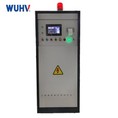
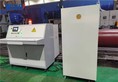
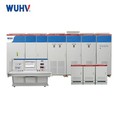
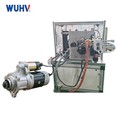
CB Analyzer
Circuit Breaker tester(CB Analyzer) is a specialized instrument used for testing and diagnosing high-voltage circuit breakers (HVCBs), which protect equipment, power lines, and substations from faults such as short circuits, overloads, and voltage fluctuations. It ensures the correct, safe, and efficient operation of the power system.
Our high-voltage Circuit Breaker tester accurately measures the mechanical dynamic parameters of various high-voltage circuit breakers, including low-oil, high-oil, vacuum, and sulfur hexafluoride (SF6) types. It is suitable for various high-voltage circuit breakers, including vacuum, SF6, and oil circuit breakers, as well as load switches, GIS grounding knife switches, contactors, relays, and air switches.
Why Choose Us?
Wuhan UHV Power Technology CO., LTD is an well experiend OEM/ODM factory, which engaged in the research, development, manufacture, sale and service of high voltage testing equipment or systems for more than 21 years, We can supply more than 140 different products and covering AC Series Resonant Test System, AC/DC/VLF Hipot Test Set, Transformer Tester, Secondary Injection Relay Tester, Cable/Line Tester, Insulation Oil Tester, Circuit Breaker/Switch Tester and SF6 Test Equipment etc.They are widely applied in electric power energy, transportation,metallurgical,chemical,mining and water conservancy project. and be exported to more than 100 different countries all over the world.
We have obtained the CE certificate, ISO 9001:2015 Quality system certificate, and all products conform to the international or Chinese state standards.
Answer within 1 hour – Quotation within 24 hours - Product demonstration available - Strict contract performance
On-time delivery - 12-month warranty – Optional extended warranty - Factory acceptance testing
Authorized calibration (optional) - Worldwide training support – Regular follow-up visits


Product Advantages
(1) Suitable for domestic and foreign production of SF6 switch, GIS combination electrical appliances, vacuum switch, oil switch, vacuum contactor, special circuit breaker (train circuit breaker). At the same time, 12 metal contact fractures, 6 main fractures and 6 auxiliary fractures can be measured. The circuit breaker is operated once, and the data and waveform such as time, bounce number and time, speed, coil current and coil resistance are obtained. With energy storage, automatic and manual low jump test, circuit breaker life test and(lock power supply and dry contact control optional) and other functions. Equipped with high speed thermal printer, convenient to print test data on site.
(2) 7 inch color screen, operating under the sun is clearly visible. Menu operation, quick test interface, one-key operation, support Chinese and English input. The 12-channel fracture status is displayed in Chinese. The time, stroke, speed and waveform are displayed on the same screen. Analyze the average velocity of the specified segment and mark it on the stroke curve for easy viewing.
(3) machine integrated operation power supply, no site secondary power, easy to use. Can provide DC20 ~ 270V adjustable power supply, current 20A. Short circuit protection function. In case of short circuit, 1ms will stop the voltage and current output and emit a beep to prompt the operator to check the circuit. Unique double circuit power supply design, such as closing or breaking control circuit in one damage, with the other can also be tested.
(4) equipped with linear sensor, 360 degrees without dead Angle rotation sensor, with special fixed multifunctional joint, installation is very convenient, simple. The length of the 30-1000mm linear sensor can be set arbitrarily. It only needs to be equipped with the sensor, and the instrument does not need to be returned to the factory to change the program.
(5) the host can store 100 groups of test data, real-time clock in the machine, easy to archive.
(6) Equipped with U disk interface and R232 interface, data saved to U disk, uploaded to the computer for analysis, saving, printing, R232 interface can be connected to the computer online operation
What Is a High-Voltage Circuit Breaker?
A high-voltage circuit breaker, also known as a high-voltage switch, serves two primary functions in the power system:
Control Function – It enables or disables electrical equipment and power lines as required by system operations.
Protective Function – In case of faults in power equipment or lines, the relay protection device triggers the circuit breaker to quickly isolate the faulty section, ensuring the normal operation of the remaining power system.
Six main reasons
1. Ensure the Reliability of the Power System
Prevent system failures – Circuit breaker malfunctions can lead to power outages and widespread disruptions.
Minimize downtime – Regular testing helps detect potential faults before they cause failures.
Enhance grid stability – Proper circuit breaker operation ensures a stable power supply and prevents voltage fluctuations.
2. Prevent Electrical Accidents and Equipment Damage
Protect transformers, generators, and substations – Prevents damage from high fault currents and voltage surges.
Improve personnel safety – Reduces the risk of electrical fires, explosions, and electrocution.
Avoid costly repairs – Identifies issues before they lead to catastrophic failures, saving on repair costs.
3. Comply with Safety and Industry Standards
Ensure adherence to IEEE, IEC, ANSI, and national grid regulations.
Meet utility standards for circuit breaker operation.
Required for power plant and substation certification.
4. Evaluate Circuit Breaker Performance
Regular analysis helps assess:
Opening and closing time – Ensures circuit breakers operate quickly to clear faults.
Contact resistance – Measures resistance between contacts to detect wear or contamination.
Timing and synchronization – Confirms that breakers operate in sync with the power system.
SF6 Gas Quality (for gas-insulated circuit breakers) – Ensures proper insulation and detects leaks.
Mechanical and electrical wear – Identifies aging components that need replacement.
5. Detect Aging and Wear in Circuit Breakers
Over time, circuit breakers degrade due to:
Contact corrosion – Frequent switching increases resistance due to contact wear.
Insulation breakdown – Dielectric materials deteriorate, leading to malfunctions.
Spring and mechanism wear – Mechanical parts weaken, causing operational delays or failures.
Key aging indicators:
Longer breaking time
Increased contact resistance
Unstable SF6 gas pressure
Elevated component temperature
6. Improve Energy Efficiency and Reduce Losses
Minimize power loss caused by aging breakers with high resistance.
Ensure quick fault resolution to reduce grid pressure.
Optimize circuit breaker operation for better energy distribution.
Types of CB Analyzers
Portable CB Analyzer – Used for on-site circuit breaker maintenance.
Laboratory CB Analyzer – Used for research and development testing.
Online Monitoring System – Provides real-time monitoring of circuit breaker status.
Term definition of the CB Analyzer
(1) Three-phase synchronism: refers to the maximum & minimum differentials of on-off three-phase separation (closing) switch.
(2) Same phase asynchronies : refers to 6 fractures or more switches, the time difference of separating (closing) brake to same phase fracture
(3) Bounce time: refers to the accumulative time values, which is the interval from first contacting to completely contacting, of all contacts while in progress of closing, separating (bounce) brake when switch’s moving & static contacts .
(4) Opening time: refers to the interval from separating brake dropping out with electrification to every polar arc contact separating, where the breaker is in closed position.
(5) Closing time: refers to the interval from closing circuit with electrification to every polar arc contact touching, where the breaker is in open position.
(6) Reclosing time: in the cyclic process of reclosing, it’s the interval from opening to each polar contacts closing together.
(7) Instant separating (closing) velocity: refers to within some appointed time of opening/ closing moving contact and static contact, or average velocity of a certain appointed stroke. Take 10ms for instance, to separating brake ,it’s average velocity to separate brake within 10ms after separating. To closing brake, it’s average velocity to close brake within 10ms before closing.
(8) Opening range: refers to the stroke of switch from divided state to instant touch of moving contact with static contact.
(9) The maximum velocity of opening (closing)switch: refers to the maximum instantaneous speed of opening (closing) switch, generally speaking, this value shall appear in this stroke or point, which is analyzed from velocity and stroke curve, while switch just opening or closing.
(10) Average velocity of opening (closing): refers to the ratio of stroke to time , where the switch moving contact exists in whole action.
Applications of CB Analyzers
Power transmission and distribution substations
Industrial plants – Ensuring safe operation in factories, refineries, and manufacturing facilities.
Renewable energy – Protecting solar power plants, wind turbines, and hydroelectric systems.
Railway and transportation systems – Ensuring reliable electrical operation in railway networks.
As one of the leading cb analyzer manufacturers and suppliers in China, we warmly welcome you to buy high-grade cb analyzer made in China here from our factory. For price consultation, contact us.
CB analyzer for maintenance teams, circuit breaker timing and resistance logging, vacuum interrupter performance test set