

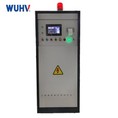
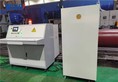
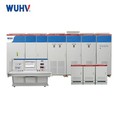
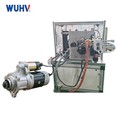
SFRA Test Kit
Our Sweep Frequency Response Analysis (SFRA) Test Kit is based on the measurement of characteristic parameters of transformer windings. It is used to evaluate the mechanical and electrical integrity of transformer windings and iron cores. This test can detect internal deformations, displacements, and faults that are difficult to identify using traditional electrical testing methods.
Why Choose Us?
Our company has been specializing in the production and manufacturing of frequency series resonance devices for 21 years, with a modern intelligent factory covering over 40,000 square meters and more than 100 automated production, manufacturing, assembly, and testing equipment. We have obtained CE certification and currently serve over 20,000 customers worldwide.
Quotation within 1 hour – Solution within 24 hours - Product demonstration available - Strict contract performance
On-time delivery - 12-month warranty – Optional extended warranty - Factory acceptance testing
Authorized calibration (optional) - Worldwide training support – Regular follow-up visits


Product Features
1.Utilizes DDS digital high-speed scanning technology for accurate fault diagnosis, including winding distortion, bulging, displacement, tilting, inter-turn short circuits, and phase-to-phase contact short circuits.
2.The acquisition control system uses a highly integrated microprocessor and high-stability components with dual-channel 16-bit A/D sampling. The test repetition rate is above 99.5%, ensuring high measurement accuracy.
3.Offers dual measurement system functionality, including linear sweep frequency measurement and segmented sweep frequency measurement, compatible with major domestic testing methodologies.
4.Testing requires only the removal of the transformer’s connecting busbar; no lifting or disassembly of the transformer is needed.
5.The signal input and output leads can be freely arranged without affecting measurement results. Personnel can stay on top of the transformer oil tank, reducing labor intensity.
6.The amplitude-frequency characteristics meet national technical specifications. The horizontal axis (frequency) supports both linear and logarithmic division, allowing users to choose according to their needs.
7.The instrument is highly intelligent, with automatic signal amplitude adjustment (maximum peak amplitude of ±10V) and automatic sampling frequency adjustment.
8.Features a multi-frequency linear sweep measurement system with a scanning range of up to 1 MHz and selectable frequency scanning intervals of 0.25 kHz, 0.5 kHz, and 1 kHz.
9.Supports historical curve comparisons. Users can load multiple historical curves for observation and select specific curves for horizontal and vertical analysis. An expert intelligent analysis system automatically diagnoses transformer winding conditions and provides diagnostic reference conclusions.
10.Advanced software management allows automatic storage of environmental parameters, automatic analysis and saving of measurement data, and generation of test reports (Word format) with color printing functionality.
21 years professional manufacturer and supplier in china, standardized factory, best product quality, and cheap wholesale prices!!!
Working Principle of SFRA Test Kit
The Sweep Frequency Response Analysis (SFRA) test kit works by injecting a low-voltage sine wave signal across a wide frequency range (typically 20 Hz to 2 MHz or higher) into a transformer winding and measuring the output response. By analyzing the frequency response curve, the SFRA test detects mechanical deformations, winding displacements, core movements, and other internal faults in transformers.
Step-by-Step Working Process
Signal Injection (Excitation)
The SFRA test kit generates a low-voltage AC signal with a frequency scan range of 20 Hz to 2 MHz (or higher).
The signal is injected into one side of the transformer winding.
Signal Transmission and Response Measurement
The signal propagates through the winding and interacts with the transformer’s inductance, capacitance, and resistance.
The SFRA device measures the amplitude and phase shift of the transmitted signal at different frequencies.
Frequency Response Curve Generation
The measured response is plotted as a Bode plot (amplitude vs. frequency and phase vs. frequency).
The shape of the response curve provides information about winding integrity, iron core condition, and mechanical stability.
Comparison with Baseline Data
The obtained frequency response curve is compared with:
Factory baseline data (for new transformers)
Historical test data (for in-service transformers)
Reference transformers of the same type
Any deviation from the expected curve indicates internal mechanical changes, deformations, or faults.
Frequency Response Analysis
Low-Frequency Response (20 Hz – 1 kHz)
Sensitive to iron core movement and overall winding displacement.
Large deviations may indicate loose windings or core delamination.
Mid-Frequency Response (1 kHz – 100 kHz)
Detects inter-turn faults and inter-turn short circuits.
Deviations may indicate insulation breakdown or partial winding deformation.
High-Frequency Response (100 kHz – 2 MHz or higher)
Sensitive to small changes in winding geometry and internal connections.
Helps detect broken winding strands, lead disconnections, or insulation defects.
Key Faults Detected Using SFRA
Winding Deformation – Due to short circuits, transportation stress, or aging.
Core Movement or Loosening – Caused by thermal cycling or mechanical impact.
Clamping Pressure Loss – Detects reduced pressure in transformer cores.
Inter-Turn Short Circuits – Identifies insulation faults between winding turns.
Broken or Loose Windings – Determines if windings have shifted or detached.
Partial Discharge and Insulation Degradation – Monitors insulation health.
Tap Changer Defects – Checks mechanical faults in on-load tap changers (OLTCs).
Applications of SFRA Test Kit
1. Power Generation, Transmission, and Distribution
Power Plants – Evaluate mechanical stability of generator step-up transformers (GSU) and detect insulation shifts due to thermal expansion.
Substations – Ensure power transformers remain structurally intact after fault currents.
Distribution Transformers – Verify the structural stability of pole-mounted and pad-mounted transformers.
2. Transformer Manufacturing and Factory Testing
Quality Control – Conduct routine and type tests before shipment to ensure compliance with IEC, IEEE, and ANSI standards.
Post-Transportation Inspection – Confirm transformers have not suffered mechanical deformation during transport.
3. Electrical Maintenance and Fault Diagnosis
Predictive Maintenance – Helps utility companies schedule maintenance and extend equipment lifespan.
Post-Fault Investigation – Determines whether the transformer can continue operation or requires maintenance after a short circuit.
4. Renewable Energy Transformers (Wind, Solar, Hydro)
Wind Farm Transformers – Detects winding displacement due to vibration and mechanical stress.
Solar Power Station Transformers – Ensures the integrity of inverter transformers under fluctuating loads.
Hydropower Transformers – Evaluates core movement and insulation degradation in step-up transformers.
21 years professional manufacturer and supplier in china, standardized factory, best product quality, and cheap wholesale prices!!!
As one of the leading sfra test kit manufacturers and suppliers in China, we warmly welcome you to buy high-grade sfra test kit made in China here from our factory. For price consultation, contact us.