

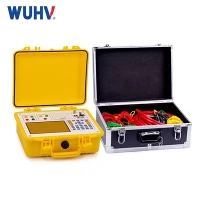


Product introduction
The DC winding resistance tester is a professional test instrument used to detect the winding resistance of power equipment such as transformers and mutual inductors. It is widely used in power system maintenance, equipment maintenance and factory inspection. Its working principle is based on Ohm's law, and the resistance value is calculated by measuring the voltage drop generated when current is applied.

Product features

1000 Test Record Storage Capacity
The instrument has a powerful storage function and can store up to 1000 test records, which allows users to record a large amount of test data for a long time and continuously without connecting external devices, which is convenient for subsequent data collation, analysis and equipment status tracking.
Built-in Large-capacity Lithium Battery
The DC winding resistance tester has a built-in large-capacity lithium battery and supports DC power supply, making the instrument lighter and reducing the constraints of power supply cables. It allows operators to switch positions more flexibly during on-site inspections, especially suitable for use outdoors or away from power sources.
Five-speed Current Selection
The DC winding resistance tester provides five current gears: automatic, 5A, 1A, 100mA and 1mA to meet different testing needs. The multi-speed current selection design allows users to flexibly adjust the current when measuring low-resistance or high-resistance devices, ensuring data stability and accuracy. For example, when measuring the low-resistance winding of a large transformer, a higher current range (such as 5A) can be selected to obtain higher measurement accuracy; when detecting the high-resistance winding of a small transformer, a lower current range (such as 1mA) can be selected to avoid equipment loss.
High-precision Measurement
The DC winding resistance tester has a high-precision measurement capability of 0.2% ± 2 digits, which is particularly suitable for power equipment detection requiring high precision. The instrument achieves resistance measurement with extremely small errors through stable current output and high-sensitivity acquisition of tiny voltage signals. This high-precision guarantee is particularly important in daily maintenance and fault diagnosis of equipment. For example, in the preventive maintenance of transformers, accurate resistance measurement can help engineers detect early signs of winding deterioration in time and avoid economic losses caused by downtime due to faults.
Wide Measurement Range And High Resolution
The tester has a wide measurement range, covering the range of 1 micro-ohm to 100 kilo-ohm, with a resolution of up to 0.1 micro-ohm, suitable for resistance measurement of various types of power equipment. Such a measurement range and high resolution design ensure that winding resistance tests can be completed accurately for both small and large devices.
Product parameters
|
type |
Integrated portable |
|
External dimensions |
Length 260mm x Width 160mm x Height 80mm |
|
Instrument weight |
3kg |
|
Built in battery |
DC lithium-ion rechargeable battery for both AC and DC use |
|
Charger input |
AC220V (50 ± 1) Hz output: DC29.4V |
|
ambient temperature |
-10℃~45℃ |
|
relative humidity |
≤ 85% RH without condensation |
|
Altitude |
≤ 2000 meters |
|
Instrument power |
The maximum output power of this instrument is 100W (with an open voltage of 20V during 5A current testing) |
|
project |
detailed |
Parameters |
|
electric current |
5A |
Automatic, 5A, 1A, 100mA, 1mA |
|
Display screen shows |
Four and a half people |
|
|
Test current |
5A |
1UΩ~4Ω |
|
1A |
20mΩ~20Ω |
|
|
100mA |
200mΩ~200Ω |
|
|
≤1mA |
20Ω~100kΩ |
|
|
Accuracy |
0.2% ±2digitals |
|


FAQS
1. What does this instrument test?
The Transformer DC Winding Resistance Tester is used to measure the DC resistance of transformer windings.
✔ Main test items:
High-voltage winding DC resistance
Medium-voltage winding DC resistance
Low-voltage winding DC resistance
Three-phase imbalance
Tap changer contact resistance variation
📌 Purpose:
To verify the integrity of the conductive circuit and detect issues such as poor contact or abnormal winding conditions.
2. Why is DC resistance testing necessary?
✔ It is used to detect:
Winding welding quality
Conductor contact condition
Tap changer contact performance
Early signs of inter-turn faults
Three-phase imbalance
📌 It is a fundamental test in both factory acceptance and maintenance of transformers.
3. What is the testing principle?
The basic principle is to apply a stable DC current to the winding, measure the voltage drop, and calculate resistance.
📌 Formula:
R = V / I
👉 UHV systems use a constant current source to ensure stable and accurate measurements.
4. Which standards does it comply with?
IEC 60076 (Power transformers)
IEEE C57 series
GB/T 1094
DL/T power industry standards
👉 UHV systems are designed to support both IEC and IEEE testing modes.
5. Measurement accuracy and range
Typical UHV configuration:
Measurement range: μΩ to kΩ level
Accuracy: ±0.2% or better
Resolution: 0.1 μΩ
Output current: 1A / 5A / 10A / 50A / 100A (depending on model)
6. Does it support fast testing?
✔ Yes, it supports rapid magnetization technology:
Automatic excitation
Automatic stabilization detection
Automatic discharge
Automatic reading
📌 Significantly reduces testing time for large transformers.
7. Does it support three-phase automatic testing?
✔ Yes:
Automatic switching between phases A/B/C
Automatic three-phase balance evaluation
Automatic deviation calculation
👉 Improves field testing efficiency.
8. How long does a test take?
Typical UHV performance:
Small transformers: 1–3 minutes
Large power transformers: 5–10 minutes
OLTC windings: depends on stabilization time
9. Does it support tap changer testing?
✔ Yes:
Resistance measurement for each OLTC position
Contact resistance variation analysis
Dynamic stabilization time recording
📌 Used to detect contact wear and poor connections.
Hot Tags: dc winding resistance tester, China dc winding resistance tester manufacturers, suppliers, factory