

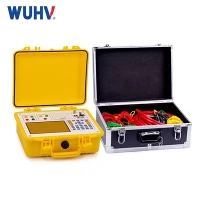


1. What is a Circuit Breaker Contact Resistance Tester?
A CB Contact Resistance Tester** is a high-current test instrument designed to measure the electrical resistance of closed contacts in circuit breakers, isolators, and joints. It is essential for detecting deterioration, corrosion, or loose connections that may compromise safe power system operation.
2. Why test contact resistance in circuit breakers?
Contact resistance testing:
Ensures low-loss conduction across contacts
Detects pitted, oxidized, or worn contacts
Prevents heating, energy loss, and failure during fault conditions
Confirms the integrity of bolted busbar connections
3. What standard governs contact resistance testing?
IEC 62271-100
IEEE C37.09 (for high-voltage CBs)
Tests are also aligned with NETA ATS/ MTS standards for maintenance.
4. What test current is used?
Typical test currents:
100 A, 200 A, 400 A, 600 A, or 1000 A DC
High-end testers can supply up to 2000 A or 3000 A DC
Why high current?
Low-resistance contacts (μΩ range) require high DC current for accurate and stable readings.
5. What is the test principle?
It uses the four-wire (Kelvin) method, which:
Separates current and voltage paths
Eliminates lead/contact resistance influence
Ensures precise low-resistance measurement
6. What is the typical resistance range?
Contact resistance values typically range from 20 µΩ to 200 µΩ depending on breaker design.
For bolted joints: usually < 100 µΩ
Values exceeding 250–300 µΩ in medium-voltage CBs often indicate a problem.
7. What are signs of bad contact resistance?
| Symptom | Possible Cause |
|---|---|
| High resistance | Worn/pitted contacts, corrosion |
| Fluctuating readings | Loose contact or unstable test probes |
| Resistance increases over time | Progressive contact wear or oxide formation |
| Unbalanced 3-phase readings | Mechanical misalignment or selective wear |
8. What's the difference between static and dynamic resistance measurement?
| Type | Purpose |
|---|---|
| Static | Tests contact resistance with contacts fully closed and stationary |
| Dynamic (DRM) | Measures contact resistance during breaker operation to analyze arcing contact condition (especially in SF₆ breakers) |
9. Is contact resistance testing destructive?
No. It uses safe, controlled DC currents and does not damage breaker contacts or components. It is a routine maintenance test.
10. What are typical testing steps?
Ensure CB is de-energized, grounded, and closed
Connect current and potential leads (4-wire method)
Select proper current level (100 A to 600 A typically)
Initiate test and record stable resistance value
Repeat for all 3 phases and average or compare
11. What factors affect test results?
Test current level (higher = more stable readings)
Contact cleanliness and pressure
Test lead quality and connection tightness
Ambient temperature
Breaker mechanism alignment
12. How do you interpret test results?
| Result | Interpretation |
|---|---|
| All phases < 100 µΩ | Healthy CB |
| One phase significantly higher | Possible defect or misalignment |
| All phases > 200–300 µΩ | Wear, oxidation, or need for maintenance |
13. Can it test disconnector switches and joints?
Yes. This tester is also used for:
Isolators (disconnect switches)
Busbar joints
Transformer connections
Cable lugs and terminations
14. Is it portable?
Yes. Most modern testers are:
Compact, lightweight
Battery- or mains-powered
Include USB/data export, thermal printers, and graphical displays
15. What are the best-known brands?
Our company has been specializing in the production and manufacturing of frequency series resonance devices for 21 years. We operate a modern intelligent factory covering over 4000 square meters, equipped with more than 100 automated production, manufacturing, assembly, and testing machines. We have obtained CE certification and currently serve the over the word customers .
If you are looking for Circuit Breaker Contact Resistance Tester manufacturers and suppliers, please feel free to contact us for high quality and good price, we have various types of Circuit Breaker Contact Resistance Tester for sales to solve your problems.
16. Can results be stored or exported?
Yes. Many testers allow:
USB export
SD card logging
Bluetooth/Wi-Fi connectivity
PC software for reporting & trending
17. What is the pass/fail criterion?
OEM specification (check breaker manual)
For many MV and HV CBs:
< 100 µΩ = excellent
100–200 µΩ = acceptable
> 200–250 µΩ = service recommended
> 300 µΩ = maintenance or replacement needed
18. Can contact resistance test predict CB failure?
Yes. It's one of the best early indicators for:
Arcing contact wear
Main contact degradation
Thermal runaway risk
Combined with timing and motion tests, it gives a complete breaker health picture.