

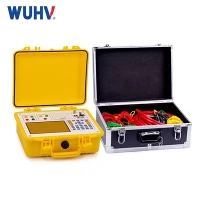


Here's a more detailed breakdown of Sweep Frequency Response Analysis (SFRA) and its application in various fields.
1. Theoretical Foundation:
Sweep Frequency Response Analysis works by injecting a signal of varying frequency into the system and measuring how the system reacts to each frequency. The system's impedance, which combines both resistance (real part) and reactance (imaginary part), is typically measured and analyzed. Impedance is a measure of how much the system resists the flow of alternating current (AC) at different frequencies.
Key parameters measured during SFRA:
Magnitude of the impedance: How large the impedance is at each frequency.
Phase angle of the impedance: The phase shift between the input signal and the system's response at each frequency.
The results are usually plotted on a Bode plot, which shows:
Magnitude vs. Frequency
Phase vs. Frequency
2. Test Setup:
Equipment Needed:
A signal generator (swept frequency generator) that can generate a sinusoidal signal over a range of frequencies.
A measurement device (often an impedance analyzer) to measure the impedance at each frequency.
A test object (e.g., a transformer, circuit board, or any electrical component/system).
Test Procedure:
A signal is injected into the system, typically through a coupling device.
The response is measured across a broad frequency range. For transformers, this could be from 10 Hz to 1 MHz, depending on the application.
The impedance is recorded at each frequency and analyzed for any deviations from the baseline (healthy) response.
3. Types of Faults Detected:
SFRA is particularly useful in detecting mechanical and electrical faults that might not be evident under normal operating conditions. It provides early warning signals that traditional tests might miss. Some of the most common faults detected include:
Mechanical Deformations:
Winding displacement: A mechanical shock, short-circuit event, or thermal stress may cause the windings to shift. This can affect the transformer's inductance and cause irregular frequency response.
Core deformation: Core faults like cracking, misalignment, or other physical damage can lead to abnormal frequency response patterns.
Insulation Degradation:
If the insulation material inside the transformer or other equipment degrades over time, it can impact the impedance at certain frequencies.
SFRA can highlight insulation weaknesses by showing shifts or degradation in the high-frequency response.
Loose Connections:
Loose or corroded connections in the windings or bushings can alter the system's impedance and can be identified by changes in the frequency response.
Turn-to-Turn Shorts:
A short circuit between turns in a winding causes a drastic change in impedance at certain frequencies. SFRA can detect this by measuring the impedance characteristics.
Partial Discharges:
Partial discharges (localized electrical breakdowns within insulation) may affect the impedance and show as anomalies in frequency response, even before they cause catastrophic failures.
4. Data Interpretation and Analysis:
Baseline Reference: Before using SFRA, it is important to obtain baseline measurements of the healthy system. These measurements serve as a reference to compare against the current system's response.
Deviation Detection:
Magnitude Deviation: Significant deviations in impedance magnitude across frequencies often indicate damage, such as insulation failure or winding deformation.
Phase Angle Deviation: A shift in phase response can indicate issues with the system's reactance. Phase shifts can indicate things like winding displacements or changes in inductive properties due to faults.
Comparative Analysis:
If you have baseline data from previous tests, you can use comparative analysis to detect even small deviations.
In case baseline data is unavailable, SFRA measurements can be compared with industry-standard data or the manufacturer's response curve for similar systems.
5. SFRA in Transformers:
Transformers are the most common application for SFRA, as they have a complex structure with windings, insulation, and a core. These systems are susceptible to mechanical and electrical faults that SFRA can help detect.
For power transformers, SFRA is used during both:
Routine maintenance: To ensure there are no developing faults.
Post-failure diagnostics: To understand the cause of transformer failures (e.g., after a short-circuit event).
Common transformer faults detected by SFRA include:
Winding movement: SFRA is very effective in detecting even small shifts or displacements in the windings that may occur due to electrical faults or mechanical shocks.
Core issues: SFRA can detect changes in core impedance characteristics, which might signal core damage or electrical faults.
Insulation defects: The insulation resistance can degrade over time, and SFRA helps detect the early stages of such deterioration.
6. Advantages of SFRA:
Non-destructive: SFRA is a non-invasive test that does not require taking the equipment offline for extended periods.
Early Fault Detection: It can detect issues long before they result in catastrophic failures, giving maintenance teams time to plan and repair.
Highly Sensitive: SFRA can detect faults like winding displacement, core deformations, or minor insulation issues that are difficult to detect by other means.
Cost-effective: It provides an affordable method for ongoing health monitoring of electrical equipment, especially when compared to the potential costs of transformer failure.
7. Limitations:
Requires Baseline Data: Without baseline data from a healthy unit, interpretation of SFRA results becomes challenging.
Sensitive to Environmental Factors: SFRA measurements can be influenced by external factors like temperature, humidity, and installation conditions.
Requires Skilled Interpretation: SFRA results can be complex and require an experienced operator to correctly identify faults, especially subtle ones.
8. Advanced Applications:
Signal Processing: SFRA data is often processed using advanced signal processing techniques (e.g., FFT or digital filtering) to enhance fault detection capabilities.
Multi-frequency Analysis: Some advanced SFRA systems use multi-frequency sweep tests that can pinpoint faults across a much broader frequency range, improving sensitivity.